







Question: Predictive modeling uses statistics to predict outcomes through the use of models such as one of below: Naive Bayes k-nearest neighbor algorithm Majority classifier Support
Predictive modeling uses statistics to predict outcomes through the use of models such as one of below:
Naive Bayes
k-nearest neighbor algorithm
Majority classifier
Support vector machines
Random forests
Boosted trees
Classification and Regression Trees (CART)
Multivariate adaptive regression splines (MARS)
Neural Networks
Ordinary Least Squares
Generalized Linear Models (GLM)
Logistic regression
Generalized additive models
Robust regression
Semiparametric regression
Choose one model to research further and then create specific example/prototype of how it could be applied to a real-world problem.
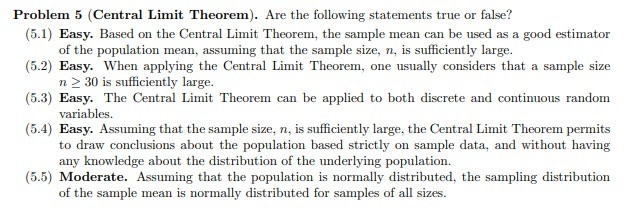
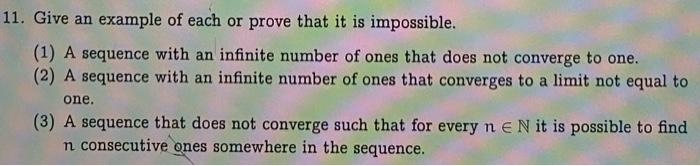
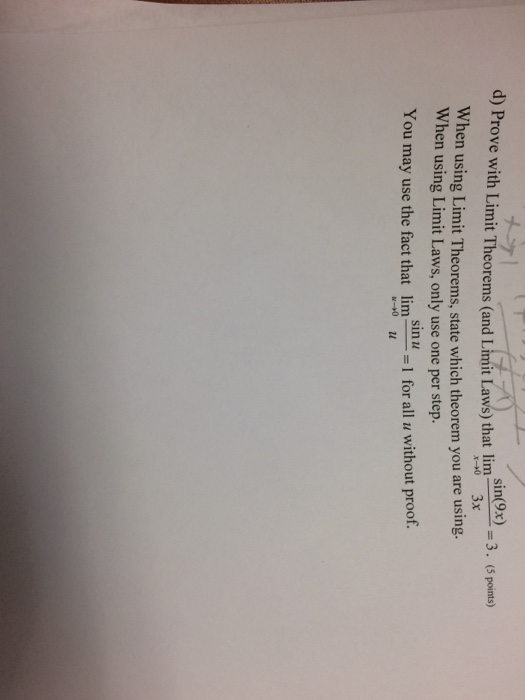
Problem 5 (Central Limit Theorem). Are the following statements true or false? (5.1) Easy. Based on the Central Limit Theorem, the sample mean can be used as a good estimator of the population mean, assuming that the sample size, n, is sufficiently large. (5.2) Easy. When applying the Central Limit Theorem, one usually considers that a sample size n 2 30 is sufficiently large. (5.3) Easy. The Central Limit Theorem can be applied to both discrete and continuous random variables. (5.4) Easy. Assuming that the sample size, n, is sufficiently large, the Central Limit Theorem permits to draw conclusions about the population based strictly on sample data, and without having any knowledge about the distribution of the underlying population. (5.5) Moderate. Assuming that the population is normally distributed, the sampling distribution of the sample mean is normally distributed for samples of all sizes.11. Give an example of each or prove that it is impossible. (1) A sequence with an infinite number of ones that does not converge to one. (2) A sequence with an infinite number of ones that converges to a limit not equal to one. (3) A sequence that does not converge such that for every n E N it is possible to find n consecutive ones somewhere in the sequence.d) Prove with Limit Theorems (and Limit Laws) that lim sin(9x) =3. (5 points) When using Limit Theorems, state which theorem you are using. When using Limit Laws, only use one per step. You may use the fact that lim sinu -=1 for all u without proof. M-+0
Step by Step Solution
There are 3 Steps involved in it

Get step-by-step solutions from verified subject matter experts
 Study Help