







Question: Preface For the final exam / project we will develop classification models using different approaches and compare their performance metrics. We will use a cleaned
Preface
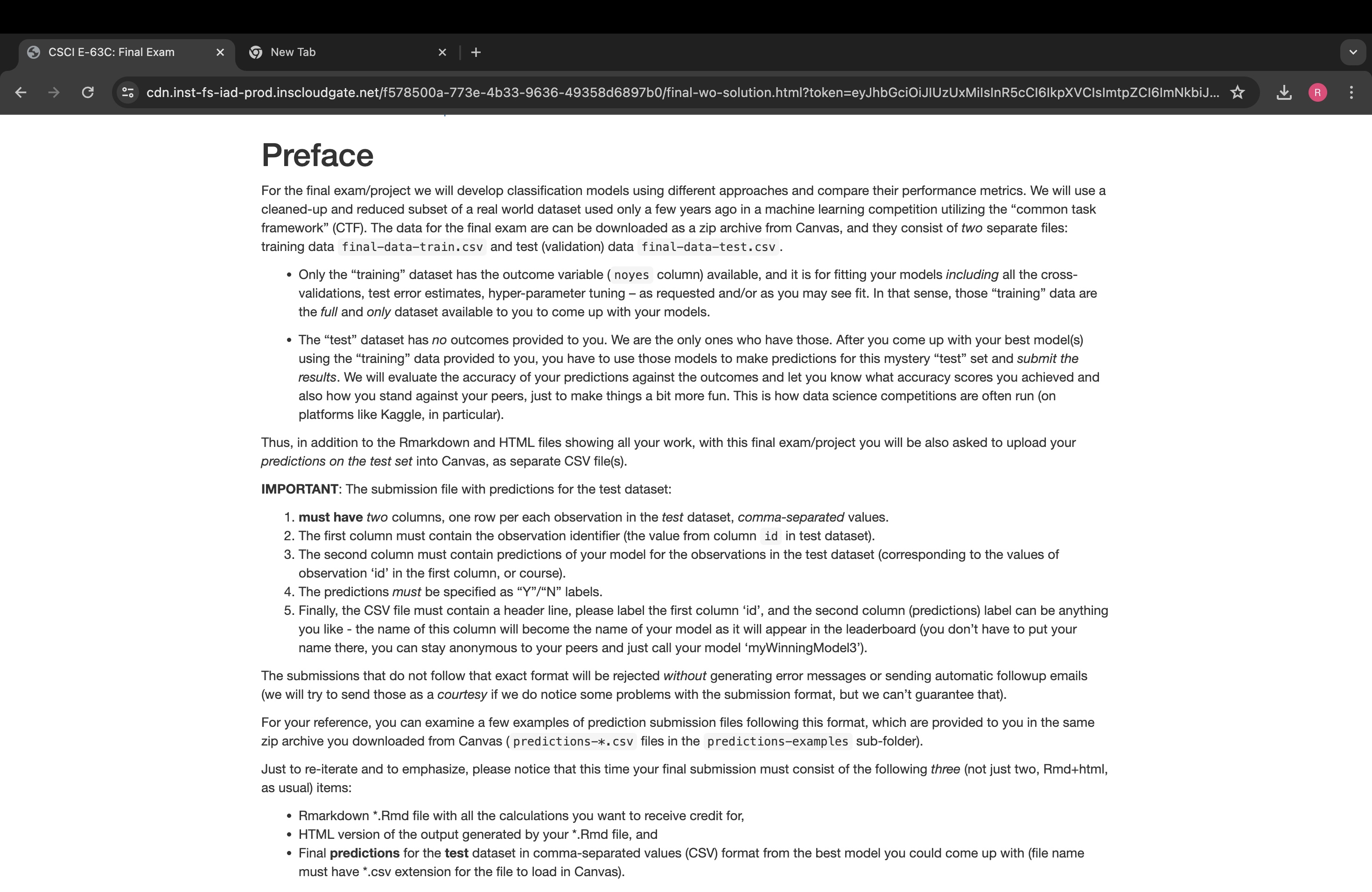
For the final examproject we will develop classification models using different approaches and compare their performance metrics. We will use a
cleanedup and reduced subset of a real world dataset used only a few years ago in a machine learning competition utilizing the "common task
framework" CTF The data for the final exam are can be downloaded as a zip archive from Canvas, and they consist of two separate files:
training data finaldatatrain.csv and test validation data finaldatatest.csv
Only the "training" dataset has the outcome variable noyes column available, and it is for fitting your models including all the cross
validations, test error estimates, hyperparameter tuning as requested andor as you may see fit. In that sense, those "training" data are
the full and only dataset available to you to come up with your models.
The "test" dataset has no outcomes provided to you. We are the only ones who have those. After you come up with your best models
using the "training" data provided to you, you have to use those models to make predictions for this mystery "test" set and submit the
results. We will evaluate the accuracy of your predictions against the outcomes and let you know what accuracy scores you achieved and
also how you stand against your peers, just to make things a bit more fun. This is how data science competitions are often run on
platforms like Kaggle, in particular
Thus, in addition to the Rmarkdown and HTML files showing all your work, with this final examproject you will be also asked to upload your
predictions on the test set into Canvas, as separate CSV files
IMPORTANT: The submission file with predictions for the test dataset:
must have two columns, one row per each observation in the test dataset, commaseparated values.
The first column must contain the observation identifier the value from column id in test dataset
The second column must contain predictions of your model for the observations in the test dataset corresponding to the values of
observation id in the first column, or course
The predictions must be specified as YN labels.
Finally, the CSV file must contain a header line, please label the first column id and the second column predictions label can be anything
you like the name of this column will become the name of your model as it will appear in the leaderboard you don't have to put your
name there, you can stay anonymous to your peers and just call your model 'myWinningModel
The submissions that do not follow that exact format will be rejected without generating error messages or sending automatic followup emails
we will try to send those as a courtesy if we do notice some problems with the submission format, but we can't guarantee that
For your reference, you can examine a few examples of prediction submission files following this format, which are provided to you in the same
zip archive you downloaded from Canvas predictions csv files in the predictionsexamples subfolder
Just to reiterate and to emphasize, please notice that this time your final submission must consist of the following three not just two, Rmdhtml
as usual items:
Rmarkdown Rmd file with all the calculations you want to receive credit for,
HTML version of the output generated by your Rmd file, and
Final predictions for the test dataset in commaseparated values CSV format from the best model you could come up with file name
must have extension for the file to load in Canvas
Step by Step Solution
There are 3 Steps involved in it
1 Expert Approved Answer
Step: 1 Unlock

Question Has Been Solved by an Expert!
Get step-by-step solutions from verified subject matter experts
Step: 2 Unlock
Step: 3 Unlock
 Study Help