Question: Prepare a case analysis with a SWOT analysis focusing on implementing strategy through the organization. NO PLAGIARISM PLEASE put in your own words! 240 210
Prepare a case analysis with a SWOT analysis focusing on implementing strategy through the organization. NO PLAGIARISM PLEASE put in your own words!
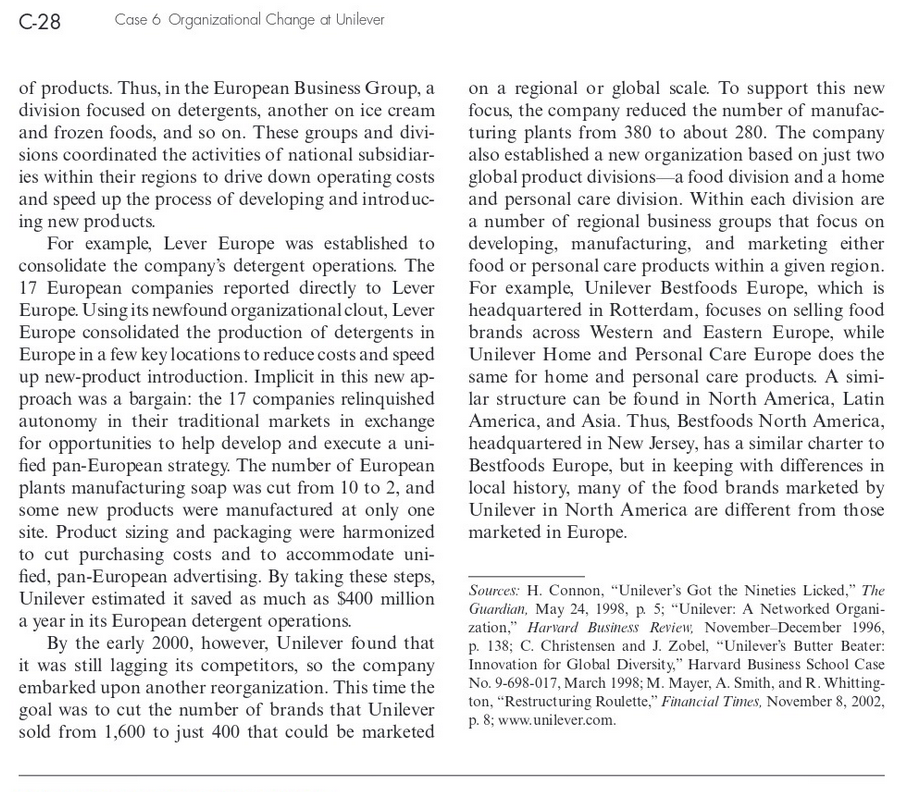
240 210 CHANGE AT UNILEVER Unilever is one of the world's oldest multinational corporations, with extensive product offerings in the food, detergent, and personal care businesses. It gen- erates annual revenues in excess of $50 billion and sells a wide range of branded products in virtually ev- ery country. Detergents, which account for about 25% of corporate revenues, include well-known names such as Omo, which is sold in more than 50 countries. Personal care products, which account for about 15% of sales, include Calvin Klein Cosmetics, Pepsodent toothpaste brands, Faberge hair care products, and Vaseline skin lotions. Food products account for the remaining 60% of sales and include strong offerings in margarine (where Unilever's market share in most countries exceeds 70%), tea, ice cream, frozen foods, and bakery products. Historically, Unilever was organized on a decen- tralized basis. Subsidiary companies in each major national market were responsible for the produc- tion, marketing, sales, and distribution of products in that market. In Western Europe, for example, the company had 17 subsidiaries in the early 1990s, each focused on a different national market. Each was a profit center and each was held accountable for its own performance. This decentralization was viewed as a source of strength. The structure allowed local managers to match product offerings and marketing strategy to local tastes and preferences and to alter sales and distribution strategies to fit the prevailing re- tail systems. The U.S. subsidiary (Lever Brothers) was run by Americans, the Indian subsidiary by Indians, and so on. By the mid-1990s, this decentralized structure was increasingly out of step with a rapidly changing com- petitive environment. Unilever's global competitors, which include the Swiss firm Nestl and Procter & Gamble from the United States, had been more suc- cessful than Unilever on several frontsbuilding global brands, reducing cost structure by consolidat- ing manufacturing operations at a few choice loca- tions, and executing simultaneous product launches in several national markets. Unilever's decentralized structure worked against efforts to build global or re- gional brands. It also meant lots of duplication, par- ticularly in manufacturing; a lack of scale economies; and a high-cost structure. Unilever also found that it was falling behind rivals in the race to bring new prod- ucts to market. In Europe, for example, while Nestl and Procter & Gamble moved toward pan-European product launches, it could take Unilever 4 to 5 years to persuade its 17 European operations to adopt a new product. Unilever began to change all this in the late 1990s. It introduced a new structure based on regional busi- ness groups. Within each business group were a num- ber of divisions, each focusing on a specific category C-28 Case 6 Organizational Change at Unilever of products. Thus, in the European Business Group, a division focused on detergents, another on ice cream and frozen foods, and so on. These groups and divi- sions coordinated the activities of national subsidiar- ies within their regions to drive down operating costs and speed up the process of developing and introduc- ing new products. For example, Lever Europe was established to consolidate the company's detergent operations. The 17 European companies reported directly to Lever Europe. Using its newfound organizational clout, Lever Europe consolidated the production of detergents in Europe in a few key locations to reduce costs and speed up new-product introduction. Implicit in this new ap- proach was a bargain: the 17 companies relinquished autonomy in their traditional markets in exchange for opportunities to help develop and execute a uni- fied pan-European strategy. The number of European plants manufacturing soap was cut from 10 to 2, and some new products were manufactured at only one site. Product sizing and packaging were harmonized to cut purchasing costs and to accommodate uni- fied, pan-European advertising. By taking these steps, Unilever estimated it saved as much as $400 million a year in its European detergent operations. By the early 2000, however, Unilever found that it was still lagging its competitors, so the company embarked upon another reorganization. This time the goal was to cut the number of brands that Unilever sold from 1,600 to just 400 that could be marketed on a regional or global scale. To support this new focus, the company reduced the number of manufac- turing plants from 380 to about 280. The company also established a new organization based on just two global product divisionsa food division and a home and personal care division. Within each division are a number of regional business groups that focus on developing, manufacturing, and marketing either food or personal care products within a given region. For example, Unilever Bestfoods Europe, which is headquartered in Rotterdam, focuses on selling food brands across Western and Eastern Europe, while Unilever Home and Personal Care Europe does the same for home and personal care products. A simi- lar structure can be found in North America, Latin America, and Asia. Thus, Bestfoods North America, headquartered in New Jersey, has a similar charter to Bestfoods Europe, but in keeping with differences in local history, many of the food brands marketed by Unilever in North America are different from those marketed in Europe. Sources: H. Connon, "Unilever's Got the Nineties Licked," The Guardian, May 24, 1998, p. 5; "Unilever: A Networked Organi- zation," Harvard Business Review November December 1996, p. 138; C. Christensen and J. Zobel, "Unilever's Butter Beater: Innovation for Global Diversity," Harvard Business School Case No. 9-698-017, March 1998; M. Mayer, A. Smith, and R. Whitting- ton, Restructuring Roulette," Financial Times, November 8, 2002, p. 8; www.unilever.com









 Study Help