







Question: Prepare a full case report analyzing the issues and making appropriate recommendations. Assume you are a consultant advising Michael Crawford , Plant Manager of Anwar

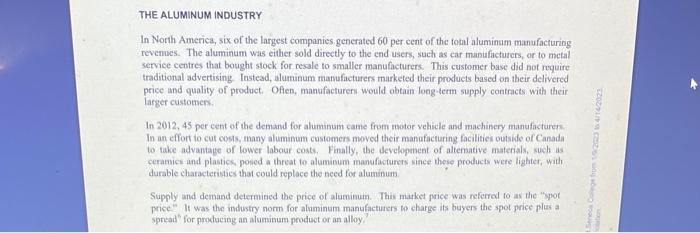
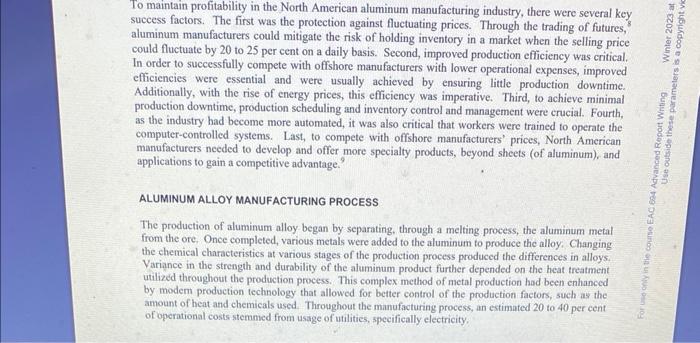
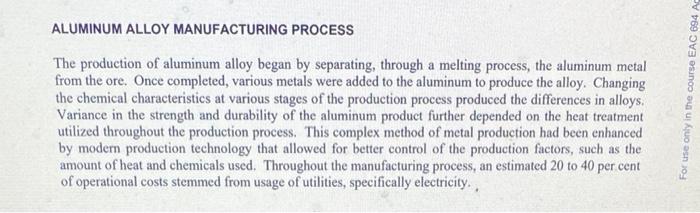
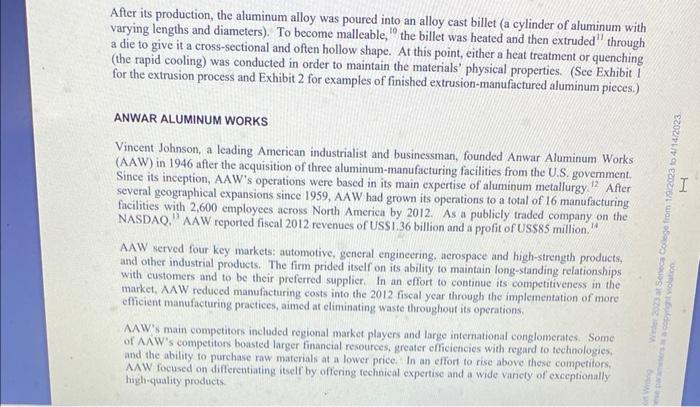
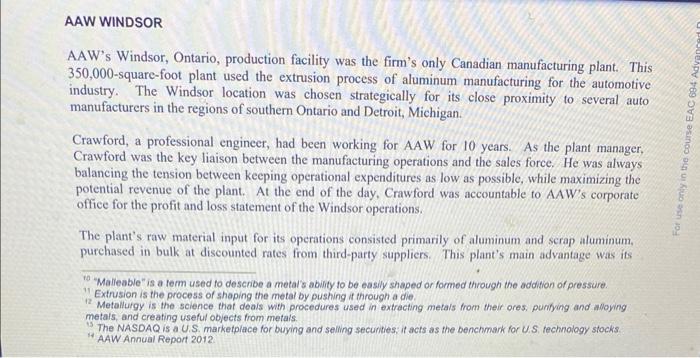
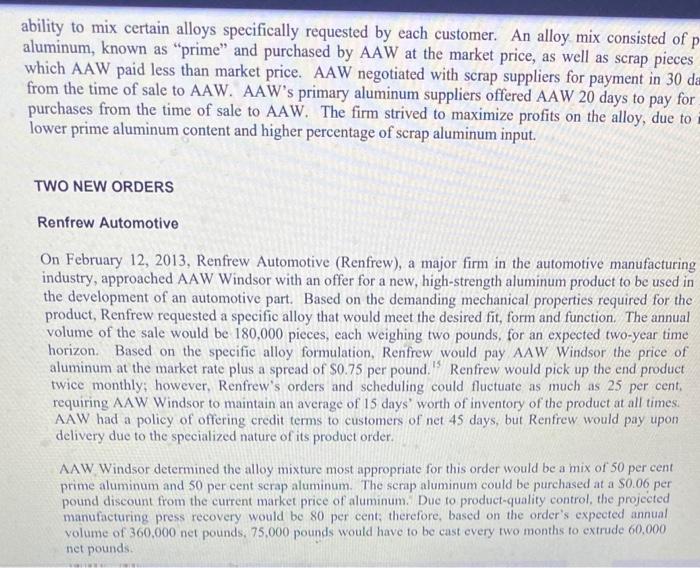
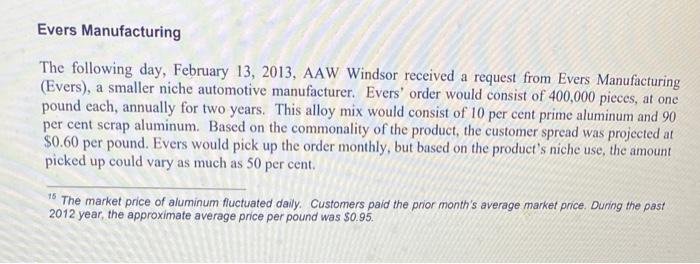
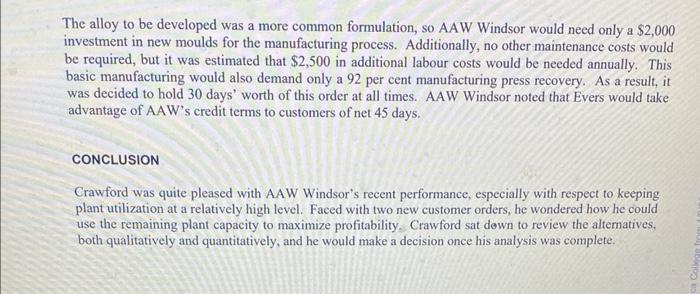
THE METALS INDUSTRY The global metals industry included the manufacturing and mining of all types of metals, such as iron and steel, aluminum, base metals, and precious metals. Total revenues generated in this industry were close to $3 trillion in 2012. 2 The primary metals industry, a subset of the global metals industry that included aluminum manufacturing, was composed of companies involved with separating metals from ores, 3 drawing or rolling metal into sheets, and pouring metal into casts and/or molds. In 2012, the North American primary metals industry reported $230 billion in annual revenues. 4 Due to increased urbanization within Asian countries and the continued need for products in developing nations, the primary metals industry had experienced unprecedented demand throughout 2012. The growth of the middle class within these Asian and developing countries had created demand for metal, especially steel, in the automotive and construction industries." After steel, aluminum was the second most commonly used metal and was produced more than all other non-ferrous metals combined. THE ALUMINUM INDUSTRY In North America, six of the largest companies generated 60 per cent of the fotal aluminum manufacturing revenues. The aluminam was either sold directly to the end users, such as car manuficturers, or to metal service centres that bought stock for resale to smaller manufacturers. This customer base did not require traditional advertising. Instead, aluminum manufacturers marketed their products based on their delivered price and quality of product. Often, manufacturen would obtain long-term supply contracts with their larger customers. In 2012, 45 per cent of the demand for aluminum came from motor vehicle and machinery manufacturern In an effort to cut cosis, many aluminum costomers moved their manufacturing facilitich outside of Canada to take advantage of lower labour costs. Finally, the developenent of altemative materials, such is ceramict-and plastics, posed a threat to aluminum manufactures since these products were lighter, with durable characieristics that could replace the need for aluminum. Supply and demand determined the price of aluminum. This matket price was referred to as the "spot price" It was the industry norm for aluminum manufacturens to charge its buyers the spot price plas a spread for producing an aluminum prodoct or an alloy. To maintain profitability in the North American aluminum manufacturing industry, there were several key success factors. The first was the protection against fluctuating prices. Through the trading of futures, aluminum manufacturers could mitigate the risk of holding inventory in a market when the selling price could fluctuate by 20 to 25 per cent on a daily basis. Second, improved production efficiency was critical. In order to successfully compete with offshore manufacturers with lower operational expenses, improved efficiencies were essential and were usually achieved by ensuring little production downtime. Additionally, with the rise of energy prices, this efficiency was imperative. Third, to achieve minimal production downtime, production scheduling and inventory control and management were crucial. Fourth, as the industry had become more automated, it was also critical that workers were trained to operate the computer-controlled systems. Last, to compete with offshore manufacturers' prices, North American manufacturers needed to develop and offer more specialty products, beyond sheets (of aluminum), and applications to gain a competitive advantage.? ALUMINUM ALLOY MANUFACTURING PROCESS The production of aluminum alloy began by separating, through a melting process, the aluminum metal from the ore, Once completed, various metals were added to the aluminum to produce the alloy. Changing the chemical characteristics at various stages of the production process produced the differences in alloys. Variance in the strength and durability of the aluminum product further depended on the heat treatment utilized throughout the production process. This complex method of metal production had been enhanced by modem production technology that allowed for better control of the production factors, such as the amount of heat and chemicals used. Throughout the manufacturing process, an estimated 20 to 40 per cent of operational costs stemmed from usage of utilities, specifically clectricity. ALUMINUM ALLOY MANUFACTURING PROCESS The production of aluminum alloy began by separating, through a melting process, the aluminum metal from the ore. Once completed, various metals were added to the aluminum to produce the alloy. Changing the chemical characteristics at various stages of the production process produced the differences in alloys. Variance in the strength and durability of the aluminum product further depended on the heat treatment utilized throughout the production process. This complex method of metal production had been enhanced by modern production technology that allowed for better control of the production factors, such as the amount of heat and chemicals used. Throughout the manufacturing process, an estimated 20 to 40 per cent of operational costs stemmed from usage of utilities, specifically electricity. After its production, the aluminum alloy was poured into an alloy cast billet (a cylinder of aluminum with varying lengths and diameters). To become malleable, 10 the billet was heated and then extruded 1 through a die to give it a cross-sectional and often hollow shape. At this point, either a heat treatment or quenching (the rapid cooling) was conducted in order to maintain the materials' physical properties. (See Exhibit 1 for the extrusion process and Exhibit 2 for examples of finished extrusion-manufactured aluminum picces.) ANWAR ALUMINUM WORKS Vincent Johnson, a leading American industrialist and businessman, founded Anwar Aluminum Works (AAW) in 1946 after the acquisition of three aluminum-manufacturing facilities from the U.S. govemment. Since its inception, AAW's operations were based in its main expertise of aluminum metallurgy, 12 After several geographical expansions since 1959, AAW had grown its operations to a total of 16 manufacturing facilities with 2,600 employees across North America by 2012. As a publicly traded company on the NASDAQ, " AAW reported fiscal 2012 revenues of USSI 36 billion and a profit of US $85 million." AAW served four key markets: automotive, general engineering, aerospace and high-strength products, and other industrial products. The firm prided itself on its ability to maintain long-standing relationships with customers and to be their preferred supplicr. In an effort to continue its competitiveness in the market, AAW reduced manufacturing costs into the 2012 fiscal year through the implementation of more efficient manufacturing practices, aimed at eliminating waste throughout its operations. AAW's main competitors included regional market players and large intemational conglomerates. Some of AAW's competitons boasted larger financial resources, greater efficiencies with regard to technologies, and the ability to purchase raw materials at a lower price. In an effort to rise above these competitons. AAW focused on differentiating itself by offering technical expertise and a wide vancty of exceptionally high-quality products. AAW's Windsor, Ontario, production facility was the firm's only Canadian manufacturing plant. This 350,000 -square-foot plant used the extrusion process of aluminum manufacturing for the automotive industry. The Windsor location was chosen strategically for its close proximity to several auto manufacturers in the regions of southern Ontario and Detroit, Michigan. Crawford, a professional engineer, had been working for AAW for 10 years. As the plant manager, Crawford was the key liaison between the manufacturing operations and the sales force. He was always balancing the tension between keeping operational expenditures as low as possible, while maximizing the potential revenue of the plant. At the end of the day, Crawford was accountable to AAW's corporate office for the profit and loss statement of the Windsor operations. The plant's raw material input for its operations consisted primarily of aluminum and scrap aluminum, purchased in bulk at discounted rates from third-party suppliers. This plant's main advantage was its 10. "Malleable" is a term used to describe a metars ablity to be casily shaped or formed through the addition or pressure. "Extrusion is the process of shaping the metal by pushing it through a die. (2. Metallugy is the science that deals with procedures used in extracting metals trom their ores. puntring and alloying metals, and creating useful objects from metals. 11. The NASDAQ is a U.S. marketplace for buying and selling secunties it acts as the benchmark for U.S. technology stocks "AAW Annual Report 2012. ability to mix certain alloys specifically requested by each customer. An alloy mix consisted of p aluminum, known as "prime" and purchased by AAW at the market price, as well as scrap pieces which AAW paid less than market price. AAW negotiated with scrap suppliers for payment in 30d. from the time of sale to AAW. AAW's primary aluminum suppliers offered AAW 20 days to pay for purchases from the time of sale to AAW. The firm strived to maximize profits on the alloy, due to lower prime aluminum content and higher percentage of scrap aluminum input. TWO NEW ORDERS Renfrew Automotive On February 12, 2013, Renfrew Automotive (Renfrew), a major firm in the automotive manufacturing industry, approached AAW Windsor with an offer for a new, high-strength aluminum product to be used in the development of an automotive part. Based on the demanding mechanical properties required for the product, Renfrew requested a specific alloy that would meet the desired fit, form and function. The annual volume of the sale would be 180,000 pieces, each weighing two pounds, for an expected two-year time horizon. Based on the specific alloy formulation, Renfrew would pay AAW Windsor the price of aluminum at the market rate plus a spread of $0.75 per pound. 15 Renfrew would pick up the end product twice monthly; however, Renfrew's orders and scheduling could fluctuate as much as 25 per cent. requiring AAW Windsor to maintain an average of 15 days' worth of inventory of the product at all times. AAW had a policy of offering credit terms to customers of net 45 days, but Renfrew would pay upon delivery due to the specialized nature of its product order. AAW. Windsor determined the alloy mixture most appropriate for this order would be a mix of 50 per cent prime aluminum and 50 per cent scrap aluminum. The serap aluminum could be purchased at a $0.06 per pound discount from the current market price of aluminum. Due to product-quality control, the projected manufacturing press recovery would be 80 per cent; therefore, based on the order's expected annual volume of 360,000 net pounds, 75,000 pounds would have to be cast every two months to extrude 60,000 net pounds. Evers Manufacturing The following day, February 13, 2013, AAW Windsor received a request from Evers Manufacturing (Evers), a smaller niche automotive manufacturer. Evers' order would consist of 400,000 pieces, at onc pound each, annually for two years. This alloy mix would consist of 10 per cent prime aluminum and 90 per cent scrap aluminum. Based on the commonality of the product, the customer spread was projected at $0.60 per pound. Evers would pick up the order monthly, but based on the product's niche use, the amount picked up could vary as much as 50 per cent. 15 The market price of aluminum fuctuated daily. Customers paid the prior month's average market price. During the past 2012 year, the approximate average price per pound was $0.95. The alloy to be developed was a more common formulation, so AAW Windsor would need only a $2,000 investment in new moulds for the manufacturing process. Additionally, no other maintenance costs would be required, but it was estimated that $2,500 in additional labour costs would be needed annually. This basic manufacturing would also demand only a 92 per cent manufacturing press recovery. As a result, it was decided to hold 30 days' worth of this order at all times. AAW Windsor noted that Evers would take advantage of AAW's credit terms to customers of net 45 days. CONCLUSION Crawford was quite pleased with AAW Windsor's recent performance, especially with respect to keeping plant utilization at a relatively high level. Faced with two new customer orders, he wondered how he could use the remaining plant capacity to maximize profitability. Crawford sat down to review the alternatives, both qualitatively and quantitatively, and he would make a decision once his analysis was complete
Step by Step Solution
There are 3 Steps involved in it

Get step-by-step solutions from verified subject matter experts
 Study Help