



Question: Prepare a pro forma income statement like that show in Exhibit 2 in the case which includes expected revenues and costs for 2005. In early
Prepare a pro forma income statement like that show in Exhibit 2 in the case which includes expected revenues and costs for 2005.
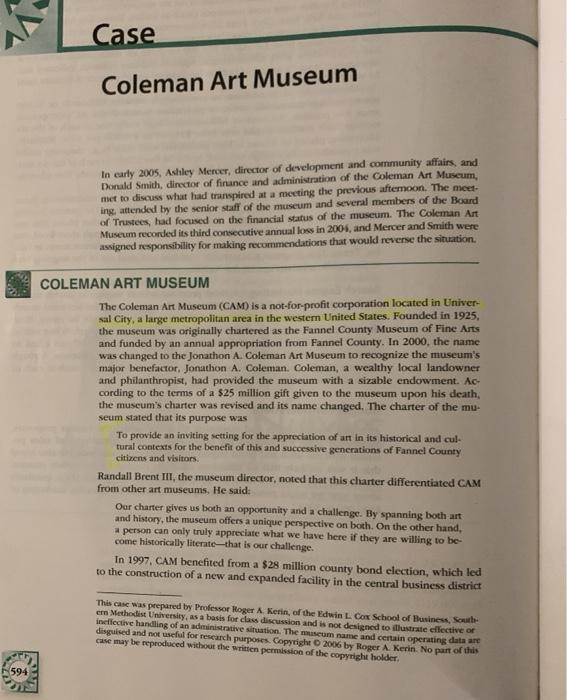
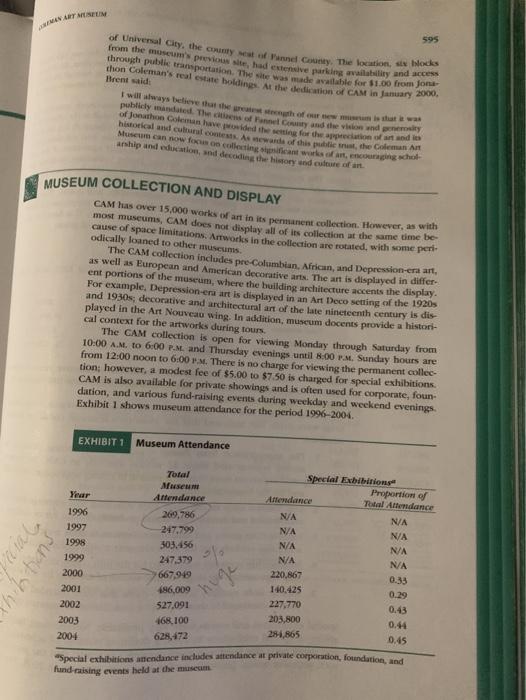
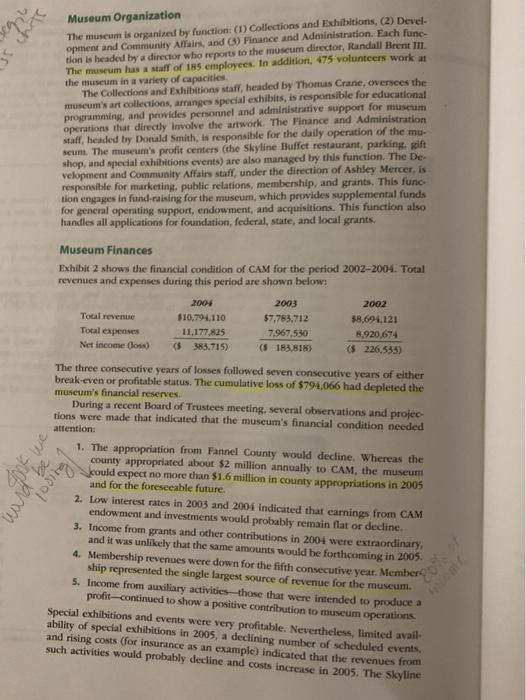


In early 2005. Ashley Mercer, director of development and community affairs, and Donald Smith, dinctior of finance and administration of the Coleman Art Museum, met to discuss what had trinspircd at a meeting the previous aftemoon. The meeting, attended by the seniot staff of the museum and sevenal members of the Board of Trustees, had focused on the financial status of the museum. The Coleman Art Museum recorded its third conkecutive annual loss in 200i, and Mercer and Smith were assigned responsibility for making recommendations that would reverse the situation. EMAN ART MUSEUM The Coleman Art Museum (CAM) is a not-for-profit corporation located in Universal City, a large metropolitan area in the western United States. Founded in 1925, the museum was originally chartered as the Fannel County Museum of Fine Arts and funded by an annual appropriation from Fannel County. In 2000, the name was changed to the Jonathon A. Coleman Art Museum to recognize the museum's major benefactor, Jonathon A. Coleman. Coleman, a wealthy local landowner and philanthropist, had provided the museum with a sizable endowment. According to the terms of a $25 million gift given to the museum upon his death, the muscum's charter was revised and its name changed. The charter of the museum stated that its purpose was To provide an inviting setting for the appreclation of art in its historical and cul. tural contexis for the benefit of this and suceessive generations of Fannel County citizens and visitors. Randall Brent III, the museum director, noted that this charter differentiated GAM from other art museums, He said: Our charter gives us both an opportunity and a challenge. By spanning both art and history, the maseum offers a unique perspective on boch. On the other hand, a person can only truly appreciate what we have here if they are willing to become historically literate-that is our challenge. In 1997, CAM benefited from a $28 million county bond election, which led to the construction of a new and expanded facility in the central business district This case was prepured by Proficssor foger A. Kerin, of the Edwin L Cox School of Husiness, Scnatr. em Methodist University, as a basis for clas discussion and is not deaiened to fllustrate effective or ineffective handling of an adminikrative sitution. The maseum name and certain operating data are disguised and not useful for research purposes. Copyright 0 2006 by Roger A. Kerin. No part of this: case may be reproduced without the written permission of the copyright holder. pipentat misetia of Univernat City. the county arat uf Finne County. Dhe location, six Wodks from the muscum's previous Nit, had exteneve parking availatidity and access Brent saidt MUSEUM COLLECTION AND DISPLAY CAM has over 15,000 works of art in its peruanent collection. However, as with most museums, CAM does not display all of its collection at the same time be- cause of space limitations. Armwoks in the collection are rutated, with some periodically loaned to other museums. The CAM collection includes pre-Columbian. Africin, and Depression-era art, as well as European and American decorative arts. The art is dlsplayed in different portions of the museum, where the building architecture accents the dispiay. For eximple, Depression-era art is displayed in an Art Deco setling of the 1920 s and 1930s; decorative and architectural art of the late nineteenth century is displayed in the Art Nouveau wing. In addition, museum docents provide a historical context for the artworks during tours. The CAM collection is open for viewing Monday through Saturday from 10:00 A.M. to 6:00 P.M. and Thursday evenings until 8:00 r.M, Sundiry hours are from 12:00 noon to 6:00 H. There is no charge for viewing the permanent collection; however, a modest fee of $5.00 to $7.50 is charged for special exhibitions. CAM is also available for private showings and is often used for corporate, foundation, and various fund-raising events during weekday and weckend evenings. Exhibit 1 shows museum attendance for the period 19962004. EXHIBIT 1 Museum Attendance aSpccial exhilbitions atfendance includes attendarece at private corjpiration, fotendation, and fund raising events beld at the musecien Museum Organization The muscum is organized by function (1) Collections and Exhibitions, (2) Development and Community Arlairs, and (3) Finance and Administration. Each function is headed by a director who reports to the museum director, Randall Brent III. The muscum has a staff of 185 employees. In addition, 475 volunteers work at the muscum in a variety of capacities. The Collections and Exhibitions staff, headed by Thomas Crane, oversees the muscum's art collections, amanges special exhibits, is responsible for educational programming, and powides peronnel and administrative support for muscum operations that directly livolve the artwork. The Finance and Administration staff, headed by Donald Smith, is responsible for the daily operation of the muscum. The museum's profit centers (the Skyline Buffet restaurant, parking. gift shop, and special exhibitions events) are also managed by this function. The Development and Community Affairs staff, under the direction of Ashley Mercer, is responsible for marketing, public relations, membership, and grants. This function engages in fund-raising for the museum, which provides supplemental funds for general operating support, endowment, and acquisitions. This function also handles all applications for foundation, fedenal, state, and local grants. Museum Finances Exhibit 2 shows the financial condition of CAM for the period 2002-2004. Total revenues and expenses during this period are shown below: The three consecutive years of losses followed seven consecutive years of either break-even or profitable status. The cumulative loss of $799,066 had depleted the museum's financial reserves. During a recent Board of Trustees meeting, several observations and projections were made that indicated that the museum's financial condition needed attention: 1. The appropriation from Fannel County would decline. Whereas the county appropriated about $2 million annually to CAM, the museum could expect no more than $1.6 million in county appropriations in 2005 and for the foreseeable future. 2. Low interest rates in 2003 and 2000 indicated that earnings from CAM endowment and investments would probably remain flat or decline. 3. Income from grants and other contributions in 200f were exiraordinary, and it was unlikely that the same amounts would be forthcoming in 2005 . 4. Membership revenues were down for the fifth consecutive year. Memberet ship represented the single largest source of revenue for the museum. 5. Income from auxiliary activities - those that were intended to produce a profit-continued to show a positive contribution to museum operitions. Special exhibitions and events were very profitable. Nevertheless, limited availability of special exhibitions in 2005 , a declining number of scheduled events, and rising costs (for insurance as an example) indicated that the revenues from such activities would probably decline and costs increase in 2005. The Skyline EXHIDIT? operations Summary of Incomit and Fapenien, 29622004 "Administration expernses included monty equipment lease agrecments, and so forth Buffet restaurant, gift shop and paricing, und the Museuru Association were operating at alsout bresk-even. SEUM MARKETING As dirccior of development and conamunity affails, Ashley Mercer was responsible for markecing at CAM. Her specific responsibilities related to enhancing the image of the maseum, iocreasing museum visitation, and building museum nemberships. Reflecting on her responsibilities, she said: In walily, mescum image, visitation, and methbership ate intermingded Image influence vhitatioe and memberthip. Vixitation is driven somewhar by memberAlip, bot menberihip scems to doo drive visitation and, in a subele way, affeets the image of the museum. Museum Image Interest in the pablic image of CAM begin soon after the new facility was ded. icated. The new four-story building, situated downtown adjacent to skyscrap: ers, was occisionally referred to at the "marble box" by its critics, since the buildeng facade contained Itallan mabble. When asked about CAMs image, Brent commented: It is bsiscally coince to say shat, in the mind of the pubtic. CAM has no imageThere is nothing atrout this fbulidingl that nays, "im a mucum," or "Come in". There are a lot of people tha are not interested in high culture and think this is a drive-in biank or an oflice buiiding Momt art anuseuna in America have a problem with imags. One of the things that makes me mad is that people think there is something wroag with the merseum. CAM is one of the atos piblic in the cuuntry, and more heavily dependent oo the memibership contribution than any ataer imuseam]. Like most, it is under. endowed and underfunded from reliable public fuods. In fact, the American As sociation of Museams reports that only ahour 60 percent of America's 2000-plus ant museams have enough income from their endlowment to cover their operat. ing costs. Nevertieless, this institution has chosen to be public, with free access. and this is very noble, lt is wonderful that the museum has decided not to belong to an agdomeration of very rich people. This auseum las more character than it thinks it has, It has the best balanced coliction between Wicatem and non-Westeria art of any museum in the codntry, We have not chosen to sell or promote the unique aspects of this colleetion of the museum's emphasis on hibtorical contect. What we have are the mak. ings of an instituation that is very different froms other muscums, and wo ought to be able to make that into an advantage rather thun apologine for it. Other saff members believed either that an image exinted but was different for the various publics the museum served or that CAM had not made a sufficient effort to create an image for itself. According to Mercen Haved on our marketing researcb, 1 think there ate two distinctly different latagen. One is a nonimuge. Prople don't know what the muscuan is They also donr know what we have ao offer in the way of lunch, dinner, brunch, shopping: movies, cle. They are not familiar witb our callecticins. They are probably proud. however, that their community has a beauliful ant maseun The other imege is thut we are only for specific pecople. This image is pmob. ably based on our membership. Ahout 85 pereent of members are college edacated (contared to to percent of the county popolation of 2.5 millioni). 60 percent have houschold incomes in excess of 870,000 (compated to 20 percent of the county populetion), haif are cher 60 yram ded (compured to 25 percent of sig Janet Rake, caff assigant in cliarge of memberihp, noted: Amang our mentiership, CAM io viewed as a connmaniky organicution that has a A critic of the museum said. The Colemun An Muleum has a definite ichage in ay opiolion. Irs a gmat place to have lunch or bnunch, buy ar art or hisecing bool for the coffec able, and soe Christanas holidays. Museum Visitation Because there is a general belief that increased numbers of visitors lead to increascel membership. Mercer's saff has historically focused its efforts on increas. ing the traffic through the muscump. Bocial, cultural, and educational activity in the museum is a major goal, and is Mercer. These efforts ean boe separd and nof eoclusive to the vfewing of art," said prognams involving special exhabitions into general and outreach programs and Press Relations CAM continually promotes its special exhibitions and activities by sending out press releass, and it maintairs a close relationship with the local media. Stories about art and history, public programs, and human interest issues are ofien fearured in the local medta. A five-year anniverary party was held at the museum in lanuary 2005, designed as a free special cvent aimed to involve the general pubfic with the museum. Education and Outreach CAM has many programs dirccted toward cducating the public. Among these are public programs sach as adult tours, school tours, lectures, art films, and feature films. The museum engeges in propramming to create community involvement and lends performting space to local performing arts organizations. Special Exhibltions Public service announcements written by the museum are aired on local radio stations to promote special exhibitions. Advertisements are run in local newspapers in a five-county area for special exhibitions. For major special exhibitions, advertising is usually sponsored by a local corporation. Mercer believed that these efforts increased museum attendance. For example, periodic visitor surveys indicate that on a typical day when only the permanent collection was available for viewing, 85 percent of visitors were non-CAM members. She added that even though less than 1 percent of nonmembers actu. ally applied for membership during a visit, this exposure helped in the annual membership solicitation. Museum Membership Lccording to Mercen Museum aembenhip and the revenve eamed from membership play significant roles in the success and daily ogerations of CAM. The museum and ins members have a symbiotic relationship. Members provide the mukcum wich a volunteer base, withour which our cont of eperation wrould to sstronomical. Memace volunicers provide tours, acain ar the miformation desk, hedp in the zift shop and the sigline thaffe, and are inciliathle is recruiiing new members and renewing exivine members. The Muscun AnNiatim was crewed to cmoonarage membership involveemene in CAM The assodacion, wilh soate 1.000 mepiben, naken our vodus. becr elfart posshble-95 perceut of ceir 475 vibunters are Avsociation memilens. The assiciarion's ansinamee in flobdraisiog is critical, and we appreciate what its members hove done fiot CAst. Lak year alone, the akociation was directly reanseciatsen ememices, ofters itien lectures by authoritics or ar ant hivtory, abit provide various ither privilegen not avallathe to the peneral memberilip. Member Categories, Benefits, and Costs CAM has two distinct memberhips: (1) perwonal and (2) corparate. These two memberahips are further divided into categories based on dollar contributions and benefits necelved. There are six categories of personal membership nanging from $50 per yoar to $5,000 per year. Comporate nemberships are divided into four categorits ranging from $1.000 per year to $10,000 per year. These calegorics and participation levels were created with the move to the new building. In 2004 , there were 17, 229 perwat member. ships and 205 corporate memberthips. Exhiblt 3 shows the benefits received by each personal membership category. Exhibit 4 prevides a breakdown of persaral memberships by category and the rezcnue generated by edch cafegory over the past five years. In 2004. personal menberships accotinted for almost 80 percent of membership revenue. Corporate memberships provide many of the sime benetits as the $500 or higher personal memberships. In addition, corporate menbers are given "Ealployee Memberships" depending on their category. For example, corporate BxiLBIT 3 Membership Benefits by Membership Categories The principal cost ftems in each categary were (1) free admisions to exhiblits; (2) parkinge (5) the monthly calenidar of museum activities, eahibits, and eventsy and (4) diwcounts at the Sicyline Buffet restaurant and gift shop. Member Recruiting and Renewals "Recruiting new members and renewinz existing members is a major undertaking," said Mercer. While some recruiting and renewals occur at the museum during visitation, the recruitment effort modly revolves around mail, telephoone, and personal solicitationo. Mail and telephone solicitations focus primarily on rocruiting and resewing personal membership in the $50 to $250 categories. Personal solicitations by the Museum Association are used to recruit and renew personal memberships in the 5500 to $5,000 categories and corporate themberships. CAM uses mailing and telephone lists obtained from other cultural orkanizations and list agencies. These listh are culied to target zip codes and telephone prefix numbers. Mail solicitations include a lefter from the museum director, a brochure describing the museum, and a membership application form. Telephone solicitations include a follow up brochure and application form. The economics of direct-mail solicitition are illustrated below, based on an August 2001 mailing considered typical by Mercer. Two direct-mail solicitations of this magnitude are conducted cach year. The solicitation process for personal memberships in larger dollar categories and corporate memberships relies on personal contact by CAM volunteers and corporate member executives. Prospective members are identified on the basis of personal contacts and from the lapsed membership roster, the society puge, other organizations' membership lists, and lower-membership-fevel lists: Once identified, these prospects are approached on a one-to-one basis. An initial letter is sent introducing the prospect to the museum. This first letter is followed by a personal teiephone call or another letter inviting the prospect to an informal gathering at the museum. At the gathering, the prospect is introduced to other members and is asked directly to become a member. Renewal efforts include mail, telephone, and Internet solicitation. In addition, membership parties, special previews, and special inserts in the monthly ealendar of CAM activities are used. Museum records indicate that 70 percent of the $50 members do not renew their membership after the fins year. Among those that do, 50 percent renew in each successive year. Members in the $100 to $500 carcgories have a renewal rate of 60 percent, and members in the $1,500 and $5,000 categocies heve a renewal rate of 85 percent, Mercer believed that less than 10 percent of personal members who do renew their membership increase the dollar value of their membership. Renewal rates among corporate members is about 75 percent, regardless of catcgory. ONSIDERATIONS FOR 2005 Ashley Mercer and Donald Smith met to discuss measures they might recommend to the Board of Trustees to reverse the deteriorating financial condition of CAM. Smith noted that at an carlier meeting with his staft, personnel reductions were discussed. Specifically, fhe felt that a 10 percent roduction in personnel and administration costs was possible. Furthemore, his stuff estimated that the appropriation from Fannel Coumty, contributions, Brants, investment income, endowment carnings, and other income would be is percent below 2004 levels. A "best guess" estimate from the director of collections and exhibitions indicated that 5pecial exhibitions and events wauld generate revenues of $1.2 million and cost $675,000 in 2005. Parking revenues and expentes resulting from nonmember visitors would remain unchanged from 200 . Rough budgets for education programs indicated that an expenditure of $500,000 for 2005 was realistic, given planned efforts. Smith said that changes in other auxiliary activities for which he was responsible, namely the Skyline Buffet restaurant and gift shop, were not planned. Mercer was impressed with the attention Smith had already given to the museum's situation. She too hatd given consideration to matters of museum image. visitation, and membership prior to the meeting. Unfortunately, an carlier meeting with her staff had raised more issues than hard and-fast recommendations. Staff suggestions ranged from implementing a modest admission fce of $2 per adult (with no charge for children under 12 years old) to instiruting student (ages 13 to 22) and senior citizen ( 60 and older) memberships at 530 . The need for institutional advertising was taised, since CAM had been promoting only special exhibitions and events. Other staff members said that the benefits given to members needed to be enhanced. For example, raising discounts at the Skyline Buffet and gift shop to 20 percent was suggested. Another possibility raised was commissioning a "coffee table" book featuring major artwork at CAM to be given with personal memberships of $500 or more. Mercer listened to these suggestions, knowing that some were unlikely to receive Board of Trustee approval. These included any proposal to increase expenses for publications/public information (for example, new books and paid institutional advertising). She had already been informed that expenses for such activities could not exceed the 200 expenditure. Improving the member benefit package secmed like a good iclea. Increasing restaurant and gift shop discounts, even though 65 percent of the business for both was already on discount, seemed like a good idea, at least at the margin. Smith said that he would give this suggestion consideration, but asked that Mercer think further about it in the context of the overall member-benefit package. Charging a nomainal admission fee for nonmembers also scemed reasonable. Visitor surveys had shown that 50 percent of nonmember visitors said that they would be willing to pay a $2 admission fee for viewing the permanent collection (access to special exhibitions would continue to have admiksion fees). Furthemore, members could then be given an additional bencfit, that is, free admission. However, Smith noted that CAM had always prided irself on free access, and he wondered how the Board of Trustees would view this suggestion. Additional membership categories below $50 and for students and senior citizens also serened to provide new opportunities to attract segments of the population that hat not typically yielded members. Mercer and Smith believed that their initial meeting had produced some good deas, but both thought that they had to give these matters further thought. They greed to meet again and begkin to prepare an integrated plan of action and a pro orma incomte statement for 2005 . In early 2005. Ashley Mercer, director of development and community affairs, and Donald Smith, dinctior of finance and administration of the Coleman Art Museum, met to discuss what had trinspircd at a meeting the previous aftemoon. The meeting, attended by the seniot staff of the museum and sevenal members of the Board of Trustees, had focused on the financial status of the museum. The Coleman Art Museum recorded its third conkecutive annual loss in 200i, and Mercer and Smith were assigned responsibility for making recommendations that would reverse the situation. EMAN ART MUSEUM The Coleman Art Museum (CAM) is a not-for-profit corporation located in Universal City, a large metropolitan area in the western United States. Founded in 1925, the museum was originally chartered as the Fannel County Museum of Fine Arts and funded by an annual appropriation from Fannel County. In 2000, the name was changed to the Jonathon A. Coleman Art Museum to recognize the museum's major benefactor, Jonathon A. Coleman. Coleman, a wealthy local landowner and philanthropist, had provided the museum with a sizable endowment. According to the terms of a $25 million gift given to the museum upon his death, the muscum's charter was revised and its name changed. The charter of the museum stated that its purpose was To provide an inviting setting for the appreclation of art in its historical and cul. tural contexis for the benefit of this and suceessive generations of Fannel County citizens and visitors. Randall Brent III, the museum director, noted that this charter differentiated GAM from other art museums, He said: Our charter gives us both an opportunity and a challenge. By spanning both art and history, the maseum offers a unique perspective on boch. On the other hand, a person can only truly appreciate what we have here if they are willing to become historically literate-that is our challenge. In 1997, CAM benefited from a $28 million county bond election, which led to the construction of a new and expanded facility in the central business district This case was prepured by Proficssor foger A. Kerin, of the Edwin L Cox School of Husiness, Scnatr. em Methodist University, as a basis for clas discussion and is not deaiened to fllustrate effective or ineffective handling of an adminikrative sitution. The maseum name and certain operating data are disguised and not useful for research purposes. Copyright 0 2006 by Roger A. Kerin. No part of this: case may be reproduced without the written permission of the copyright holder. pipentat misetia of Univernat City. the county arat uf Finne County. Dhe location, six Wodks from the muscum's previous Nit, had exteneve parking availatidity and access Brent saidt MUSEUM COLLECTION AND DISPLAY CAM has over 15,000 works of art in its peruanent collection. However, as with most museums, CAM does not display all of its collection at the same time be- cause of space limitations. Armwoks in the collection are rutated, with some periodically loaned to other museums. The CAM collection includes pre-Columbian. Africin, and Depression-era art, as well as European and American decorative arts. The art is dlsplayed in different portions of the museum, where the building architecture accents the dispiay. For eximple, Depression-era art is displayed in an Art Deco setling of the 1920 s and 1930s; decorative and architectural art of the late nineteenth century is displayed in the Art Nouveau wing. In addition, museum docents provide a historical context for the artworks during tours. The CAM collection is open for viewing Monday through Saturday from 10:00 A.M. to 6:00 P.M. and Thursday evenings until 8:00 r.M, Sundiry hours are from 12:00 noon to 6:00 H. There is no charge for viewing the permanent collection; however, a modest fee of $5.00 to $7.50 is charged for special exhibitions. CAM is also available for private showings and is often used for corporate, foundation, and various fund-raising events during weekday and weckend evenings. Exhibit 1 shows museum attendance for the period 19962004. EXHIBIT 1 Museum Attendance aSpccial exhilbitions atfendance includes attendarece at private corjpiration, fotendation, and fund raising events beld at the musecien Museum Organization The muscum is organized by function (1) Collections and Exhibitions, (2) Development and Community Arlairs, and (3) Finance and Administration. Each function is headed by a director who reports to the museum director, Randall Brent III. The muscum has a staff of 185 employees. In addition, 475 volunteers work at the muscum in a variety of capacities. The Collections and Exhibitions staff, headed by Thomas Crane, oversees the muscum's art collections, amanges special exhibits, is responsible for educational programming, and powides peronnel and administrative support for muscum operations that directly livolve the artwork. The Finance and Administration staff, headed by Donald Smith, is responsible for the daily operation of the muscum. The museum's profit centers (the Skyline Buffet restaurant, parking. gift shop, and special exhibitions events) are also managed by this function. The Development and Community Affairs staff, under the direction of Ashley Mercer, is responsible for marketing, public relations, membership, and grants. This function engages in fund-raising for the museum, which provides supplemental funds for general operating support, endowment, and acquisitions. This function also handles all applications for foundation, fedenal, state, and local grants. Museum Finances Exhibit 2 shows the financial condition of CAM for the period 2002-2004. Total revenues and expenses during this period are shown below: The three consecutive years of losses followed seven consecutive years of either break-even or profitable status. The cumulative loss of $799,066 had depleted the museum's financial reserves. During a recent Board of Trustees meeting, several observations and projections were made that indicated that the museum's financial condition needed attention: 1. The appropriation from Fannel County would decline. Whereas the county appropriated about $2 million annually to CAM, the museum could expect no more than $1.6 million in county appropriations in 2005 and for the foreseeable future. 2. Low interest rates in 2003 and 2000 indicated that earnings from CAM endowment and investments would probably remain flat or decline. 3. Income from grants and other contributions in 200f were exiraordinary, and it was unlikely that the same amounts would be forthcoming in 2005 . 4. Membership revenues were down for the fifth consecutive year. Memberet ship represented the single largest source of revenue for the museum. 5. Income from auxiliary activities - those that were intended to produce a profit-continued to show a positive contribution to museum operitions. Special exhibitions and events were very profitable. Nevertheless, limited availability of special exhibitions in 2005 , a declining number of scheduled events, and rising costs (for insurance as an example) indicated that the revenues from such activities would probably decline and costs increase in 2005. The Skyline EXHIDIT? operations Summary of Incomit and Fapenien, 29622004 "Administration expernses included monty equipment lease agrecments, and so forth Buffet restaurant, gift shop and paricing, und the Museuru Association were operating at alsout bresk-even. SEUM MARKETING As dirccior of development and conamunity affails, Ashley Mercer was responsible for markecing at CAM. Her specific responsibilities related to enhancing the image of the maseum, iocreasing museum visitation, and building museum nemberships. Reflecting on her responsibilities, she said: In walily, mescum image, visitation, and methbership ate intermingded Image influence vhitatioe and memberthip. Vixitation is driven somewhar by memberAlip, bot menberihip scems to doo drive visitation and, in a subele way, affeets the image of the museum. Museum Image Interest in the pablic image of CAM begin soon after the new facility was ded. icated. The new four-story building, situated downtown adjacent to skyscrap: ers, was occisionally referred to at the "marble box" by its critics, since the buildeng facade contained Itallan mabble. When asked about CAMs image, Brent commented: It is bsiscally coince to say shat, in the mind of the pubtic. CAM has no imageThere is nothing atrout this fbulidingl that nays, "im a mucum," or "Come in". There are a lot of people tha are not interested in high culture and think this is a drive-in biank or an oflice buiiding Momt art anuseuna in America have a problem with imags. One of the things that makes me mad is that people think there is something wroag with the merseum. CAM is one of the atos piblic in the cuuntry, and more heavily dependent oo the memibership contribution than any ataer imuseam]. Like most, it is under. endowed and underfunded from reliable public fuods. In fact, the American As sociation of Museams reports that only ahour 60 percent of America's 2000-plus ant museams have enough income from their endlowment to cover their operat. ing costs. Nevertieless, this institution has chosen to be public, with free access. and this is very noble, lt is wonderful that the museum has decided not to belong to an agdomeration of very rich people. This auseum las more character than it thinks it has, It has the best balanced coliction between Wicatem and non-Westeria art of any museum in the codntry, We have not chosen to sell or promote the unique aspects of this colleetion of the museum's emphasis on hibtorical contect. What we have are the mak. ings of an instituation that is very different froms other muscums, and wo ought to be able to make that into an advantage rather thun apologine for it. Other saff members believed either that an image exinted but was different for the various publics the museum served or that CAM had not made a sufficient effort to create an image for itself. According to Mercen Haved on our marketing researcb, 1 think there ate two distinctly different latagen. One is a nonimuge. Prople don't know what the muscuan is They also donr know what we have ao offer in the way of lunch, dinner, brunch, shopping: movies, cle. They are not familiar witb our callecticins. They are probably proud. however, that their community has a beauliful ant maseun The other imege is thut we are only for specific pecople. This image is pmob. ably based on our membership. Ahout 85 pereent of members are college edacated (contared to to percent of the county popolation of 2.5 millioni). 60 percent have houschold incomes in excess of 870,000 (compated to 20 percent of the county populetion), haif are cher 60 yram ded (compured to 25 percent of sig Janet Rake, caff assigant in cliarge of memberihp, noted: Amang our mentiership, CAM io viewed as a connmaniky organicution that has a A critic of the museum said. The Colemun An Muleum has a definite ichage in ay opiolion. Irs a gmat place to have lunch or bnunch, buy ar art or hisecing bool for the coffec able, and soe Christanas holidays. Museum Visitation Because there is a general belief that increased numbers of visitors lead to increascel membership. Mercer's saff has historically focused its efforts on increas. ing the traffic through the muscump. Bocial, cultural, and educational activity in the museum is a major goal, and is Mercer. These efforts ean boe separd and nof eoclusive to the vfewing of art," said prognams involving special exhabitions into general and outreach programs and Press Relations CAM continually promotes its special exhibitions and activities by sending out press releass, and it maintairs a close relationship with the local media. Stories about art and history, public programs, and human interest issues are ofien fearured in the local medta. A five-year anniverary party was held at the museum in lanuary 2005, designed as a free special cvent aimed to involve the general pubfic with the museum. Education and Outreach CAM has many programs dirccted toward cducating the public. Among these are public programs sach as adult tours, school tours, lectures, art films, and feature films. The museum engeges in propramming to create community involvement and lends performting space to local performing arts organizations. Special Exhibltions Public service announcements written by the museum are aired on local radio stations to promote special exhibitions. Advertisements are run in local newspapers in a five-county area for special exhibitions. For major special exhibitions, advertising is usually sponsored by a local corporation. Mercer believed that these efforts increased museum attendance. For example, periodic visitor surveys indicate that on a typical day when only the permanent collection was available for viewing, 85 percent of visitors were non-CAM members. She added that even though less than 1 percent of nonmembers actu. ally applied for membership during a visit, this exposure helped in the annual membership solicitation. Museum Membership Lccording to Mercen Museum aembenhip and the revenve eamed from membership play significant roles in the success and daily ogerations of CAM. The museum and ins members have a symbiotic relationship. Members provide the mukcum wich a volunteer base, withour which our cont of eperation wrould to sstronomical. Memace volunicers provide tours, acain ar the miformation desk, hedp in the zift shop and the sigline thaffe, and are inciliathle is recruiiing new members and renewing exivine members. The Muscun AnNiatim was crewed to cmoonarage membership involveemene in CAM The assodacion, wilh soate 1.000 mepiben, naken our vodus. becr elfart posshble-95 perceut of ceir 475 vibunters are Avsociation memilens. The assiciarion's ansinamee in flobdraisiog is critical, and we appreciate what its members hove done fiot CAst. Lak year alone, the akociation was directly reanseciatsen ememices, ofters itien lectures by authoritics or ar ant hivtory, abit provide various ither privilegen not avallathe to the peneral memberilip. Member Categories, Benefits, and Costs CAM has two distinct memberhips: (1) perwonal and (2) corparate. These two memberahips are further divided into categories based on dollar contributions and benefits necelved. There are six categories of personal membership nanging from $50 per yoar to $5,000 per year. Comporate nemberships are divided into four categorits ranging from $1.000 per year to $10,000 per year. These calegorics and participation levels were created with the move to the new building. In 2004 , there were 17, 229 perwat member. ships and 205 corporate memberthips. Exhiblt 3 shows the benefits received by each personal membership category. Exhibit 4 prevides a breakdown of persaral memberships by category and the rezcnue generated by edch cafegory over the past five years. In 2004. personal menberships accotinted for almost 80 percent of membership revenue. Corporate memberships provide many of the sime benetits as the $500 or higher personal memberships. In addition, corporate menbers are given "Ealployee Memberships" depending on their category. For example, corporate BxiLBIT 3 Membership Benefits by Membership Categories The principal cost ftems in each categary were (1) free admisions to exhiblits; (2) parkinge (5) the monthly calenidar of museum activities, eahibits, and eventsy and (4) diwcounts at the Sicyline Buffet restaurant and gift shop. Member Recruiting and Renewals "Recruiting new members and renewinz existing members is a major undertaking," said Mercer. While some recruiting and renewals occur at the museum during visitation, the recruitment effort modly revolves around mail, telephoone, and personal solicitationo. Mail and telephone solicitations focus primarily on rocruiting and resewing personal membership in the $50 to $250 categories. Personal solicitations by the Museum Association are used to recruit and renew personal memberships in the 5500 to $5,000 categories and corporate themberships. CAM uses mailing and telephone lists obtained from other cultural orkanizations and list agencies. These listh are culied to target zip codes and telephone prefix numbers. Mail solicitations include a lefter from the museum director, a brochure describing the museum, and a membership application form. Telephone solicitations include a follow up brochure and application form. The economics of direct-mail solicitition are illustrated below, based on an August 2001 mailing considered typical by Mercer. Two direct-mail solicitations of this magnitude are conducted cach year. The solicitation process for personal memberships in larger dollar categories and corporate memberships relies on personal contact by CAM volunteers and corporate member executives. Prospective members are identified on the basis of personal contacts and from the lapsed membership roster, the society puge, other organizations' membership lists, and lower-membership-fevel lists: Once identified, these prospects are approached on a one-to-one basis. An initial letter is sent introducing the prospect to the museum. This first letter is followed by a personal teiephone call or another letter inviting the prospect to an informal gathering at the museum. At the gathering, the prospect is introduced to other members and is asked directly to become a member. Renewal efforts include mail, telephone, and Internet solicitation. In addition, membership parties, special previews, and special inserts in the monthly ealendar of CAM activities are used. Museum records indicate that 70 percent of the $50 members do not renew their membership after the fins year. Among those that do, 50 percent renew in each successive year. Members in the $100 to $500 carcgories have a renewal rate of 60 percent, and members in the $1,500 and $5,000 categocies heve a renewal rate of 85 percent, Mercer believed that less than 10 percent of personal members who do renew their membership increase the dollar value of their membership. Renewal rates among corporate members is about 75 percent, regardless of catcgory. ONSIDERATIONS FOR 2005 Ashley Mercer and Donald Smith met to discuss measures they might recommend to the Board of Trustees to reverse the deteriorating financial condition of CAM. Smith noted that at an carlier meeting with his staft, personnel reductions were discussed. Specifically, fhe felt that a 10 percent roduction in personnel and administration costs was possible. Furthemore, his stuff estimated that the appropriation from Fannel Coumty, contributions, Brants, investment income, endowment carnings, and other income would be is percent below 2004 levels. A "best guess" estimate from the director of collections and exhibitions indicated that 5pecial exhibitions and events wauld generate revenues of $1.2 million and cost $675,000 in 2005. Parking revenues and expentes resulting from nonmember visitors would remain unchanged from 200 . Rough budgets for education programs indicated that an expenditure of $500,000 for 2005 was realistic, given planned efforts. Smith said that changes in other auxiliary activities for which he was responsible, namely the Skyline Buffet restaurant and gift shop, were not planned. Mercer was impressed with the attention Smith had already given to the museum's situation. She too hatd given consideration to matters of museum image. visitation, and membership prior to the meeting. Unfortunately, an carlier meeting with her staff had raised more issues than hard and-fast recommendations. Staff suggestions ranged from implementing a modest admission fce of $2 per adult (with no charge for children under 12 years old) to instiruting student (ages 13 to 22) and senior citizen ( 60 and older) memberships at 530 . The need for institutional advertising was taised, since CAM had been promoting only special exhibitions and events. Other staff members said that the benefits given to members needed to be enhanced. For example, raising discounts at the Skyline Buffet and gift shop to 20 percent was suggested. Another possibility raised was commissioning a "coffee table" book featuring major artwork at CAM to be given with personal memberships of $500 or more. Mercer listened to these suggestions, knowing that some were unlikely to receive Board of Trustee approval. These included any proposal to increase expenses for publications/public information (for example, new books and paid institutional advertising). She had already been informed that expenses for such activities could not exceed the 200 expenditure. Improving the member benefit package secmed like a good iclea. Increasing restaurant and gift shop discounts, even though 65 percent of the business for both was already on discount, seemed like a good idea, at least at the margin. Smith said that he would give this suggestion consideration, but asked that Mercer think further about it in the context of the overall member-benefit package. Charging a nomainal admission fee for nonmembers also scemed reasonable. Visitor surveys had shown that 50 percent of nonmember visitors said that they would be willing to pay a $2 admission fee for viewing the permanent collection (access to special exhibitions would continue to have admiksion fees). Furthemore, members could then be given an additional bencfit, that is, free admission. However, Smith noted that CAM had always prided irself on free access, and he wondered how the Board of Trustees would view this suggestion. Additional membership categories below $50 and for students and senior citizens also serened to provide new opportunities to attract segments of the population that hat not typically yielded members. Mercer and Smith believed that their initial meeting had produced some good deas, but both thought that they had to give these matters further thought. They greed to meet again and begkin to prepare an integrated plan of action and a pro orma incomte statement for 2005
Step by Step Solution
There are 3 Steps involved in it

Get step-by-step solutions from verified subject matter experts