







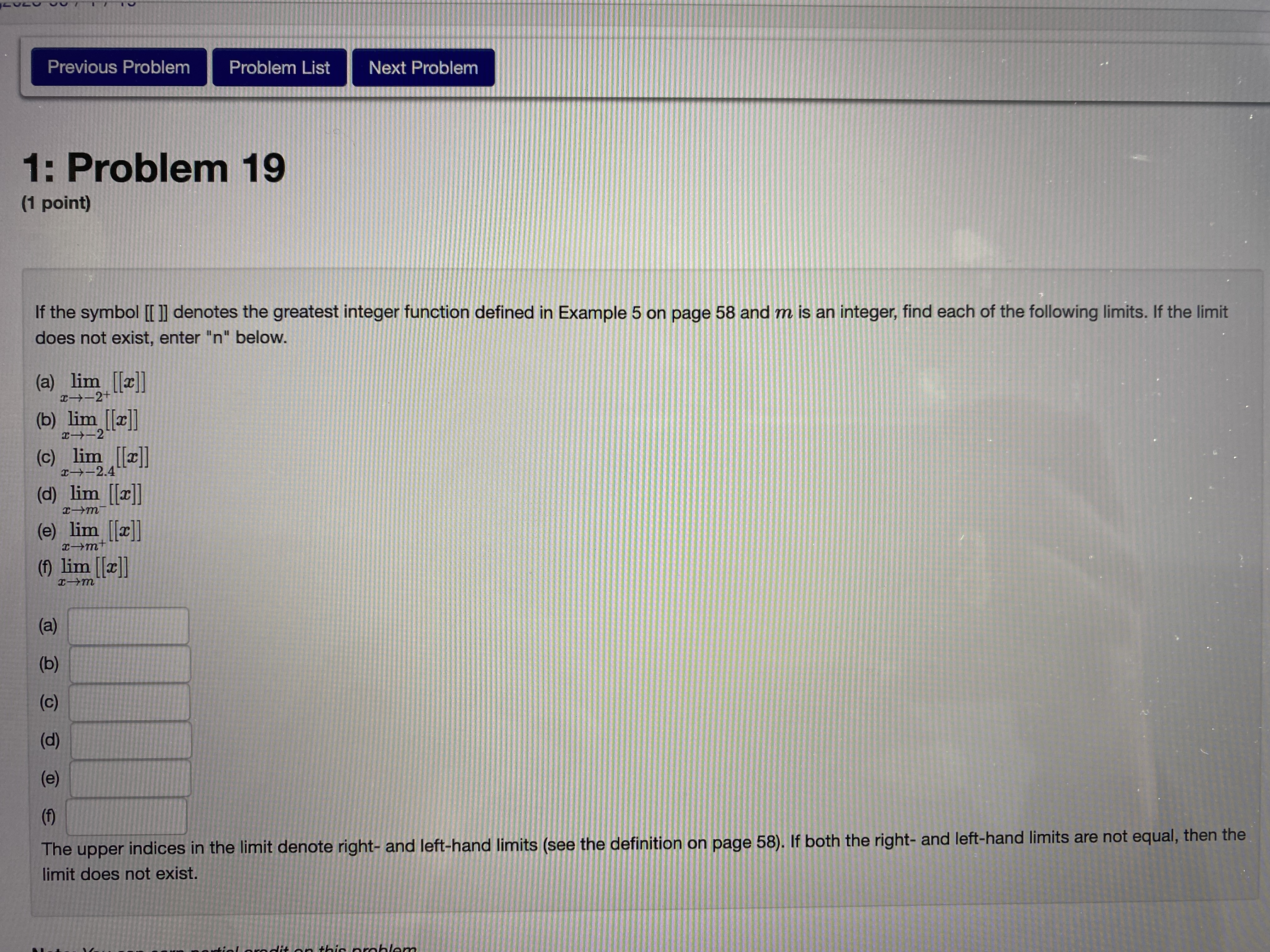
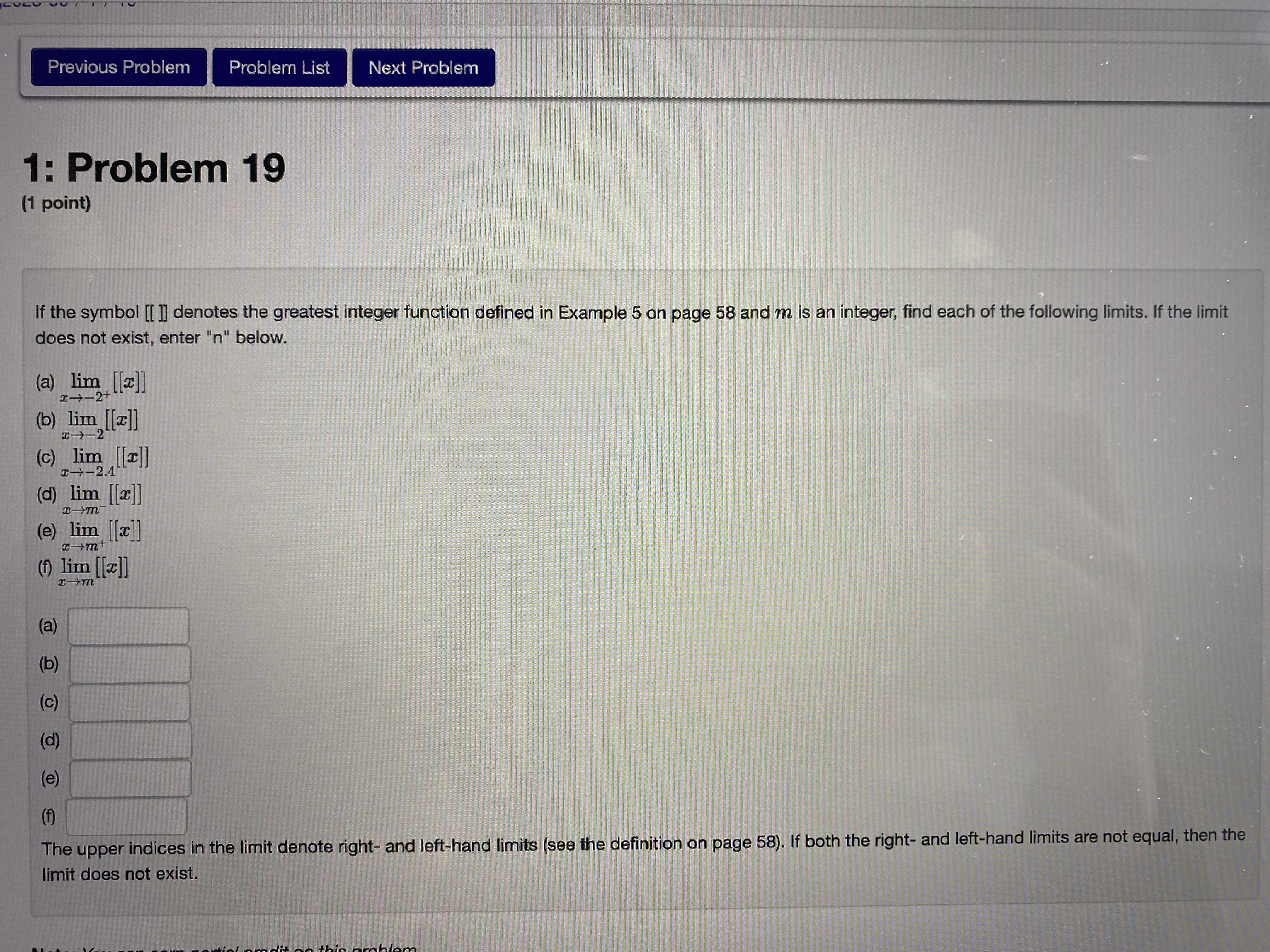
Question: Previous Problem Problem List Next Problem 1: Problem 19 (1 point) If the symbol [[ ]] denotes the greatest integer function defined in Example 5
![If the symbol [[ ]] denotes the greatest integer function defined in](https://s3.amazonaws.com/si.experts.images/answers/2024/06/6661fb51e502a_3616661fb5183d01.jpg)
![below. (a) lim [[x]] * - - 2+ (b) lim [[x]] (c)](https://s3.amazonaws.com/si.experts.images/answers/2024/06/6661fb54a2dd6_3646661fb5443836.jpg)
![lim [[x]] 2- -2.4 (d) lim [[x]] (e) lim [[x]] I- +m](https://s3.amazonaws.com/si.experts.images/answers/2024/06/6661fb558f836_3656661fb5516c52.jpg)
Previous Problem Problem List Next Problem 1: Problem 19 (1 point) If the symbol [[ ]] denotes the greatest integer function defined in Example 5 on page 58 and m is an integer, find each of the following limits. If the limit does not exist, enter "n" below. (a) lim [[x]] * - - 2+ (b) lim [[x]] (c) lim [[x]] 2- -2.4 (d) lim [[x]] (e) lim [[x]] I- +m (f) lim [[xx]] I-+m (a) (b ) (C) (d) The upper indices in the limit denote right- and left-hand limits (see the definition on page 58). If both the right- and left-hand limits are not equal, then the limit does not exist.MAA MATHEMATICAL ASSOCIATION OF AMERICA Ospring2023-90 / 1 / 22 Previous Problem Problem List Next Problem 1: Problem 22 (1 point) Let f be defined by f(x) - 15x + m, 2
Step by Step Solution
There are 3 Steps involved in it

Get step-by-step solutions from verified subject matter experts
 Study Help