







Question: previously instructed. All submitted work will be considered, Consider the perfectly competitive market for pencils. The inverse supply function is P = (1/3)Q5 and the
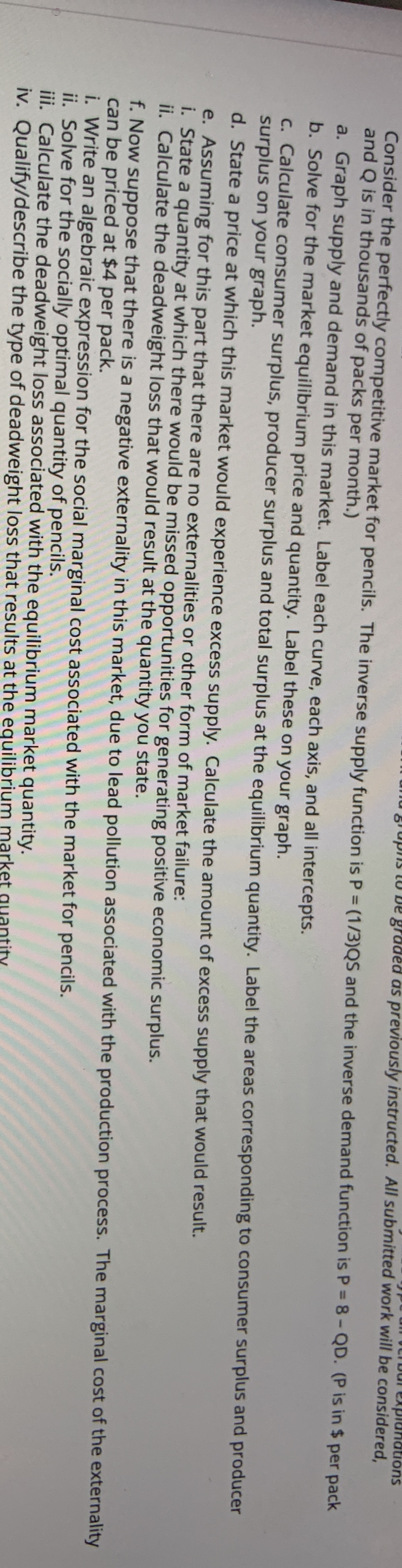
previously instructed. All submitted work will be considered, Consider the perfectly competitive market for pencils. The inverse supply function is P = (1/3)Q5 and the inverse demand function is P = 8 - QD. (P is in $ per pack and Q is in thousands of packs per month.) a. Graph supply and demand in this market. Label each curve, each axis, and all intercepts. b. Solve for the market equilibrium price and quantity. Label these on your graph. c. Calculate consumer surplus, producer surplus and total surplus at the equilibrium quantity. Label the areas corresponding to consumer surplus and producer surplus on your graph. d. State a price at which this market would experience excess supply. Calculate the amount of excess supply that would result. e. Assuming for this part that there are no externalities or other form of market failure: i. State a quantity at which there would be missed opportunities for generating positive economic surplus. ii. Calculate the deadweight loss that would result at the quantity you state. f. Now suppose that there is a negative externality in this market, due to lead pollution associated with the production process. The marginal cost of the externality can be priced at $4 per pack. i. Write an algebraic expression for the social marginal cost associated with the market for pencils. ii. Solve for the socially optimal quantity of pencils. iii. Calculate the deadweight loss associated with the equilibrium market quantity. iv. Qualify/describe the type of deadweight loss that results at the equilibrium market
Step by Step Solution
There are 3 Steps involved in it

Get step-by-step solutions from verified subject matter experts
 Study Help