







Question: Price elasticity A :E. AaBbCcDdEe AaBbCcDdEe AaBbCcDC A E Sh Normal No Spacing Heading 1 Question 4 (20 marks)| Consider the market for potatoes. You
Price elasticity
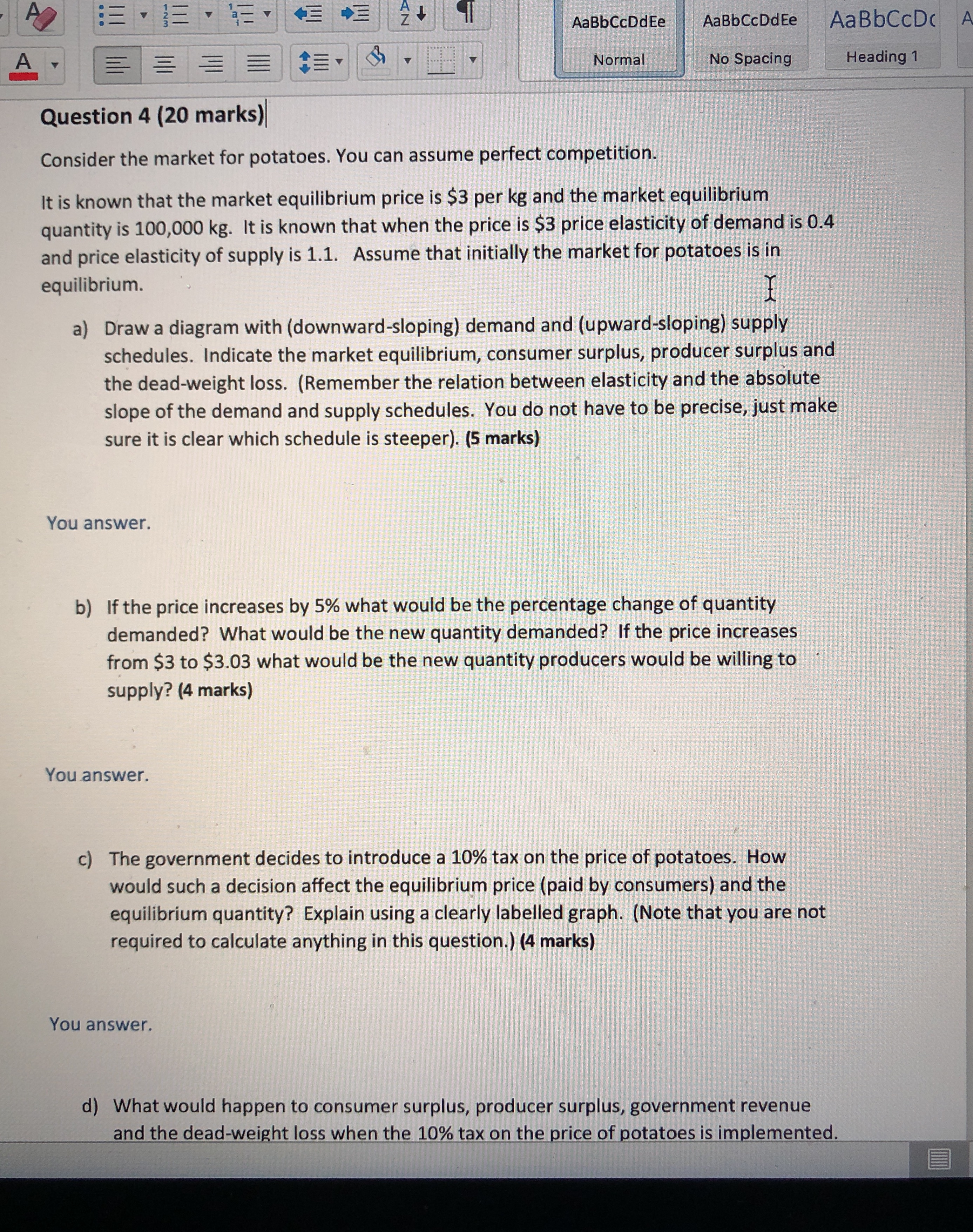
A :E. AaBbCcDdEe AaBbCcDdEe AaBbCcDC A E Sh Normal No Spacing Heading 1 Question 4 (20 marks)| Consider the market for potatoes. You can assume perfect competition. It is known that the market equilibrium price is $3 per kg and the market equilibrium quantity is 100,000 kg. It is known that when the price is $3 price elasticity of demand is 0.4 and price elasticity of supply is 1.1. Assume that initially the market for potatoes is in equilibrium. I a) Draw a diagram with (downward-sloping) demand and (upward-sloping) supply schedules. Indicate the market equilibrium, consumer surplus, producer surplus and the dead-weight loss. (Remember the relation between elasticity and the absolute slope of the demand and supply schedules. You do not have to be precise, just make sure it is clear which schedule is steeper). (5 marks) You answer. b) If the price increases by 5% what would be the percentage change of quantity demanded? What would be the new quantity demanded? If the price increases from $3 to $3.03 what would be the new quantity producers would be willing to supply? (4 marks) You answer. c) The government decides to introduce a 10% tax on the price of potatoes. How would such a decision affect the equilibrium price (paid by consumers) and the equilibrium quantity? Explain using a clearly labelled graph. (Note that you are not required to calculate anything in this question.) (4 marks) You answer. d) What would happen to consumer surplus, producer surplus, government revenue and the dead-weight loss when the 10% tax on the price of potatoes is implemented
Step by Step Solution
There are 3 Steps involved in it

Get step-by-step solutions from verified subject matter experts
 Study Help