







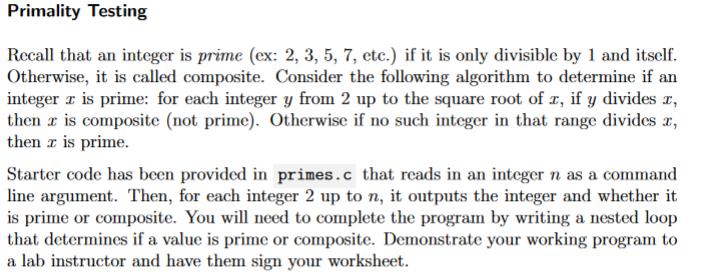
Question: Primality Testing Here is the partially completed code: Primality Testing Recall that an integer is prime (cx: 2, 3, 5, 7, etc.) if it is
Primality Testing
Here is the partially completed code:
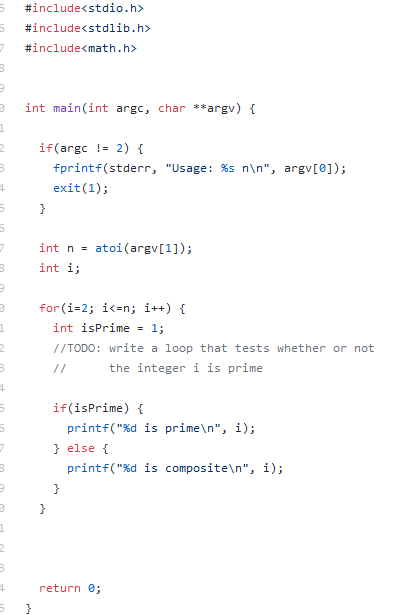
Primality Testing Recall that an integer is prime (cx: 2, 3, 5, 7, etc.) if it is only divisible by 1 and itself. Otherwise, it is called composite. Consider the following algorithm to determine if an integer z is prime: for each integer y from 2 up to the square root of r, if y divides r, then r is composite (not prime). Otherwise if no such integer in that range divides x, then is prime. Starter code has been provided in primes.c that reads in an integer n as a command line argument. Then, for each integer 2 up to n, it outputs the integer and whether it is prime or composite. You will need to complete the program by writing a nested loop that determines if a value is prime or composite. Demonstrate your working program to a lab instructor and have them sign your worksheet #includestdio.h #includestdlib.h #includemath.h> int main(int argc, char**argv) if(argc 1-2) { fprintf(stderr, exit (1); "Usage: %s n ", argv [0]); 7int n-atoi(argv[1]) int i for (i#2 ; i
Step by Step Solution
There are 3 Steps involved in it

Get step-by-step solutions from verified subject matter experts
 Study Help