Question: Primary processing to extract the bean from the skin and pulp of the berry was carried out within the producing country, either at a central
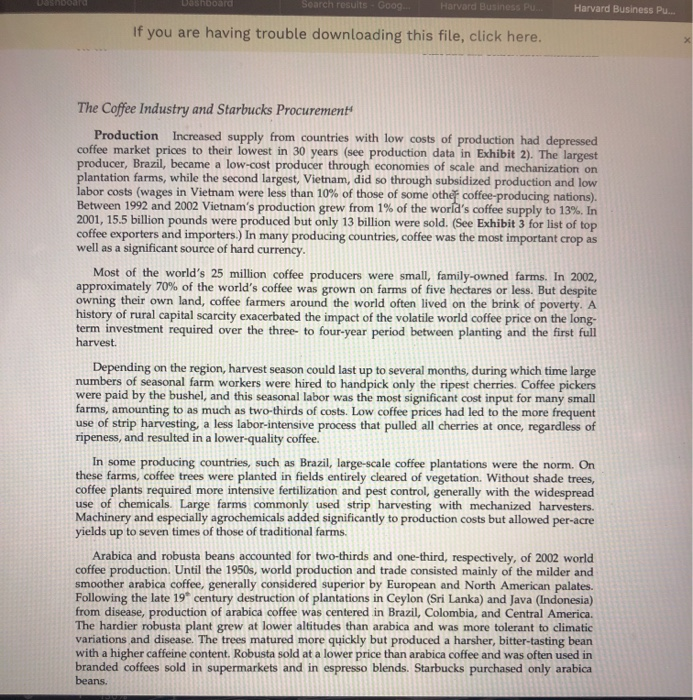
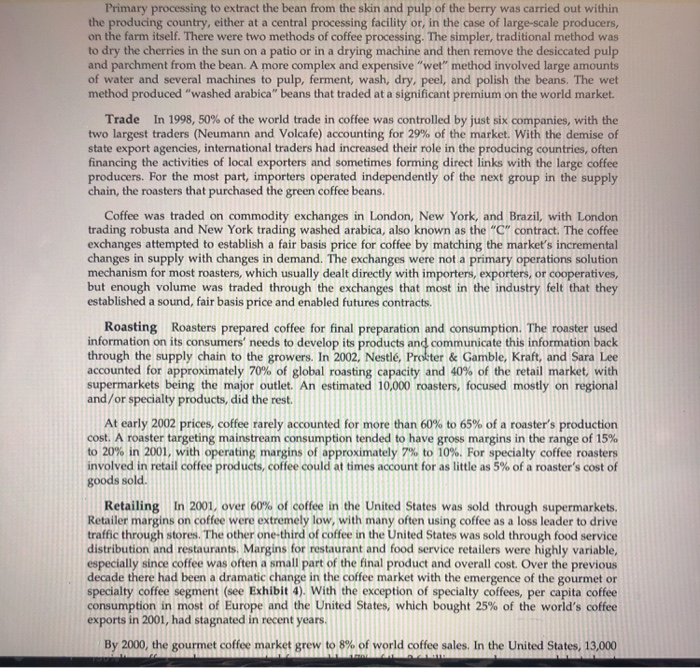
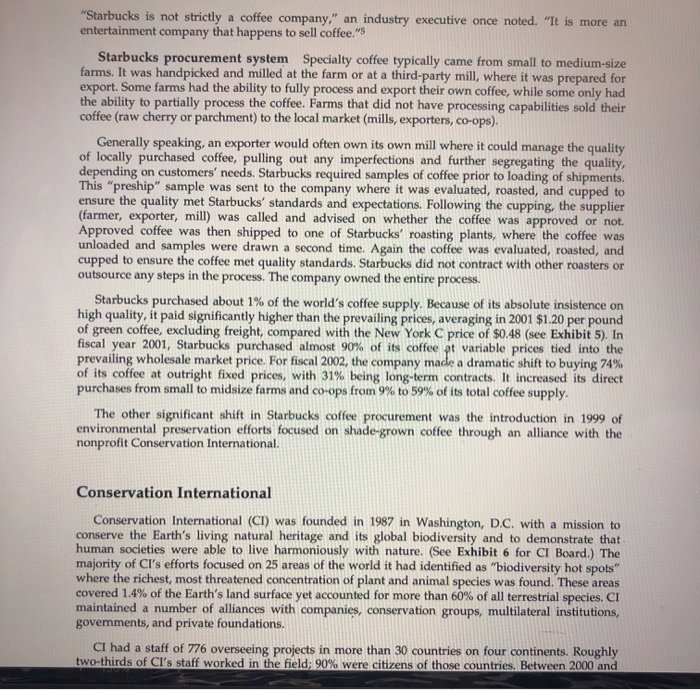
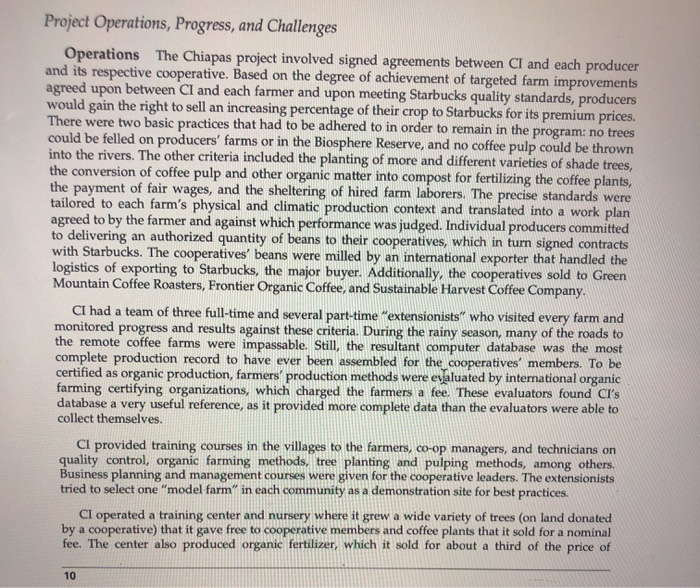
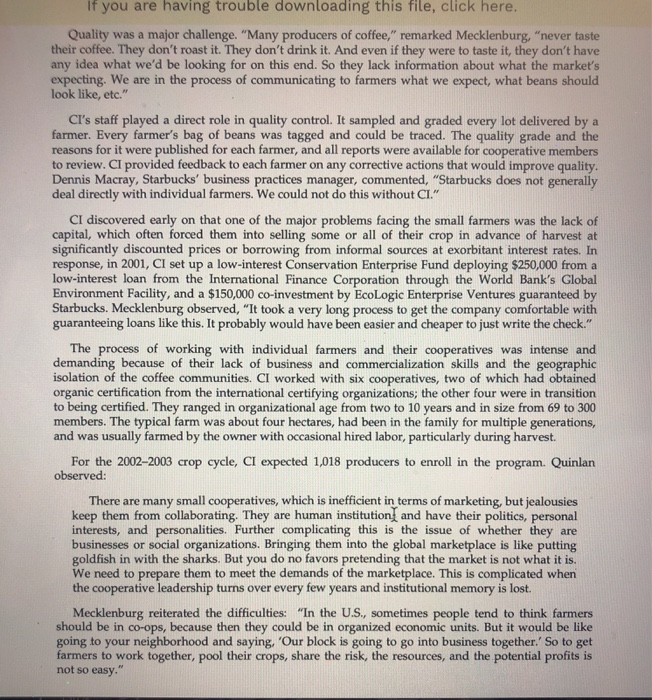
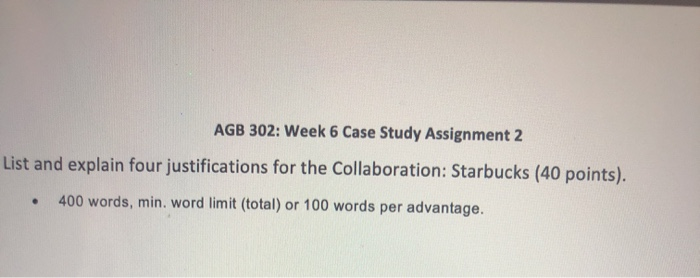
Primary processing to extract the bean from the skin and pulp of the berry was carried out within the producing country, either at a central processing facility or, in the case of large-scale producers, on the farm itself. There were two methods of coffee processing. The simpler, traditional method was to dry the cherries in the sun on a patio or in a drying machine and then remove the desiccated pulp and parchment from the bean. A more complex and expensive "wet" method involved large amounts of water and several machines to pulp, ferment, wash, dry, peel, and polish the beans. The wet method produced "washed arabica" beans that traded at a significant premium on the world market. Trade In 1998, 50% of the world trade in coffee was controlled by just six companies, with the two largest traders (Neumann and Volcafe) accounting for 29% of the market. With the demise of state export agencies, international traders had increased their role in the producing countries, often financing the activities of local exporters and sometimes forming direct links with the large coffee producers. For the most part, importers operated independently of the next group in the supply chain, the roasters that purchased the green coffee beans. Coffee was traded on commodity exchanges in London, New York, and Brazil, with London trading robusta and New York trading washed arabica, also known as the "C" contract. The coffee exchanges attempted to establish a fair basis price for coffee by matching the market's incremental changes in supply with changes in demand. The exchanges were not a primary operat mechanism for most roasters, which usually dealt directly with importers, exporters, or cooperatives, but enough volume was traded through the exchanges that most in the industry felt that they established a sound, fair basis price and enabled futures contracts. Roasting Roasters prepared coffee for final preparation and consumption. The roaster used information on its consumers' needs to develop its products and communicate this information back through the supply chain to the growers. In 2002, Nestl, Protter & Gamble, Kraft, and Sara Lee accounted for approximately 70% of global roasting capacity and 40% of the retail market, with supermarkets being the major outlet. An estimated 10,000 roasters, focused mostly on regional and/or specialty products, did the rest. At early 2002 prices, coffee rarely accounted for more than 60% to 65% of a roaster's production cost. A roaster targeting mainstream consumption tended to have gross margins in the range of 15% to 20% in 2001, with operating margins of approximately 7% to 10%. For specialty coffee roasters involved in retail coffee products, coffee could at times account for as little as 5% of a roaster's cost of goods sold. Retailing in 2001, over 60% of coffee in the United States was sold through supermarkets, Retailer margins on coffee were extremely low, with many often using coffee as a loss leader to drive traffic through stores. The other one-third of coffee in the United States was sold through food service distribution and restaurants. Margins for restaurant and food service retailers were highly variable, especially since coffee was often a small part of the final product and overall cost. Over the previous decade there had been a dramatic change in the coffee market with the emergence of the gourmet or specialty coffee segment (see Exhibit 4). With the exception of specialty coffees, per capita coffee consumption in most of Europe and the United States, which bought 25% of the world's coffee exports in 2001, had stagnated in recent years. By 2000, the gourmet coffee market grew to 8% of world coffee sales. In the United States, 13,000 MAT "Starbucks is not strictly a coffee company," an industry executive once noted. "It is more an entertainment company that happens to sell coffee." Starbucks procurement system Specialty coffee typically came from small to medium-size farms. It was handpicked and milled at the farm or at a third-party mill, where it was prepared for export. Some farms had the ability to fully process and export their own coffee, while some only had the ability to partially process the coffee. Farms that did not have processing capabilities sold their coffee (raw cherry or parchment) to the local market (mills, exporters, co-ops). Generally speaking, an exporter would often own its own mill where it could manage the quality of locally purchased coffee, pulling out any imperfections and further segregating the quality, depending on customers' needs. Starbucks required samples of coffee prior to loading of shipments. This "preship" sample was sent to the company where it was evaluated, roasted, and cupped to ensure the quality met Starbucks' standards and expectations. Following the cupping, the supplier (farmer, exporter, mill) was called and advised on whether the coffee was approved or not. Approved coffee was then shipped to one of Starbucks' roasting plants, where the coffee was unloaded and samples were drawn a second time. Again the coffee was evaluated, roasted, and cupped to ensure the coffee met quality standards. Starbucks did not contract with other roasters or outsource any steps in the process. The company owned the entire process. Starbucks purchased about 1% of the world's coffee supply. Because of its absolute insistence on high quality, it paid significantly higher than the prevailing prices, averaging in 2001 $1.20 per pound of green coffee, excluding freight, compared with the New York C price of $0.48 (see Exhibit 5). In purchased almost 90% of its coffee pt variable prices tied into the prevailing wholesale market price. For fiscal 2002, the company made a dramatic shift to buying 74% of its coffee at outright fixed prices, with 31% being long-term contracts. It increased its direct purchases from small to midsize farms and co-ops from 9% to 59% of its total coffee supply. The other significant shift in Starbucks coffee procurement was the introduction in 1999 of environmental preservation efforts focused on shade-grown coffee through an alliance with the nonprofit Conservation International. Conservation International Conservation International (CI) was founded in 1987 in Washington, D.C. with a mission to conserve the Earth's living natural heritage and its global biodiversity and to demonstrate that human societies were able to live harmoniously with nature. (See Exhibit 6 for CI Board.) The majority of CI's efforts focused on 25 areas of the world it had identified as "biodiversity hot spots" where the richest, most threatened concentration of plant and animal species was found. These areas covered 1.4% of the Earth's land surface yet accounted for more than 60% of all terrestrial species. CI maintained a number of alliances with companies, conservation groups, multilateral institutions, governments, and private foundations. CI had a staff of 776 overseeing projects in more than 30 countries on four continents. Roughly two-thirds of CI's staff worked in the field; 90% were citizens of those countries. Between 2000 and Project Operations, Progress, and Challenges Operations The Chiapas project involved signed agreements between CI and each producer and its respective cooperative. Based on the degree of achievement of targeted farm improvements agreed upon between CI and each farmer and upon meeting Starbucks quality standards, producers would gain the right to sell an increasing percentage of their crop to Starbucks for its premium prices. There were two basic practices that had to be adhered to in order to remain in the program: no trees could be felled on producers' farms or in the Biosphere Reserve, and no coffee pulp could be thrown into the rivers. The other criteria included the planting of more and different varieties of shade trees, the conversion of coffee pulp and other organic matter into compost for fertilizing the coffee plants, the payment of fair wages, and the sheltering of hired farm laborers. The precise standards were tailored to each farm's physical and climatic production context and translated into a work plan agreed to by the farmer and against which performance was judged. Individual producers committed to delivering an authorized quantity of beans to their cooperatives, which in turn signed contracts with Starbucks. The cooperatives' beans were milled by an international exporter that handled the logistics of exporting to Starbucks, the major buyer. Additionally, the cooperatives sold to Green Mountain Coffee Roasters, Frontier Organic Coffee, and Sustainable Harvest Coffee Company CI had a team of three full-time and several part-time "extensionists who visited every farm and monitored progress and results against these criteria. During the rainy season, many of the roads to the remote coffee farms were impassable. Still, the resultant computer database was the most complete production record to have ever been assembled for the cooperatives' members. To be certified as organic production, farmers' production methods were evaluated by international organic farming certifying organizations, which charged the farmers a fee. These evaluators found CI's database a very useful reference, as it provided more complete data than the evaluators were able to collect themselves. CI provided training courses in the villages to the farmers, co-op managers, and technicians on quality control, organic farming methods, tree planting and pulping methods, among others. Business planning and management courses were given for the cooperative leaders. The extensionists tried to select one "model farm" in each community as a demonstration site for best practices. CI operated a training center and nursery where it grew a wide variety of trees (on land donated by a cooperative) that it gave free to cooperative members and coffee plants that it sold for a nominal fee. The center also produced organic fertilizer, which it sold for about a third of the price of 10 If you are having trouble downloading this file, click here. Quality was a major challenge. "Many producers of coffee," remarked Mecklenburg, "never taste their coffee. They don't roast it. They don't drink it. And even if they were to taste it, they don't have any idea what we'd be looking for on this end. So they lack information about what the market's expecting. We are in the process of communicating to farmers what we expect, what beans should look like, etc." CI's staff played a direct role in quality control. It sampled and graded every lot delivered by a farmer. Every farmer's bag of beans was tagged and could be traced. The quality grade and the reasons for it were published for each farmer, and all reports were available for cooperative members to review. CI provided feedback to each farmer on any corrective actions that would improve quality. Dennis Macray, Starbucks' business practices manager, commented, "Starbucks does not generally deal directly with individual farmers. We could not do this without CI. CI discovered early on that one of the major problems facing the small farmers was the lack of capital, which often forced them into selling some or all of their crop in advance of harvest at significantly discounted prices or borrowing from informal sources at exorbitant interest rates. In response, in 2001, CI set up a low-interest Conservation Enterprise Fund deploying $250,000 from a low-interest loan from the International Finance Corporation through the World Bank's Global Environment Facility, and a $150,000 co-investment by EcoLogic Enterprise Ventures guaranteed by Starbucks. Mecklenburg observed, "It took a very long process to get the company comfortable with guaranteeing loans like this. It probably would have been easier and cheaper to just write the check." The process of working with individual farmers and their cooperatives was intense and demanding because of their lack of business and commercialization skills and the geographic isolation of the coffee communities. CI worked with six cooperatives, two of which had obtained organic certification from the international certifying organizations, the other four were in transition to being certified. They ranged in organizational age from two to 10 years and in size from 69 to 300 members. The typical farm was about four hectares, had been in the family for multiple generations, and was usually formed by the owner with occasional hired labor, particularly during harvest. For the 2002-2003 crop cycle, CI expected 1,018 producers to enroll in the program. Quinlan observed: There are many small cooperatives, which is inefficient in terms of marketing, but jealousies keep them from collaborating. They are human institution and have their politics, personal interests, and personalities. Further complicating this is the issue of whether they are businesses or social organizations. Bringing them into the global marketplace is like putting goldfish in with the sharks. But you do no favors pretending that the market is not what it is. We need to prepare them to meet the demands of the marketplace. This is complicated when the cooperative leadership turns over every few years and institutional memory is lost. Mecklenburg reiterated the difficulties: "In the U.S., sometimes people tend to think farmers should be in co-ops, because then they could be in organized eco going to your neighborhood and saying, 'Our block is going to go into business together.' So to get farmers to work together, pool their crops, share the risk, the resources, and the potential profits is not so easy." AGB 302: Week 6 Case Study Assignment 2 List and explain four justifications for the Collaboration: Starbucks (40 points). 400 words, min. word limit (total) or 100 words per advantage









 Study Help