







Question: print(isinstance(attractions,print(isinstance(attractions,Generator))Tterable)) (e) (1 point) Select one option below that can best explain the phenomenon seen in question d. A. Mixin B. Duck Typing C. Simple
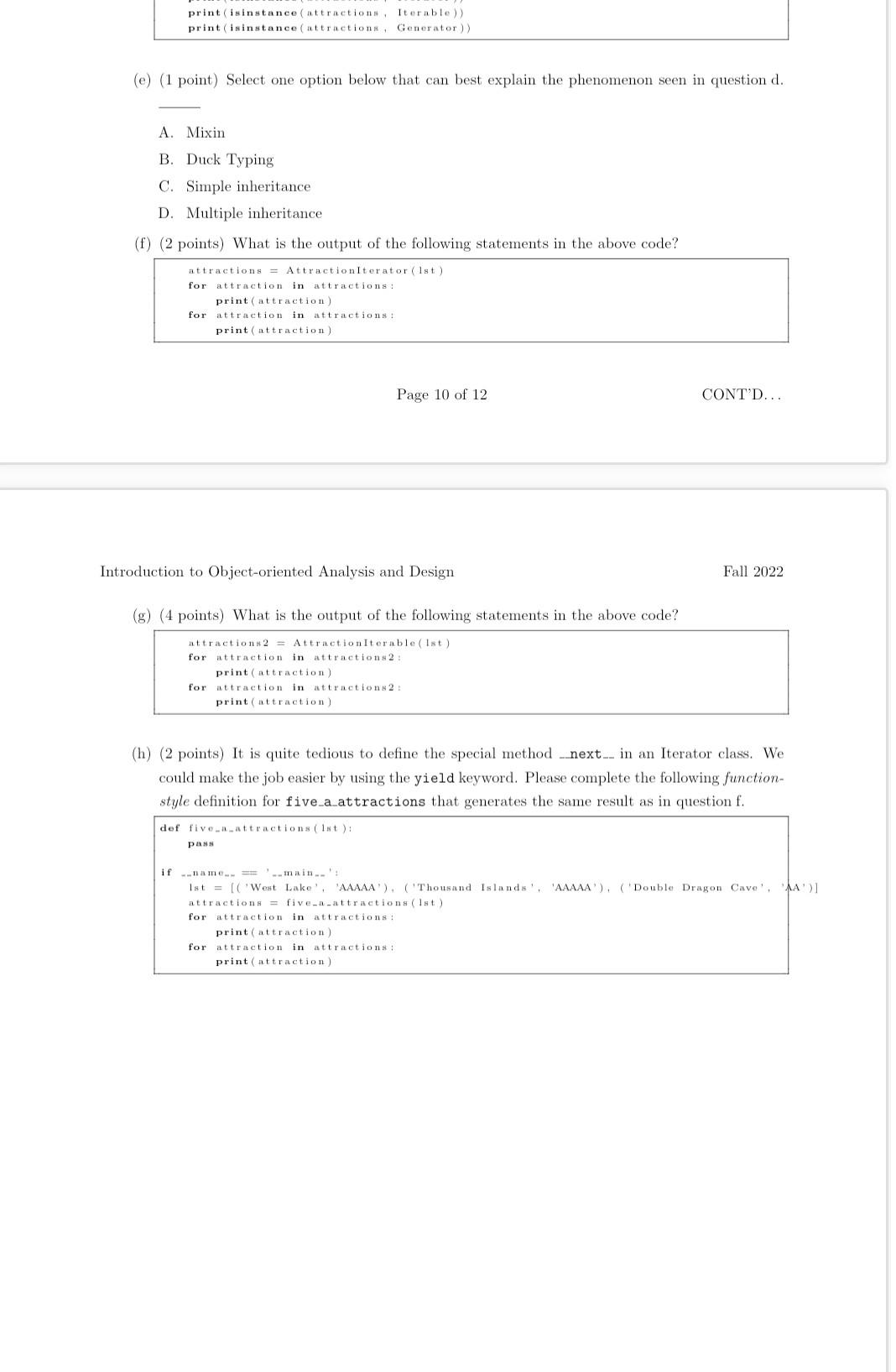
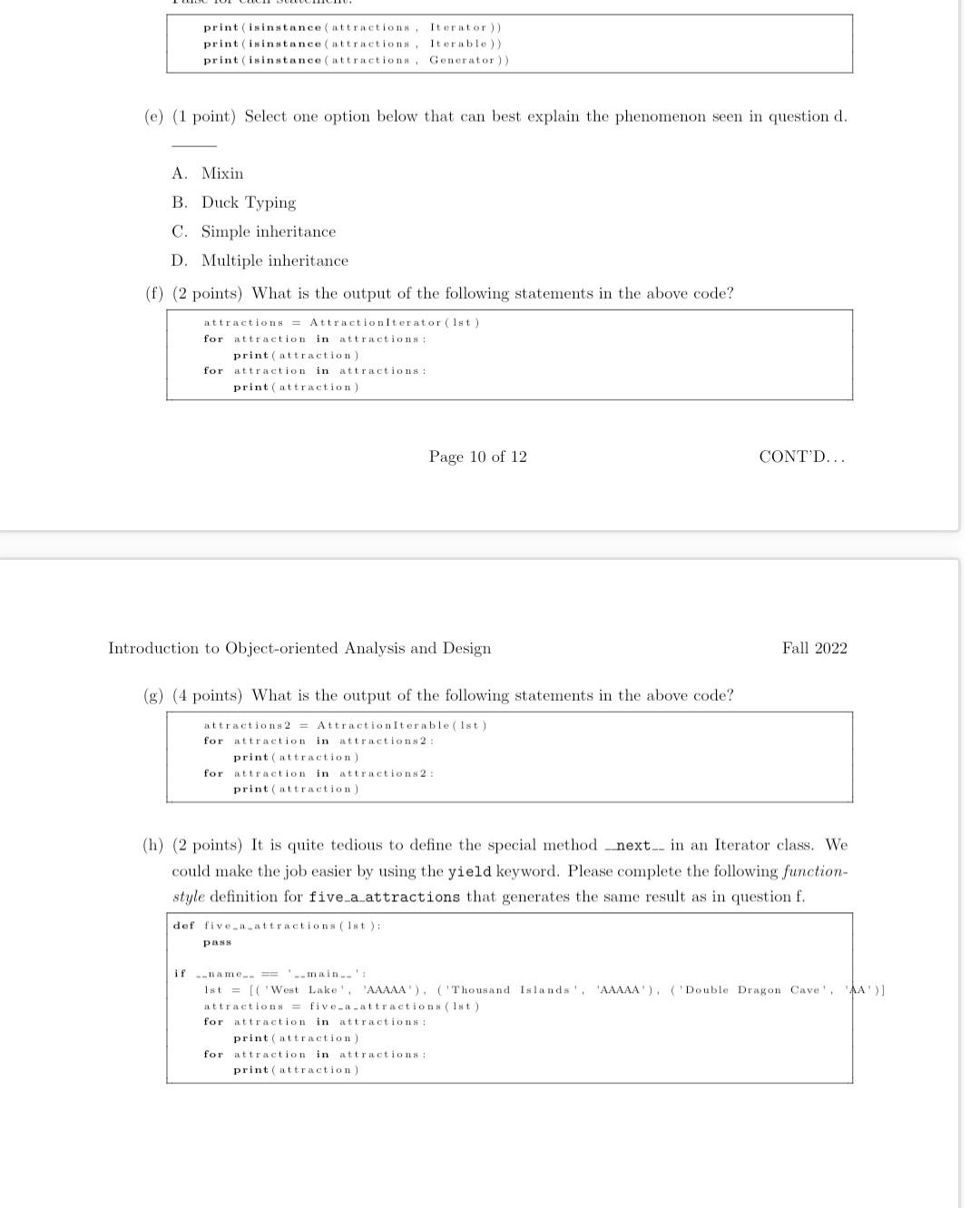
print(isinstance(attractions,print(isinstance(attractions,Generator))Tterable)) (e) (1 point) Select one option below that can best explain the phenomenon seen in question d. A. Mixin B. Duck Typing C. Simple inheritance D. Multiple inheritance (f) (2 points) What is the output of the following statements in the above code? \begin{tabular}{l} attractions = Attractioniterator (lst) \\ for attraction in attractions: \\ for attraction in attractions: \\ print(attraction) \\ \hline \end{tabular} Page 10 of 12 CONT'D... ntroduction to Object-oriented Analysis and Design Fall 2022 (g) (4 points) What is the output of the following statements in the above code? attractions 2= Attractioniterable(tst) for attraction in attractions2: for attraction in attractions2: print(attraction) (h) (2 points) It is quite tedious to define the special method _next_- in an Iterator class. We could make the job easier by using the yield keyword. Please complete the following functionstyle definition for five_a_attractions that generates the same result as in question f. print(isinstance(attractions,Iterator))print(isinstance(attractions,Iterable))print(isinstance(attractions,Generator)) (e) (1 point) Select one option below that can best explain the phenomenon seen in question d. A. Mixin B. Duck Typing C. Simple inheritance D. Multiple inheritance (f) (2 points) What is the output of the following statements in the above code? \begin{tabular}{|l} \hline attractions = Attractioniterator(lst) \\ for attraction in attractions: \\ for print(attraction) \\ print(attraction) \\ \hline \end{tabular} Page 10 of 12 CONT'D... Introduction to Object-oriented Analysis and Design Fall 2022 (g) (4 points) What is the output of the following statements in the above code? print(isinstance(attractions,print(isinstance(attractions,Generator))Tterable)) (e) (1 point) Select one option below that can best explain the phenomenon seen in question d. A. Mixin B. Duck Typing C. Simple inheritance D. Multiple inheritance (f) (2 points) What is the output of the following statements in the above code? \begin{tabular}{l} attractions = Attractioniterator (lst) \\ for attraction in attractions: \\ for attraction in attractions: \\ print(attraction) \\ \hline \end{tabular} Page 10 of 12 CONT'D... ntroduction to Object-oriented Analysis and Design Fall 2022 (g) (4 points) What is the output of the following statements in the above code? attractions 2= Attractioniterable(tst) for attraction in attractions2: for attraction in attractions2: print(attraction) (h) (2 points) It is quite tedious to define the special method _next_- in an Iterator class. We could make the job easier by using the yield keyword. Please complete the following functionstyle definition for five_a_attractions that generates the same result as in question f. print(isinstance(attractions,Iterator))print(isinstance(attractions,Iterable))print(isinstance(attractions,Generator)) (e) (1 point) Select one option below that can best explain the phenomenon seen in question d. A. Mixin B. Duck Typing C. Simple inheritance D. Multiple inheritance (f) (2 points) What is the output of the following statements in the above code? \begin{tabular}{|l} \hline attractions = Attractioniterator(lst) \\ for attraction in attractions: \\ for print(attraction) \\ print(attraction) \\ \hline \end{tabular} Page 10 of 12 CONT'D... Introduction to Object-oriented Analysis and Design Fall 2022 (g) (4 points) What is the output of the following statements in the above code
Step by Step Solution
There are 3 Steps involved in it

Get step-by-step solutions from verified subject matter experts
 Study Help