







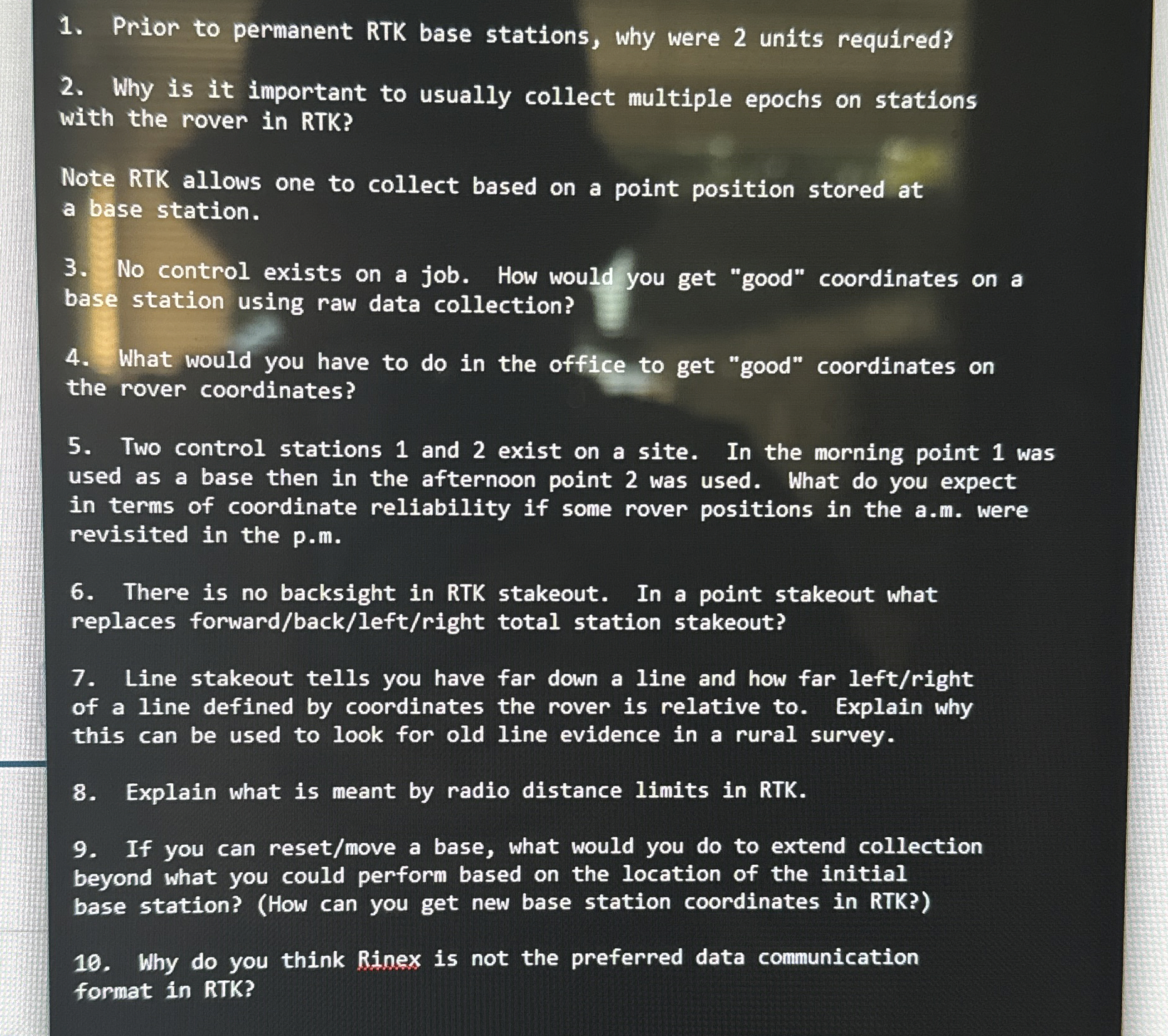
Question: Prior to permanent RTK base stations, why were 2 units required? Why is it important to usually collect multiple epochs on stations with the rover
Prior to permanent RTK base stations, why were units required?
Why is it important to usually collect multiple epochs on stations
with the rover in RTK
Note RTK allows one to collect based on a point position stored at
a base station.
No control exists on a job. How would you get "good" coordinates on a
base station using raw data collection?
What would you have to do in the office to get "good" coordinates on
the rover coordinates?
Two control stations and exist on a site. In the morning point was
used as a base then in the afternoon point was used. What do you expect
in terms of coordinate reliability if some rover positions in the am were
revisited in the pm
There is no backsight in RTK stakeout. In a point stakeout what
replaces forwardbackleftright total station stakeout?
Line stakeout tells you have far down a line and how far leftright
of a line defined by coordinates the rover is relative to Explain why
this can be used to look for old line evidence in a rural survey.
Explain what is meant by radio distance limits in RTK
If you can resetmove a base, what would you do to extend collection
beyond what you could perform based on the location of the initial
base station? How can you get new base station coordinates in RTK
Why do you think Rinex is not the preferred data communication
format in RTK
Step by Step Solution
There are 3 Steps involved in it
1 Expert Approved Answer
Step: 1 Unlock

Question Has Been Solved by an Expert!
Get step-by-step solutions from verified subject matter experts
Step: 2 Unlock
Step: 3 Unlock
 Study Help