







Question: Priority Encoder Design A Priority Encoder is a combinational circuit that takes a bit vector as input and outputs the binary number corresponding to the
Priority Encoder Design
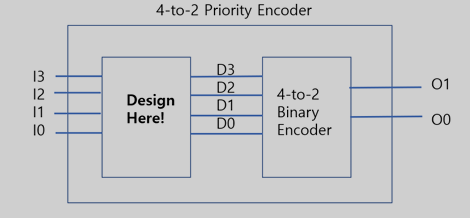
A Priority Encoder is a combinational circuit that takes a bit vector as input and outputs the binary number corresponding to the position of the highestpriority active bit. For example, when a bit vector IIII is input, and assuming that the most significant bit MSB has the highest priority, the circuit will output the position of the highest priority bit in this case, the st bit as a binary number OO
In the given block diagram, write the Boolean expressions for D D D and DA Binary Encoder is the opposite of a Binary Decoder. In a Binary Encoder, one bit in the input vector is always set to and the encoder outputs the binary number corresponding to the position of that bit. For example, in the circuit shown below, if D D D D the output will be OO
Step by Step Solution
There are 3 Steps involved in it
1 Expert Approved Answer
Step: 1 Unlock

Question Has Been Solved by an Expert!
Get step-by-step solutions from verified subject matter experts
Step: 2 Unlock
Step: 3 Unlock
 Study Help