







Question: Probabilistic algorithms and/or stochastic simulation are often used to estimate values or predict the likelihood of specific events, particularly if direct calculation is algorithmically complex
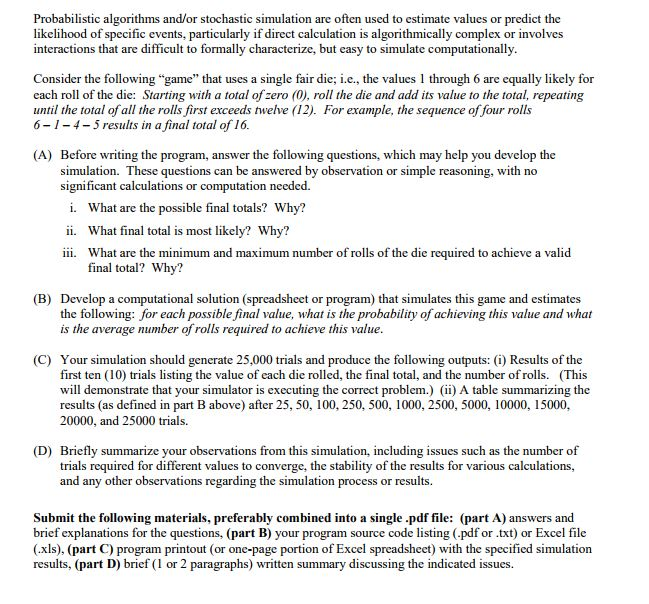
Probabilistic algorithms and/or stochastic simulation are often used to estimate values or predict the likelihood of specific events, particularly if direct calculation is algorithmically complex or involves interactions that are difficult to formally characterize, but easy to simulate computationally Consider the following "game" that uses a single fair die; i.e., the values 1 through 6 are equally likely for each roll of the die: Starting with a total of zero (0), roll the die and add its value to the total, repeating until the total of all the rolls first exceeds twelve (12). For example, the sequence of four rolls 6-1-4-5 results in a final total of 16 Before writing the program, answer the following questions, which may help you develop the simulation. These questions can be answered by observation or simple reasoning, with no significant calculations or (A) computation needed. i. What are the possible final totals? Why? ii. What final total is most likely? Why? ii. What are the minimum and maximum number of rolls of the die required to achieve a valid final total? Why? (B) Develop a computational solution (spreadsheet or program) that simulates this game and estimates the following: for each possible final value, what is the probability of achieving this value and what is the average number of rolls required to achieve this value (C) Your simulation should generate 25,000 trials and produce the following outputs: (i) Results of the first ten (10) trials listing the value of each die rolled, the final total, and the number ofrolls. (This will demonstrate that your simulator is executing the correct problem.) (ii) A table summarizing the results (as defined in part B above) after 25, 50, 100, 250, 500, 1000, 2500, 5000, 10000, 15000, 20000, and 25000 trials. (D) Briefly summarize your observations from this simulation, including issues such as the number of ifferent values to converge, the stability of the results for various calculations, trials required for d and any other observations regarding the simulation process or results. Submit the following materials, preferably combined into a single pdf file: (part A) answers and brief explanations for the questions, (part B) your program source code listing (-pdf or.txt) or Excel file (.xls), (part C) program printout (or one-page portion of Excel spreadsheet) with the specified simulation results, (partD bief (l or 2 paragraphs) written summary discussing the indicated issues. Probabilistic algorithms and/or stochastic simulation are often used to estimate values or predict the likelihood of specific events, particularly if direct calculation is algorithmically complex or involves interactions that are difficult to formally characterize, but easy to simulate computationally Consider the following "game" that uses a single fair die; i.e., the values 1 through 6 are equally likely for each roll of the die: Starting with a total of zero (0), roll the die and add its value to the total, repeating until the total of all the rolls first exceeds twelve (12). For example, the sequence of four rolls 6-1-4-5 results in a final total of 16 Before writing the program, answer the following questions, which may help you develop the simulation. These questions can be answered by observation or simple reasoning, with no significant calculations or (A) computation needed. i. What are the possible final totals? Why? ii. What final total is most likely? Why? ii. What are the minimum and maximum number of rolls of the die required to achieve a valid final total? Why? (B) Develop a computational solution (spreadsheet or program) that simulates this game and estimates the following: for each possible final value, what is the probability of achieving this value and what is the average number of rolls required to achieve this value (C) Your simulation should generate 25,000 trials and produce the following outputs: (i) Results of the first ten (10) trials listing the value of each die rolled, the final total, and the number ofrolls. (This will demonstrate that your simulator is executing the correct problem.) (ii) A table summarizing the results (as defined in part B above) after 25, 50, 100, 250, 500, 1000, 2500, 5000, 10000, 15000, 20000, and 25000 trials. (D) Briefly summarize your observations from this simulation, including issues such as the number of ifferent values to converge, the stability of the results for various calculations, trials required for d and any other observations regarding the simulation process or results. Submit the following materials, preferably combined into a single pdf file: (part A) answers and brief explanations for the questions, (part B) your program source code listing (-pdf or.txt) or Excel file (.xls), (part C) program printout (or one-page portion of Excel spreadsheet) with the specified simulation results, (partD bief (l or 2 paragraphs) written summary discussing the indicated issues
Step by Step Solution
There are 3 Steps involved in it

Get step-by-step solutions from verified subject matter experts
 Study Help