Question: probability .3 and partial occupancy with probability .7. Full occupancy will provide income of $2,000,000, but partial occupancy will provide income of only $500,000. Order
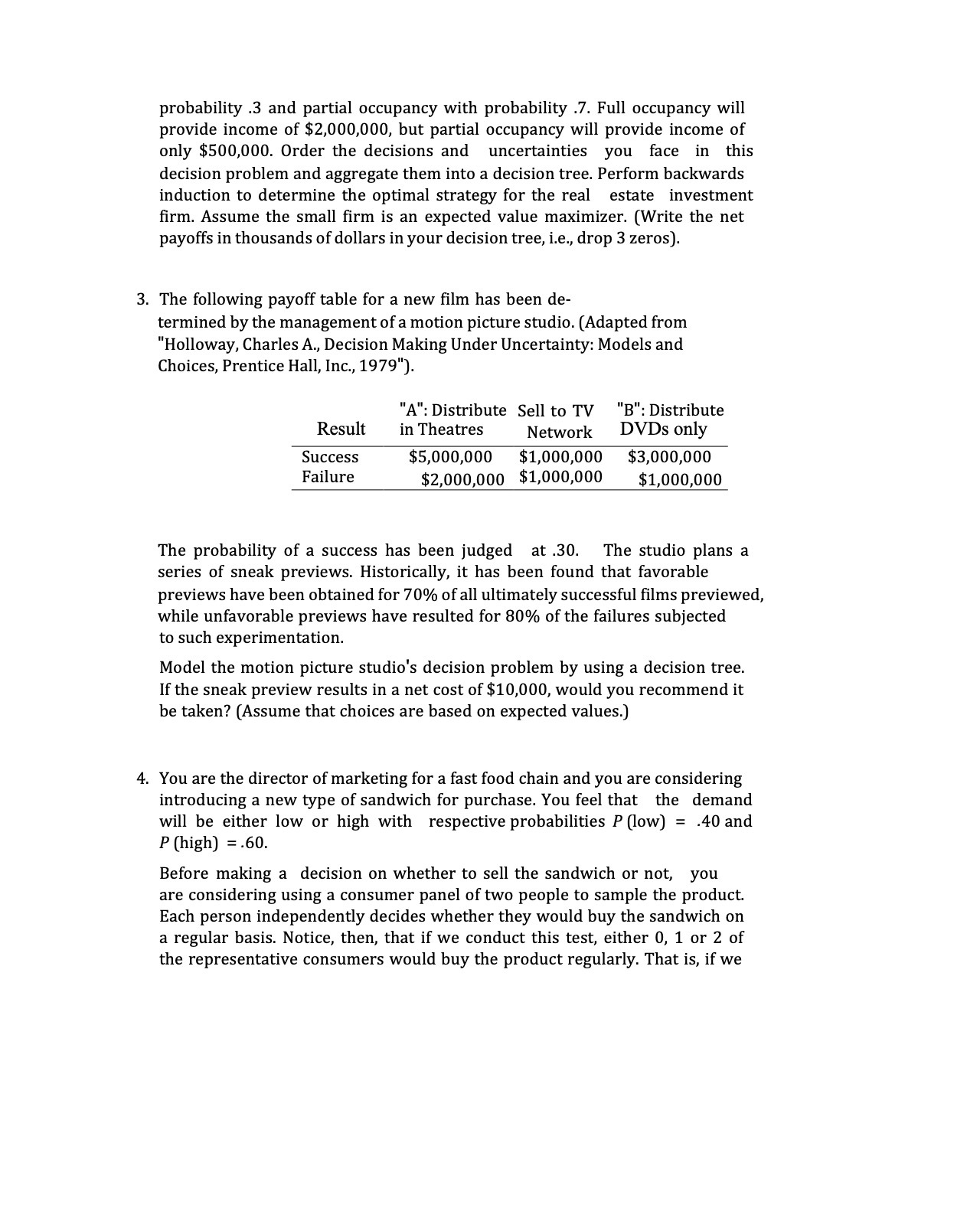
probability .3 and partial occupancy with probability .7. Full occupancy will provide income of $2,000,000, but partial occupancy will provide income of only $500,000. Order the decisions and uncertainties you face in this decision problem and aggregate them into a decision tree. Perform backwards induction to determine the optimal strategy for the real estate investment rm. Assume the small rm is an expected value maximizer. [Write the net payoffs in thousands of dollars in your decision tree, i.e., drop 3 zeros]. 3. The following payoff table for a new film has been de- termined by the management of a motion picture studio. (Adapted from "Holloway, Charles A., Decision Making Under Uncertainty: Models and Choices, Prentice Hall, Inc., 1979"). "A": Distribute Sell to TV "B": Distribute Result in Theatres Network DVDS only Success $5,000,000 $1,000,000 $3,000,000 Failure $2,000,000 $1300.00\" $1,000,000 The probability of a success has been judged at .30. The studio plans a series of sneak previews. Historically, it has been found that favorable previews have been obtained for 70% of all ultimately successful films previewed, while unfavorable previews have resulted for 80% of the failures subjected to such experimentation. Model the motion picture studio's decision problem by using a decision tree. If the sneak preview results in a net cost of $10,000, would you recommend it be taken? [Assume that choices are based on expected values.) 4. You are the director of marketing for a fast food chain and you are considering introducing a new type of sandwich for purchase. You feel that the demand will be either low or high with respective probabilities P (low) = .40 and P (high) =.60. Before making a decision on whether to sell the sandwich or not, you are considering using a consumer panel oftwo people to sample the product Each person independently decides whether they would buy the sandwich on a regular basis. Notice, then, that if we conduct this test, either 0, 1 or 2 of the representative consumers would buy the product regularly. That is, if we









 Study Help