







Question: PROBABILITY 36 Exercise 6 1. Two fair dice are rolled and the two numbers showing on the uppermost faces are multiplied together. Show the 36
PROBABILITY
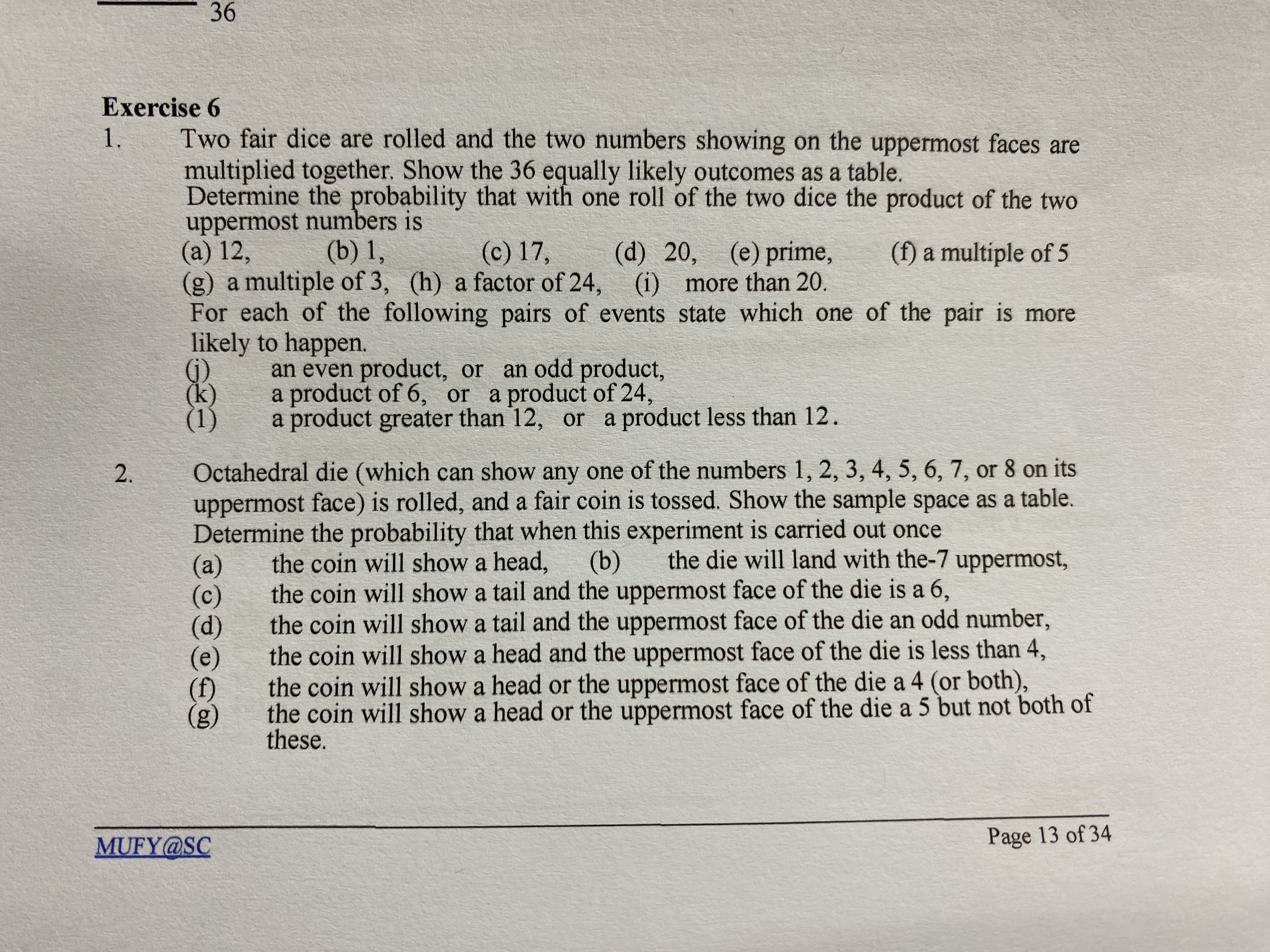
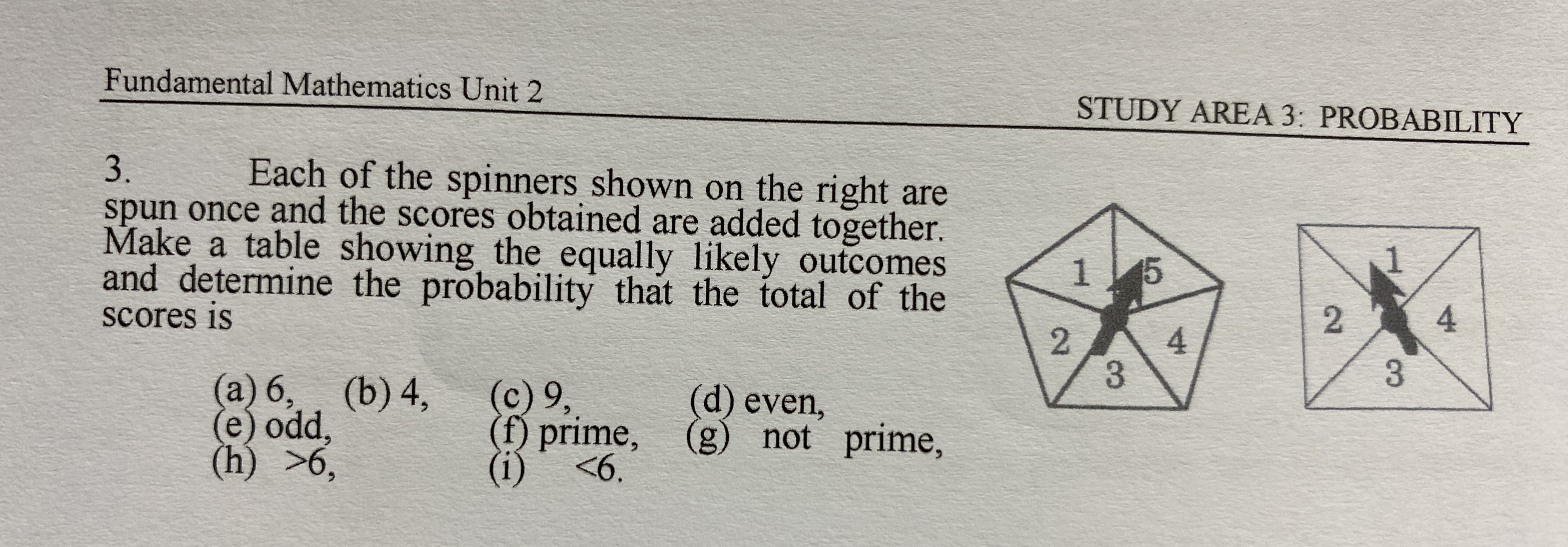
36 Exercise 6 1. Two fair dice are rolled and the two numbers showing on the uppermost faces are multiplied together. Show the 36 equally likely outcomes as a table. Determine the probability that with one roll of the two dice the product of the two uppermost numbers is (a) 12, (b) 1, (c) 17, (d) 20, (e) prime, (f) a multiple of 5 (g) a multiple of 3, (h) a factor of 24, (i) more than 20. For each of the following pairs of events state which one of the pair is more likely to happen. an even product, or an odd product, a product of 6, or a product of 24, a product greater than 12, or a product less than 12. 2. Octahedral die (which can show any one of the numbers 1, 2, 3, 4, 5, 6, 7, or 8 on its uppermost face) is rolled, and a fair coin is tossed. Show the sample space as a table. Determine the probability that when this experiment is carried out once (a the coin will show a head, (b) the die will land with the-7 uppermost, (c) the coin will show a tail and the uppermost face of the die is a 6, (a) the coin will show a tail and the uppermost face of the die an odd number, the coin will show a head and the uppermost face of the die is less than 4, the coin will show a head or the uppermost face of the die a 4 (or both), the coin will show a head or the uppermost face of the die a 5 but not both of these. MUFY@SC Page 13 of 34Fundamental Mathematics Unit 2 STUDY AREA 3: PROBABILITY 3. Each of the spinners shown on the right are spun once and the scores obtained are added together. Make a table showing the equally likely outcomes 15 and determine the probability that the total of the 2 4 scores is 2 4 3 3 (a) 6, (b) 4, (c) 9, (d) even, e) odd, (f) prime, g ) not prime, ( h ) > 6 , 46
Step by Step Solution
There are 3 Steps involved in it

Get step-by-step solutions from verified subject matter experts
 Study Help