







Question: probability in CS thanks 5. (Private Sampling, 10 points) You would like to conduct a survey on some sensitive topic. To ensure that your subjects
probability in CS thanks
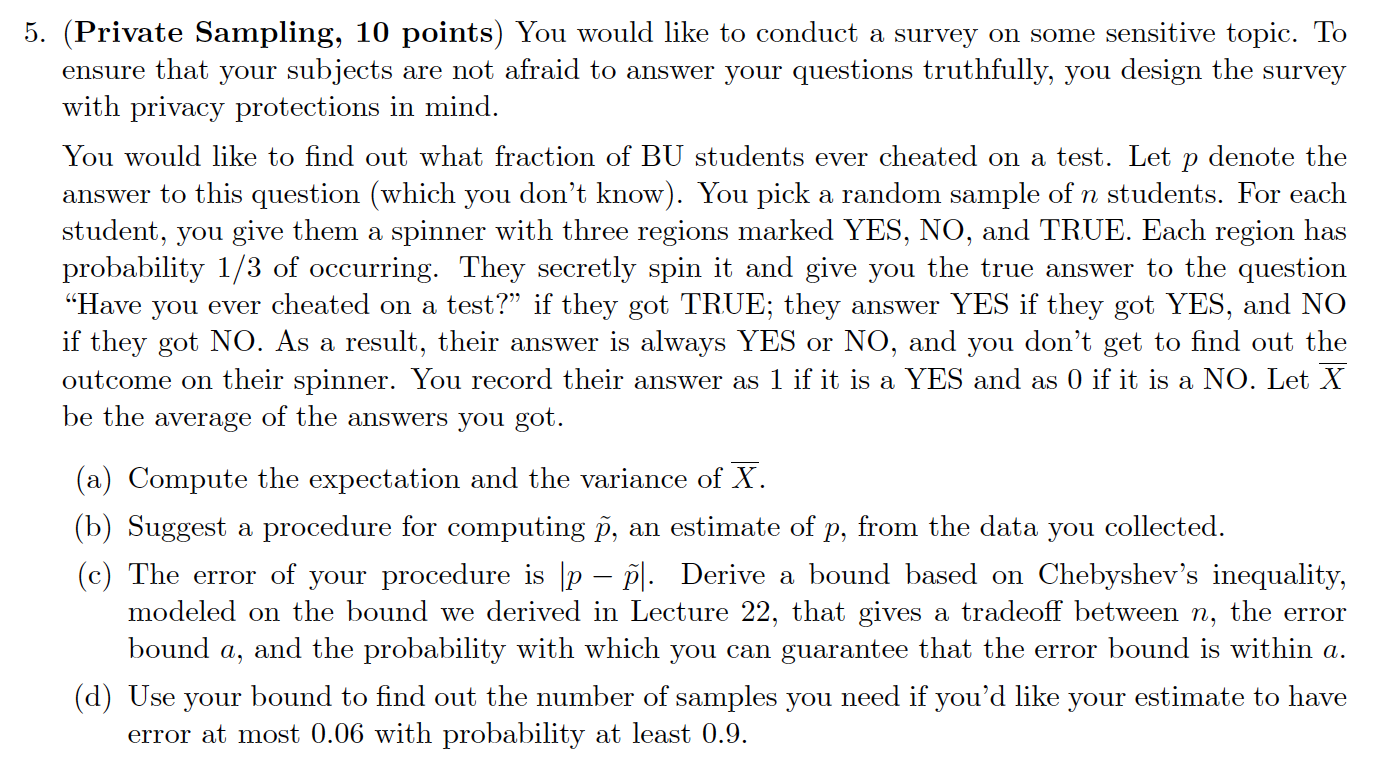
5. (Private Sampling, 10 points) You would like to conduct a survey on some sensitive topic. To ensure that your subjects are not afraid to answer your questions truthfully, you design the survey with privacy protections in mind. You would like to find out what fraction of BU students ever cheated on a test. Let denote the answer to this question (which you don't know). You pick a random sample of n students. For each student, you give them a spinner with three regions marked YES, NO, and TRUE. Each region has probability 1/3 of occurring. They secretly spin it and give you the true answer to the question "Have you ever cheated on a test? if they got TRUE; they answer YES if they got YES, and NO if they got NO. As a result, their answer is always YES or NO, and you don't get to find out the outcome on their spinner. You record their answer as 1 if it is a YES and as O if it is a NO. Let X be the average of the answers you got. (a) Compute the expectation and the variance of X. (b) Suggest a procedure for computing , an estimate of p, from the data you collected. (c) The error of your procedure is \p Pl. Derive a bound based on Chebyshev's inequality, modeled on the bound we derived in Lecture 22, that gives a tradeoff between n, the error bound a, and the probability with which you can guarantee that the error bound is within a. (d) Use your bound to find out the number of samples you need if you'd like your estimate to have error at most 0.06 with probability at least 0.9. 5. (Private Sampling, 10 points) You would like to conduct a survey on some sensitive topic. To ensure that your subjects are not afraid to answer your questions truthfully, you design the survey with privacy protections in mind. You would like to find out what fraction of BU students ever cheated on a test. Let denote the answer to this question (which you don't know). You pick a random sample of n students. For each student, you give them a spinner with three regions marked YES, NO, and TRUE. Each region has probability 1/3 of occurring. They secretly spin it and give you the true answer to the question "Have you ever cheated on a test? if they got TRUE; they answer YES if they got YES, and NO if they got NO. As a result, their answer is always YES or NO, and you don't get to find out the outcome on their spinner. You record their answer as 1 if it is a YES and as O if it is a NO. Let X be the average of the answers you got. (a) Compute the expectation and the variance of X. (b) Suggest a procedure for computing , an estimate of p, from the data you collected. (c) The error of your procedure is \p Pl. Derive a bound based on Chebyshev's inequality, modeled on the bound we derived in Lecture 22, that gives a tradeoff between n, the error bound a, and the probability with which you can guarantee that the error bound is within a. (d) Use your bound to find out the number of samples you need if you'd like your estimate to have error at most 0.06 with probability at least 0.9
Step by Step Solution
There are 3 Steps involved in it

Get step-by-step solutions from verified subject matter experts
 Study Help