







Question: Probability spreadsheet Project. In this project, we will be building a spreadsheet investigating the behavior of experimental data as the number of trials grows large.
Probability spreadsheet Project. In this project, we will be building a spreadsheet investigating the behavior of experimental data as the number of trials grows large. the data will be collected by rolling a single die. you will calculate a running percentage of how many times you roll a number 4 throughout 100 trials. Part 1. column B counts the number of die rolls we make. Column c records the outcome of each roll Column D records the frequency of a 4 outcome with a complicated formula. column E records the percentage of a 4 outcome based on our data. column F list the theoretical probability of a 4 outcome, expressed as a percentage. the formula for Column E3 should be = D3/B3. Part 2. Create a graph displaying the experimental percentage in column E and the theoretical percentage in column F. Part 3. what happens to the experimental data as the number of trials grows larger.? If you rolled the die 10,000 times , would you expect the difference in experimental percentage and theoretical percentage of 4s rolled to increase or decrease? Imagine the biggest container of m&ms you've ever seen. one the size of a person, or even a car. Do you think the relative (percent) differences you measured in your bag? why? A copy of Probability spreadsheet can be downloaded from docs.goole.com/spreadsheet.
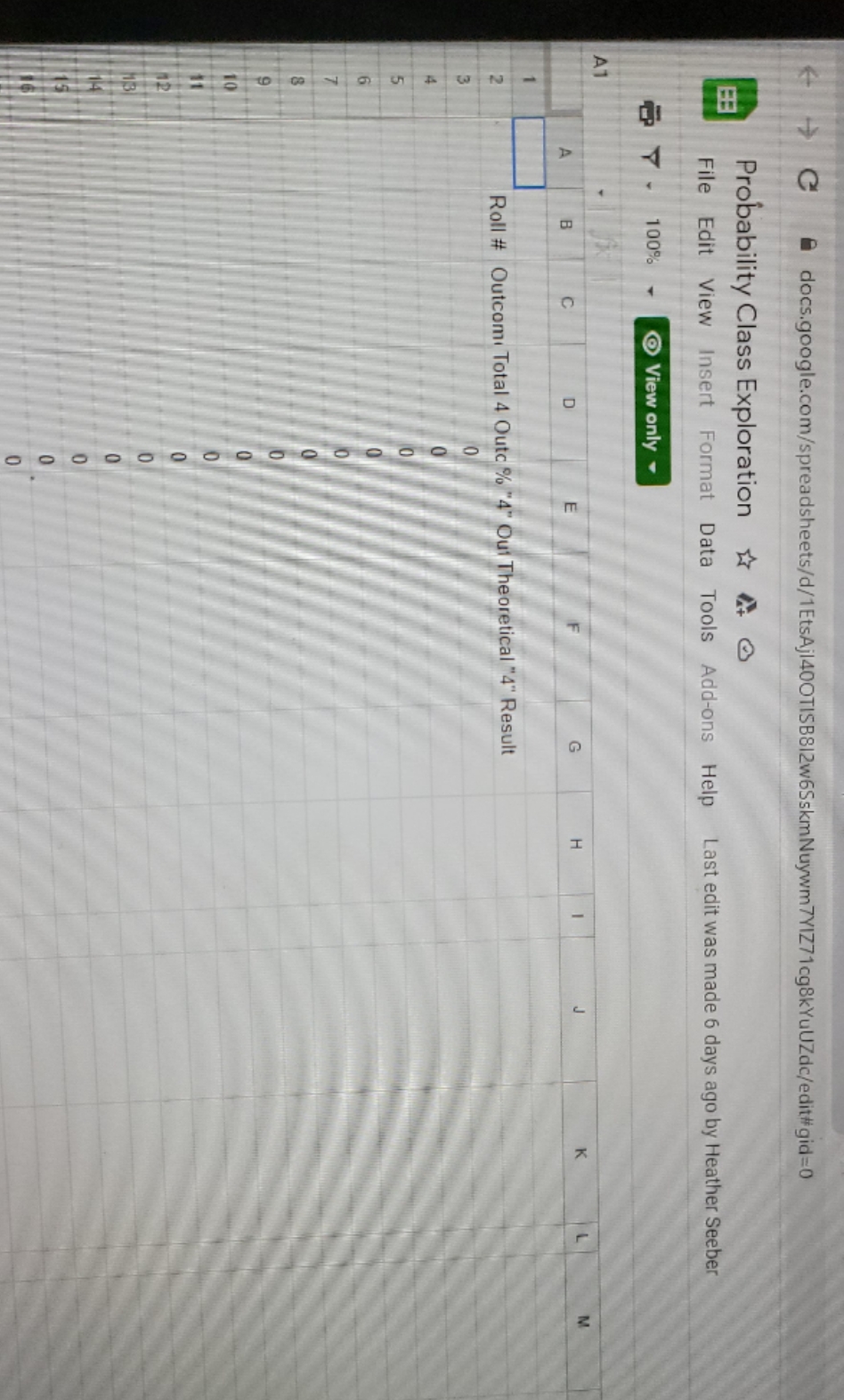
docs.google.com/spreadsheets/d/1EtsAjl40OTISB812w6SskmNuywm7YIZ71cg8kYuUZdc/edit#gid=0 Probability Class Exploration * File Edit View Insert Format Data Tools Add-ons Help Last edit was made 6 days ago by Heather Seeber Y - 100% View only 2 I Roll # Outcom Total 4 Outc % "4" Out Theoretical "4" Result
Step by Step Solution
There are 3 Steps involved in it

Get step-by-step solutions from verified subject matter experts
 Study Help