







Question: Problem 0 4 . 0 0 4 - Calculate velocity using a venturi tube in a convergent - divergent duct References An instrument used to
Problem Calculate velocity using a venturi tube in a convergentdivergent duct
References
An instrument used to measure the airspeed on many early lowspeed airplanes, principally during to was the venturi tube.
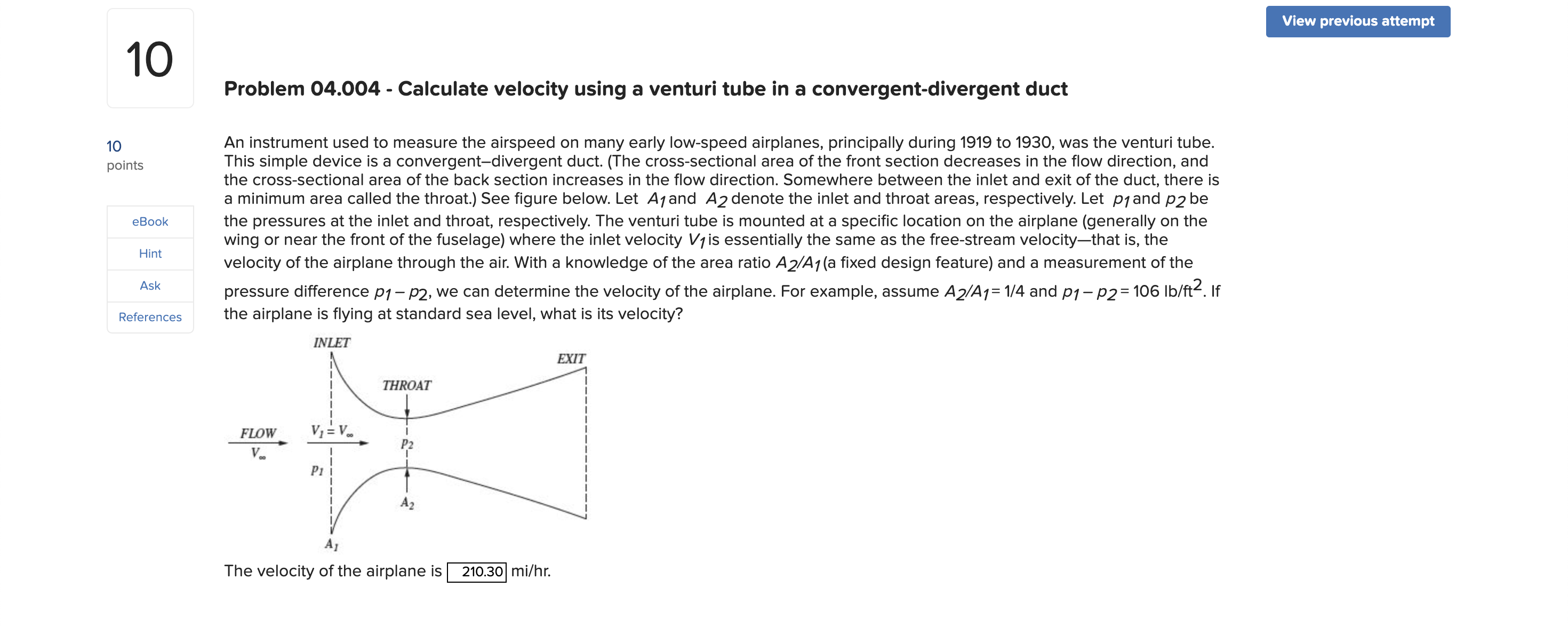
This simple device is a convergentdivergent duct. The crosssectional area of the front section decreases in the flow direction, and
the crosssectional area of the back section increases in the flow direction. Somewhere between the inlet and exit of the duct, there is
a minimum area called the throat. See figure below. Let and denote the inlet and throat areas, respectively. Let and be
the pressures at the inlet and throat, respectively. The venturi tube is mounted at a specific location on the airplane generally on the
wing or near the front of the fuselage where the inlet velocity is essentially the same as the freestream velocitythat is the
velocity of the airplane through the air. With a knowledge of the area ratio a fixed design feature and a measurement of the
pressure difference we can determine the velocity of the airplane. For example, assume and If
the airplane is flying at standard sea level, what is its velocity?
Step by Step Solution
There are 3 Steps involved in it
1 Expert Approved Answer
Step: 1 Unlock

Question Has Been Solved by an Expert!
Get step-by-step solutions from verified subject matter experts
Step: 2 Unlock
Step: 3 Unlock
 Study Help