







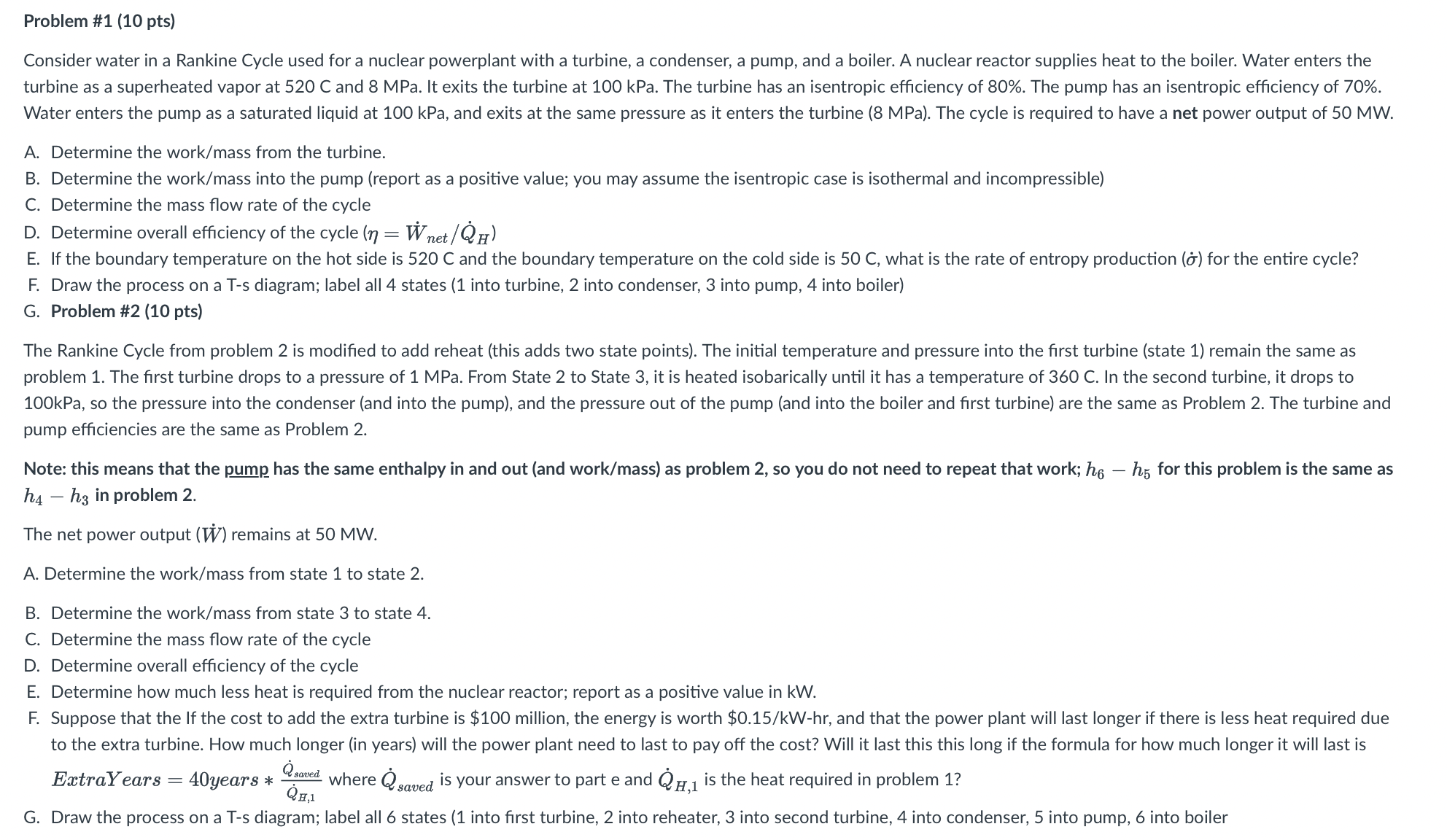
Question: Problem # 1 ( 1 0 pts ) Consider water in a Rankine Cycle used for a nuclear powerplant with a turbine, a condenser,
Problem # pts
Consider water in a Rankine Cycle used for a nuclear powerplant with a turbine, a condenser, a pump, and a boiler. A nuclear reactor supplies heat to the boiler. Water enters the turbine as a superheated vapor at C and MPa It exits the turbine at kPa The turbine has an isentropic efficiency of The pump has an isentropic efficiency of Water enters the pump as a saturated liquid at kPa and exits at the same pressure as it enters the turbine MPa The cycle is required to have a net power output of MW
A Determine the workmass from the turbine.
B Determine the workmass into the pump report as a positive value; you may assume the isentropic case is isothermal and incompressible
C Determine the mass flow rate of the cycle
D Determine overall efficiency of the cycle etadotWn e tdotQH
E If the boundary temperature on the hot side is C and the boundary temperature on the cold side is C what is the rate of entropy production dotsigma for the entire cycle?
F Draw the process on a Ts diagram; label all states into turbine, into condenser, into pump, into boiler
G Problem # pts
The Rankine Cycle from problem is modified to add reheat this adds two state points The initial temperature and pressure into the first turbine state remain the same as problem The first turbine drops to a pressure of MPa From State to State it is heated isobarically until it has a temperature of C In the second turbine, it drops to kPa, so the pressure into the condenser and into the pump and the pressure out of the pump and into the boiler and first turbine are the same as Problem The turbine and pump efficiencies are the same as Problem
Note: this means that the pump has the same enthalpy in and out and workmass as problem so you do not need to repeat that work; hh for this problem is the same as hh in problem
The net power output dotW remains at MW
A Determine the workmass from state to state
B Determine the workmass from state to state
C Determine the mass flow rate of the cycle
D Determine overall efficiency of the cycle
E Determine how much less heat is required from the nuclear reactor; report as a positive value in kW
F Suppose that the If the cost to add the extra turbine is $ million, the energy is worth $ mathrmkWhr and that the power plant will last longer if there is less heat required due to the extra turbine. How much longer in years will the power plant need to last to pay off the cost? Will it last this this long if the formula for how much longer it will last is ExtraYears years fracdotQtext saved dotQH where dotQtext saved is your answer to part e and dotQH is the heat required in problem
G Draw the process on a Ts diagram; label all states into first turbine, into reheater, into second turbine, into condenser, into pump, into boiler
Please just solve Problem # AG
Step by Step Solution
There are 3 Steps involved in it
1 Expert Approved Answer
Step: 1 Unlock

Question Has Been Solved by an Expert!
Get step-by-step solutions from verified subject matter experts
Step: 2 Unlock
Step: 3 Unlock
 Study Help