







Question: Problem 1. (1 point) Problem 3. (1 point) The linear approximation at x = 0 to f(x) = is Use linear approximation, i.e. the tangent
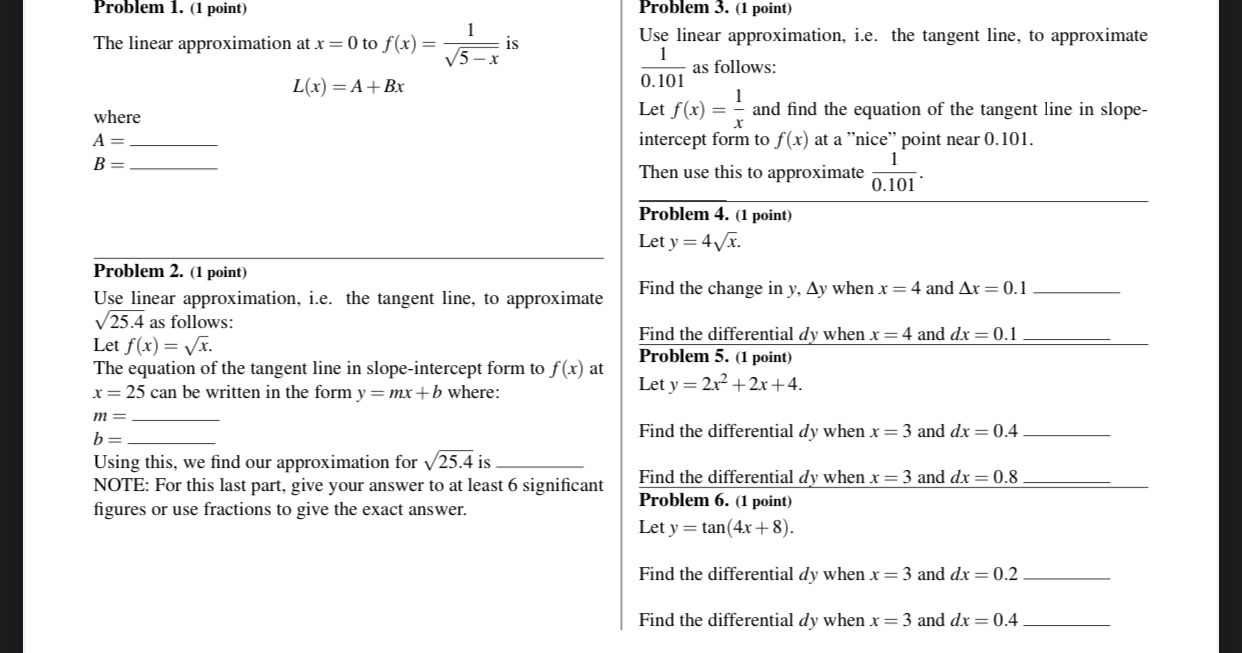
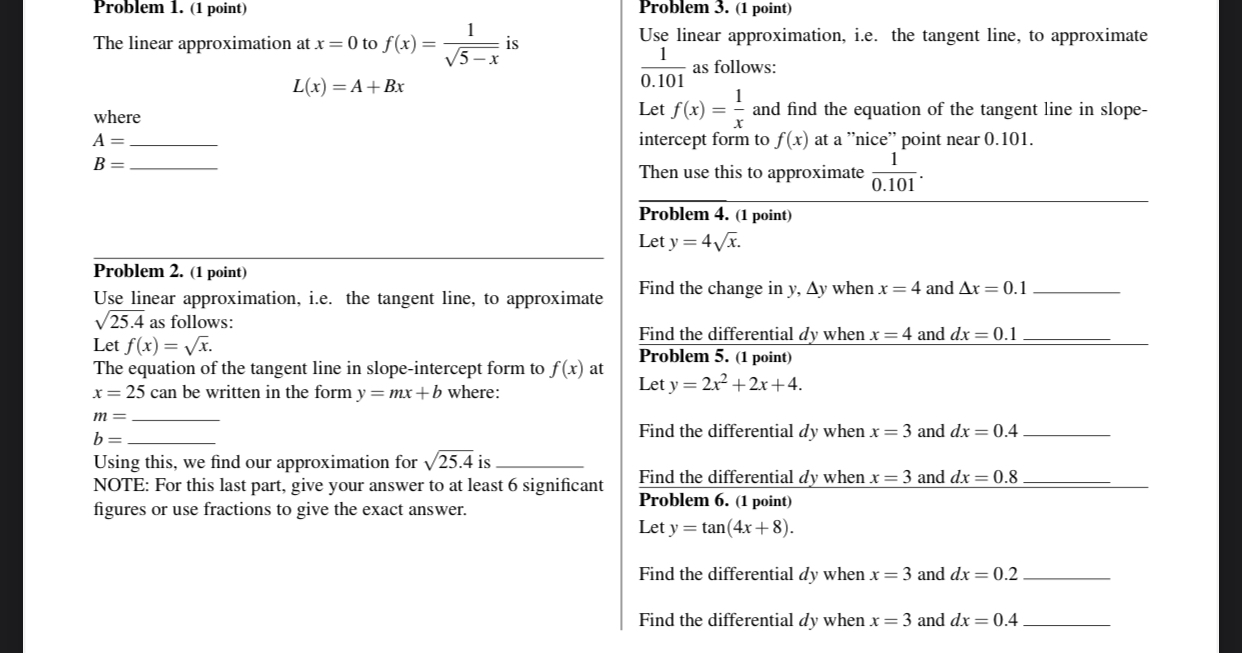
Problem 1. (1 point) Problem 3. (1 point) The linear approximation at x = 0 to f(x) = is Use linear approximation, i.e. the tangent line, to approximate V5-X 1 as follows: L(x) = A + Bx 0.101 where Let f(x) = - and find the equation of the tangent line in slope- A = intercept form to f(x) at a "nice" point near 0.101. B = Then use this to approximate 0.101 Problem 4. (1 point) Let y = 4Vx. Problem 2. (1 point) Use linear approximation, i.e. the tangent line, to approximate Find the change in y, Ay when x = 4 and Ax = 0.1 V25.4 as follows: Let f (x) = Vx. Find the differential dy when x = 4 and dx = 0.1 The equation of the tangent line in slope-intercept form to f (x) at Problem 5. (1 point) x = 25 can be written in the form y = mx + b where: Let y = 2x- + 2x +4. m = b = Find the differential dy when x = 3 and dx = 0.4 Using this, we find our approximation for v25.4 is NOTE: For this last part, give your answer to at least 6 significant Find the differential dy when x = 3 and dx = 0.8 figures or use fractions to give the exact answer. Problem 6. (1 point) Let y = tan(4x + 8). Find the differential dy when x = 3 and dx = 0.2 Find the differential dy when x = 3 and dx = 0.4
Step by Step Solution
There are 3 Steps involved in it

Get step-by-step solutions from verified subject matter experts
 Study Help