





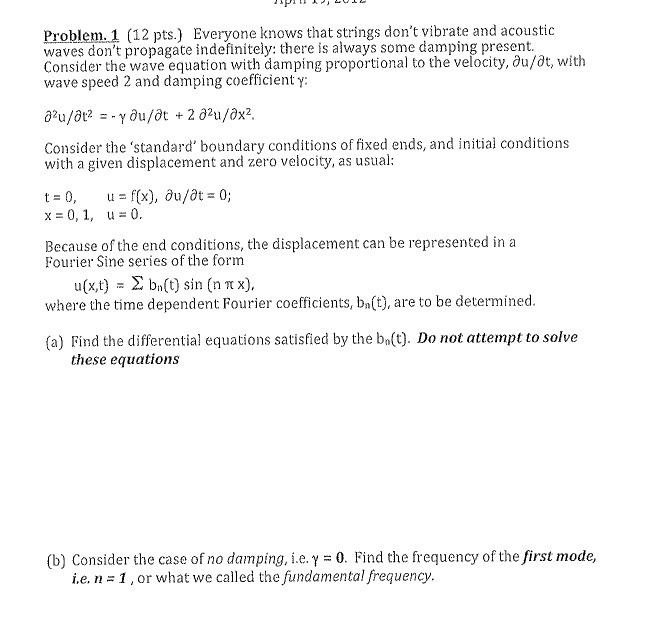
Question: Problem. 1 (12 pts.) Everyone knows that strings don't vibrate and acoustic waves don't propagate indefinitely: there is always some damping present. Consider the wave
Problem. 1 (12 pts.) Everyone knows that strings
Problem. 1 (12 pts.) Everyone knows that strings don't vibrate and acoustic waves don't propagate indefinitely: there is always some damping present. Consider the wave equation with damping proportional to the velocity, du/dt, with wave speed 2 and damping coefficient y: 020/at? = - you/at + 2 02u/dxz. Consider the 'standard' boundary conditions of fixed ends, and initial conditions with a given displacement and zero velocity, as usual: t=0, u = f(x), ou/at = 0; x =0, 1, u=0. Because of the end conditions, the displacement can be represented in a Fourier Sine series of the form u(x,t) = 2 bu(t) sin (nux). where the time dependent Fourier coefficients, ba(t), are to be determined. (a) Find the differential equations satisfied by the bo(t). Do not attempt to solve these equations (b) Consider the case of no damping, ie. y = 0. Find the frequency of the first mode, ie. n = 1 , or what we called the fundamental frequency

Step by Step Solution

There are 3 Steps involved in it

1 Expert Approved Answer
Step: 1 Unlock blur-text-image

Question Has Been Solved by an Expert!

Get step-by-step solutions from verified subject matter experts

Step: 2 Unlock
Step: 3 Unlock

Students Have Also Explored These Related Mathematics Questions!