





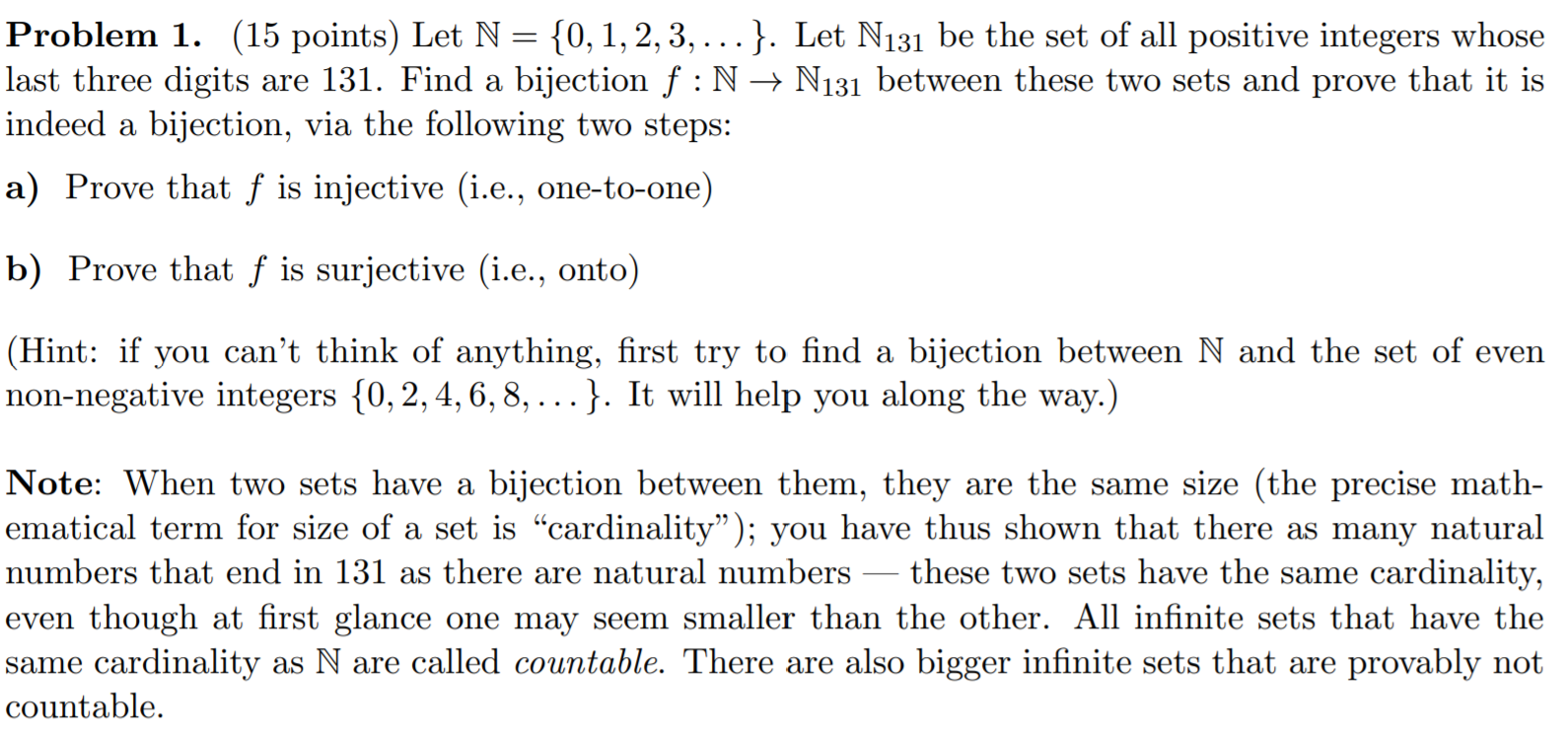
Question: Problem 1. (15 points) Let N = {0, 1, 2, 3, . . . }. Let N131 be the set of all positive integers whose
Problem 1. (15 points) Let N = {0, 1, 2, 3, . . .
Problem 1. (15 points) Let N = {0, 1, 2, 3, . . . }. Let N131 be the set of all positive integers whose last three digits are 131. Find a bijection f : N > N131 between these two sets and prove that it is indeed a bijection, via the following two steps: a) Prove that f is injective (i.e., one-toone) b) Prove that f is surjective (i.e., onto) (Hint: if you can't think of anything, rst try to nd a bijection between N and the set of even nonnegative integers {0, 2,4, 6, 8, . . . }. It will help you along the way.) Note: When two sets have a bijection between them, they are the same size (the precise math- ematical term for size of a set is \"cardinality\"); you have thus shown that there as many natural numbers that end in 131 as there are natural numbers these two sets have the same cardinality, even though at rst glance one may seem smaller than the other. All innite sets that have the same cardinality as N are called countable. There are also bigger innite sets that are provably not countable

Step by Step Solution

There are 3 Steps involved in it

1 Expert Approved Answer
Step: 1 Unlock blur-text-image

Question Has Been Solved by an Expert!

Get step-by-step solutions from verified subject matter experts

Step: 2 Unlock
Step: 3 Unlock

Students Have Also Explored These Related Mathematics Questions!