







Question: Problem 1 (16pts). Write a top-down depth-first parser with backtracking for the language (1) SaSbS (2) S bSaS (3) S Write your parser in Python.
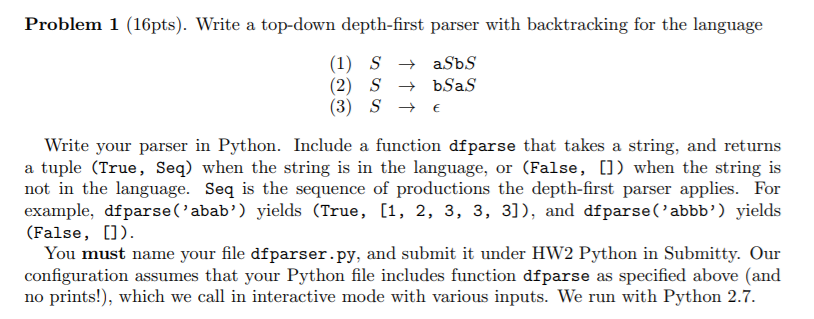
Problem 1 (16pts). Write a top-down depth-first parser with backtracking for the language (1) SaSbS (2) S bSaS (3) S Write your parser in Python. Include a function dfparse that takes a string, and returns a tuple (True, Seq) when the string is in the language, or (False, [) when the string is not in the language. Seq is the sequence of productions the depth-first parser applies. For example, dfparse ('abab') yields (True, [1, 2, 3, 3, 3]), and dfparse ('abbb') yields (False, ) You must name your file dfparser.py, and submit it under HW2 Python in Submitty. Our configuration assumes that your Python file includes function dfparse as specified above (and no prints!), which we call in interactive mode with various inputs. We run with Python 2.7. Problem 1 (16pts). Write a top-down depth-first parser with backtracking for the language (1) SaSbS (2) S bSaS (3) S Write your parser in Python. Include a function dfparse that takes a string, and returns a tuple (True, Seq) when the string is in the language, or (False, [) when the string is not in the language. Seq is the sequence of productions the depth-first parser applies. For example, dfparse ('abab') yields (True, [1, 2, 3, 3, 3]), and dfparse ('abbb') yields (False, ) You must name your file dfparser.py, and submit it under HW2 Python in Submitty. Our configuration assumes that your Python file includes function dfparse as specified above (and no prints!), which we call in interactive mode with various inputs. We run with Python 2.7
Step by Step Solution
There are 3 Steps involved in it

Get step-by-step solutions from verified subject matter experts
 Study Help