







Question: Problem 1. (20 points) Consider a database byffer manager that uses the algorithm explained in Section 13.5.1 of the textbook for a hard drive which
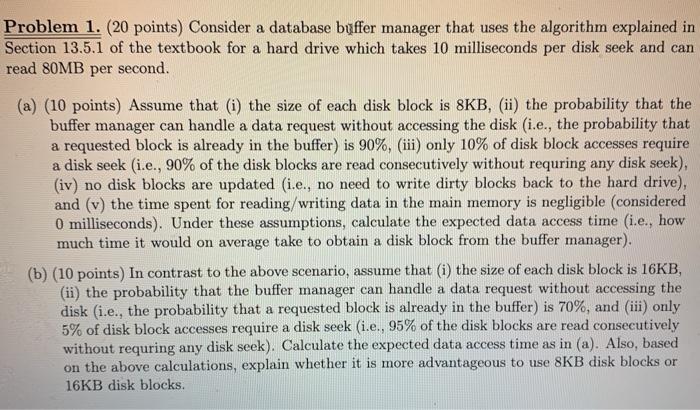
Problem 1. (20 points) Consider a database byffer manager that uses the algorithm explained in Section 13.5.1 of the textbook for a hard drive which takes 10 milliseconds per disk seek and can read 80MB per second. (a) (10 points) Assume that (i) the size of each disk block is 8KB, (ii) the probability that the buffer manager can handle a data request without accessing the disk (i.e., the probability that a requested block is already in the buffer) is 90%, (iii) only 10% of disk block accesses require a disk seek (i.e., 90% of the disk blocks are read consecutively without requring any disk seek), (iv) no disk blocks are updated (i.e., no need to write dirty blocks back to the hard drive), and (v) the time spent for reading/writing data in the main memory is negligible (considered 0 milliseconds). Under these assumptions, calculate the expected data access time (i.e., how much time it would on average take to obtain a disk block from the buffer manager). (b) (10 points) In contrast to the above scenario, assume that (i) the size of each disk block is 16KB, (ii) the probability that the buffer manager can handle a data request without accessing the disk (i.e., the probability that a requested block is already in the buffer) is 70%, and (iii) only 5% of disk block accesses require a disk seek (i.e., 95% of the disk blocks are read consecutively without requring any disk seek). Calculate the expected data access time as in (a). Also, based on the above calculations, explain whether it is more advantageous to use 8KB disk blocks or 16KB disk blocks
Step by Step Solution
There are 3 Steps involved in it

Get step-by-step solutions from verified subject matter experts
 Study Help