







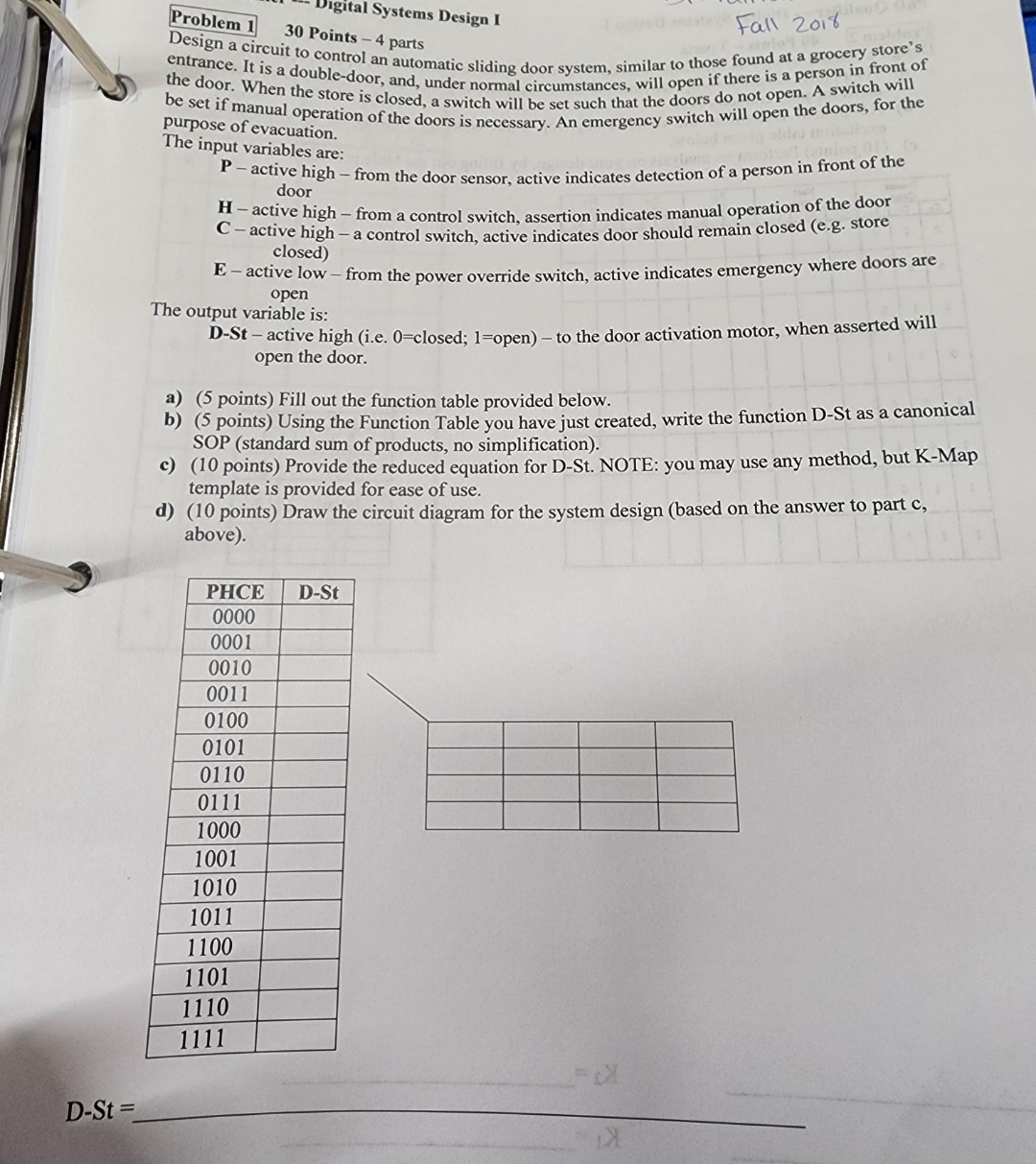
Question: Problem 1 , 3 0 Points - 4 parts Design a circuit to control an automatic sliding door system, similar to those found at a
Problem Points parts
Design a circuit to control an automatic sliding door system, similar to those found at a grocery store's entrance. It is a doubledoor, and, under normal circumstances, will open if there is a person in front of the door. When the store is closed, a switch will be set such that the doors do not open. A switch will be set if manual operation of the doors is necessary. An emergency switch will open the doors, for the purpose of evacuation.
The input variables are:
active high from the door sensor active indicates detection of a person in front of the door
active high from a control switch, assertion indicates manual operation of the door
C active high a control switch, active indicates door should remain closed eg store closed
active low from the power override switch, active indicates emergency where doors are open
The output variable is:
DSt active high ie closed; open to the door activation motor, when asserted will open the door.
a points Fill out the function table provided below.
b points Using the Function Table you have just created, write the function DSt as a canonical SOP standard sum of products, no simplification
c points Provide the reduced equation for DSt NOTE: you may use any method, but KMap template is provided for ease of use.
d points Draw the circuit diagram for the system design based on the answer to part c above
tablePHCEDSt
please include do not care conditions
Step by Step Solution
There are 3 Steps involved in it
1 Expert Approved Answer
Step: 1 Unlock

Question Has Been Solved by an Expert!
Get step-by-step solutions from verified subject matter experts
Step: 2 Unlock
Step: 3 Unlock
 Study Help