







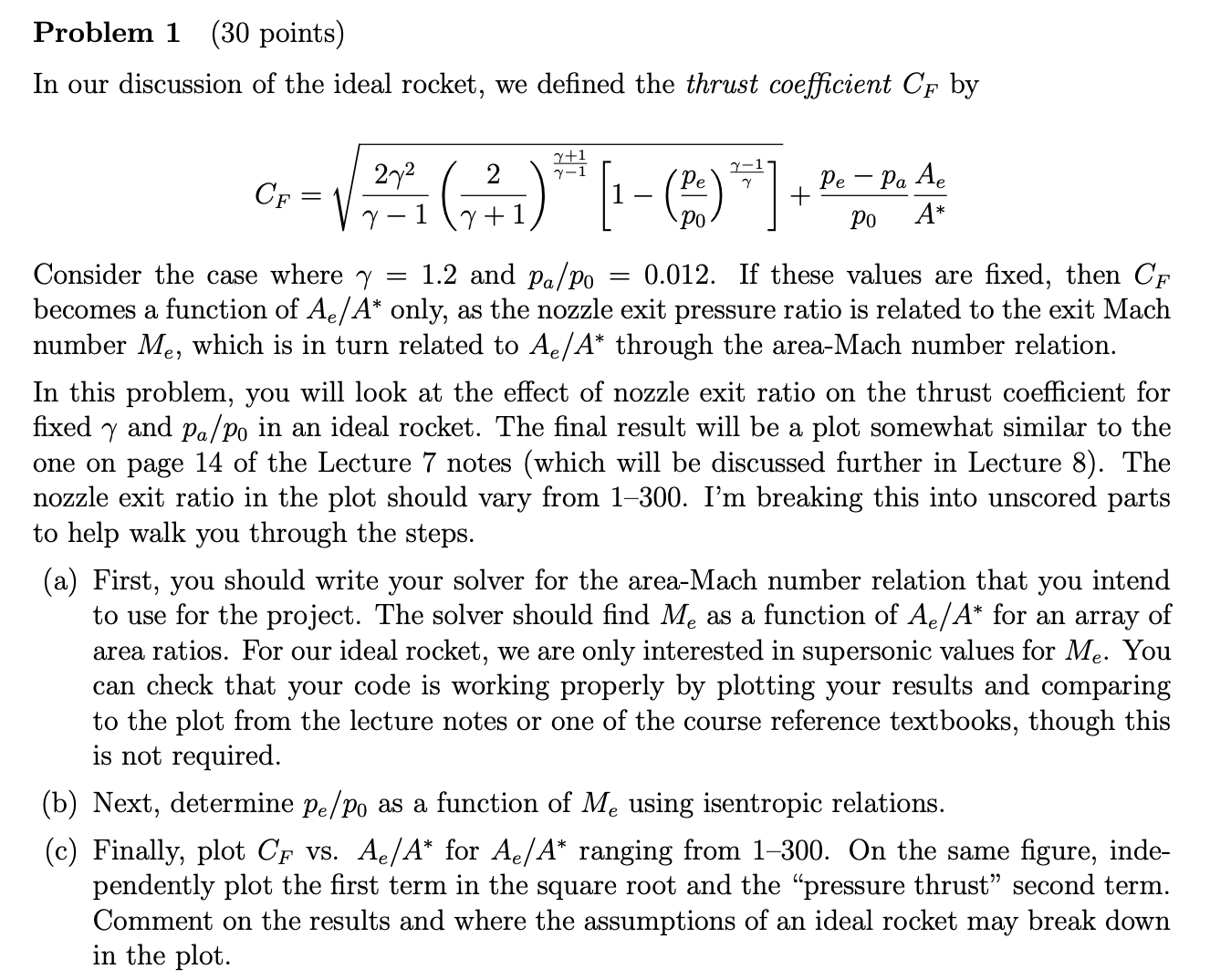
Question: Problem 1 ( 3 0 points ) In our discussion of the ideal rocket, we defined the thrust coefficient C F by C F =
Problem points
In our discussion of the ideal rocket, we defined the thrust coefficient by
Consider the case where and If these values are fixed, then
becomes a function of only, as the nozzle exit pressure ratio is related to the exit Mach
number which is in turn related to through the areaMach number relation.
In this problem, you will look at the effect of nozzle exit ratio on the thrust coefficient for
fixed and in an ideal rocket. The final result will be a plot somewhat similar to the
one on page of the Lecture notes which will be discussed further in Lecture The
nozzle exit ratio in the plot should vary from Im breaking this into unscored parts
to help walk you through the steps.
a First, you should write your solver for the areaMach number relation that you intend
to use for the project. The solver should find as a function of for an array of
area ratios. For our ideal rocket, we are only interested in supersonic values for You
can check that your code is working properly by plotting your results and comparing
to the plot from the lecture notes or one of the course reference textbooks, though this
is not required.
b Next, determine as a function of using isentropic relations.
c Finally, plot vs for ranging from On the same figure, inde
pendently plot the first term in the square root and the "pressure thrust" second term.
Comment on the results and where the assumptions of an ideal rocket may break down
in the plot.
Step by Step Solution
There are 3 Steps involved in it
1 Expert Approved Answer
Step: 1 Unlock

Question Has Been Solved by an Expert!
Get step-by-step solutions from verified subject matter experts
Step: 2 Unlock
Step: 3 Unlock
 Study Help