







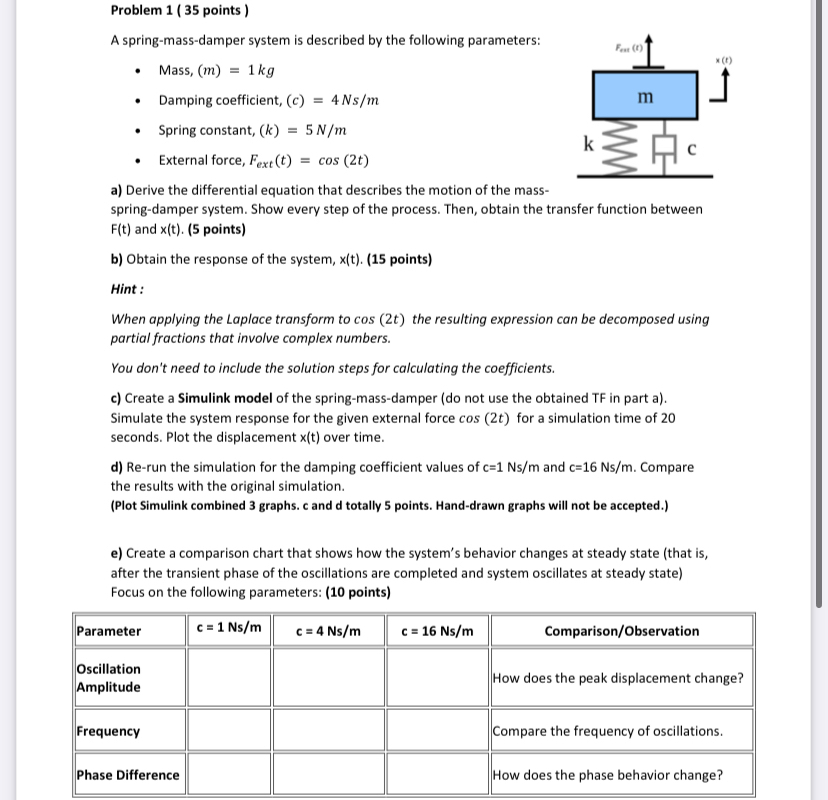
Question: Problem 1 ( 3 5 points ) A spring - mass - damper system is described by the following parameters: Mass, ( m ) =
Problem points
A springmassdamper system is described by the following parameters:
Mass,
Damping coefficient,
Spring constant,
External force,
a Derive the differential equation that describes the motion of the massspringdamper system. Show every step of the process. Then, obtain the transfer function between and points
b Obtain the response of the system, points
Hint :
When applying the Laplace transform to the resulting expression can be decomposed using partial fractions that involve complex numbers.
You don't need to include the solution steps for calculating the coefficients.
c Create a Simulink model of the springmassdamper do not use the obtained TF in part a Simulate the system response for the given external force for a simulation time of seconds. Plot the displacement over time.
d Rerun the simulation for the damping coefficient values of and Compare the results with the original simulation.
Plot Simulink combined graphs. and d totally points. Handdrawn graphs will not be accepted.
e Create a comparison chart that shows how the system's behavior changes at steady state that is after the transient phase of the oscillations are completed and system oscillates at steady state Focus on the following parameters: points
tableParameterComparisonObservationOscillationHow does the peak displacement change?AmplitudeCompare the frequency of oscillations.FrequencyHow does the phase behavior change?Phase Difference,,,,
Step by Step Solution
There are 3 Steps involved in it
1 Expert Approved Answer
Step: 1 Unlock

Question Has Been Solved by an Expert!
Get step-by-step solutions from verified subject matter experts
Step: 2 Unlock
Step: 3 Unlock
 Study Help