







Question: Problem #1 (30 marks) A general contractor in the energy sector is considering a long-term Build-Operate-Transfer investment option for building an electricity generating powerplant project
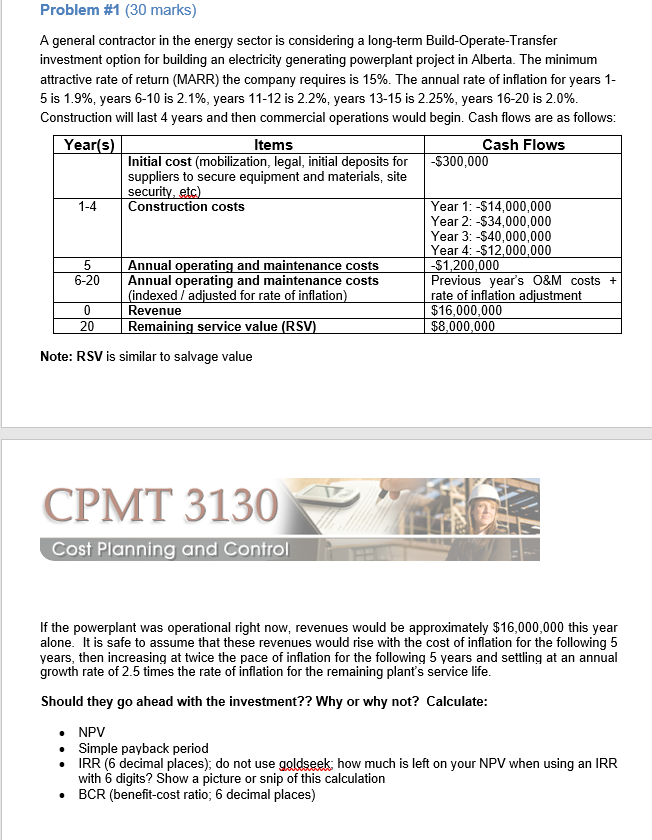
Problem #1 (30 marks) A general contractor in the energy sector is considering a long-term Build-Operate-Transfer investment option for building an electricity generating powerplant project in Alberta. The minimum attractive rate of return (MARR) the company requires is 15%. The annual rate of inflation for years 1- 5 is 1.9%, years 6-10 is 2.1%, years 11-12 is 2.2%, years 13-15 is 2.25%, years 16-20 is 2.0%. Construction will last 4 years and then commercial operations would begin. Cash flows are as follows: Year(s) Items Cash Flows Initial cost (mobilization, legal, initial deposits for -$300,000 suppliers to secure equipment and materials, site security, etc.) 1-4 Construction costs Year 1: -$14,000,000 Year 2: -$34,000,000 Year 3: -$40,000,000 Year 4: -$12,000,000 Annual operating and maintenance costs $1,200,000 6-20 Annual operating and maintenance costs Previous year's O&M costs + (indexed / adjusted for rate of inflation) rate of inflation adjustment Revenue $16,000,000 20 Remaining service value (RSV) $8,000,000 5 0 Note: RSV is similar to salvage value CPMT 3130 Cost Planning and Control If the powerplant was operational right now, revenues would be approximately $16,000,000 this year alone. It is safe to assume that these revenues would rise with the cost of inflation for the following 5 years, then increasing at twice the pace of inflation for the following 5 years and settling at an annual growth rate of 2.5 times the rate of inflation for the remaining plant's service life. Should they go ahead with the investment?? Why or why not? Calculate: NPV Simple payback period IRR (6 decimal places); do not use goldseek; how much is left on your NPV when using an IRR with 6 digits? Show a picture or snip of this calculation BCR (benefit-cost ratio, 6 decimal places) Problem #1 (30 marks) A general contractor in the energy sector is considering a long-term Build-Operate-Transfer investment option for building an electricity generating powerplant project in Alberta. The minimum attractive rate of return (MARR) the company requires is 15%. The annual rate of inflation for years 1- 5 is 1.9%, years 6-10 is 2.1%, years 11-12 is 2.2%, years 13-15 is 2.25%, years 16-20 is 2.0%. Construction will last 4 years and then commercial operations would begin. Cash flows are as follows: Year(s) Items Cash Flows Initial cost (mobilization, legal, initial deposits for -$300,000 suppliers to secure equipment and materials, site security, etc.) 1-4 Construction costs Year 1: -$14,000,000 Year 2: -$34,000,000 Year 3: -$40,000,000 Year 4: -$12,000,000 Annual operating and maintenance costs $1,200,000 6-20 Annual operating and maintenance costs Previous year's O&M costs + (indexed / adjusted for rate of inflation) rate of inflation adjustment Revenue $16,000,000 20 Remaining service value (RSV) $8,000,000 5 0 Note: RSV is similar to salvage value CPMT 3130 Cost Planning and Control If the powerplant was operational right now, revenues would be approximately $16,000,000 this year alone. It is safe to assume that these revenues would rise with the cost of inflation for the following 5 years, then increasing at twice the pace of inflation for the following 5 years and settling at an annual growth rate of 2.5 times the rate of inflation for the remaining plant's service life. Should they go ahead with the investment?? Why or why not? Calculate: NPV Simple payback period IRR (6 decimal places); do not use goldseek; how much is left on your NPV when using an IRR with 6 digits? Show a picture or snip of this calculation BCR (benefit-cost ratio, 6 decimal places)
Step by Step Solution
There are 3 Steps involved in it

Get step-by-step solutions from verified subject matter experts
 Study Help