





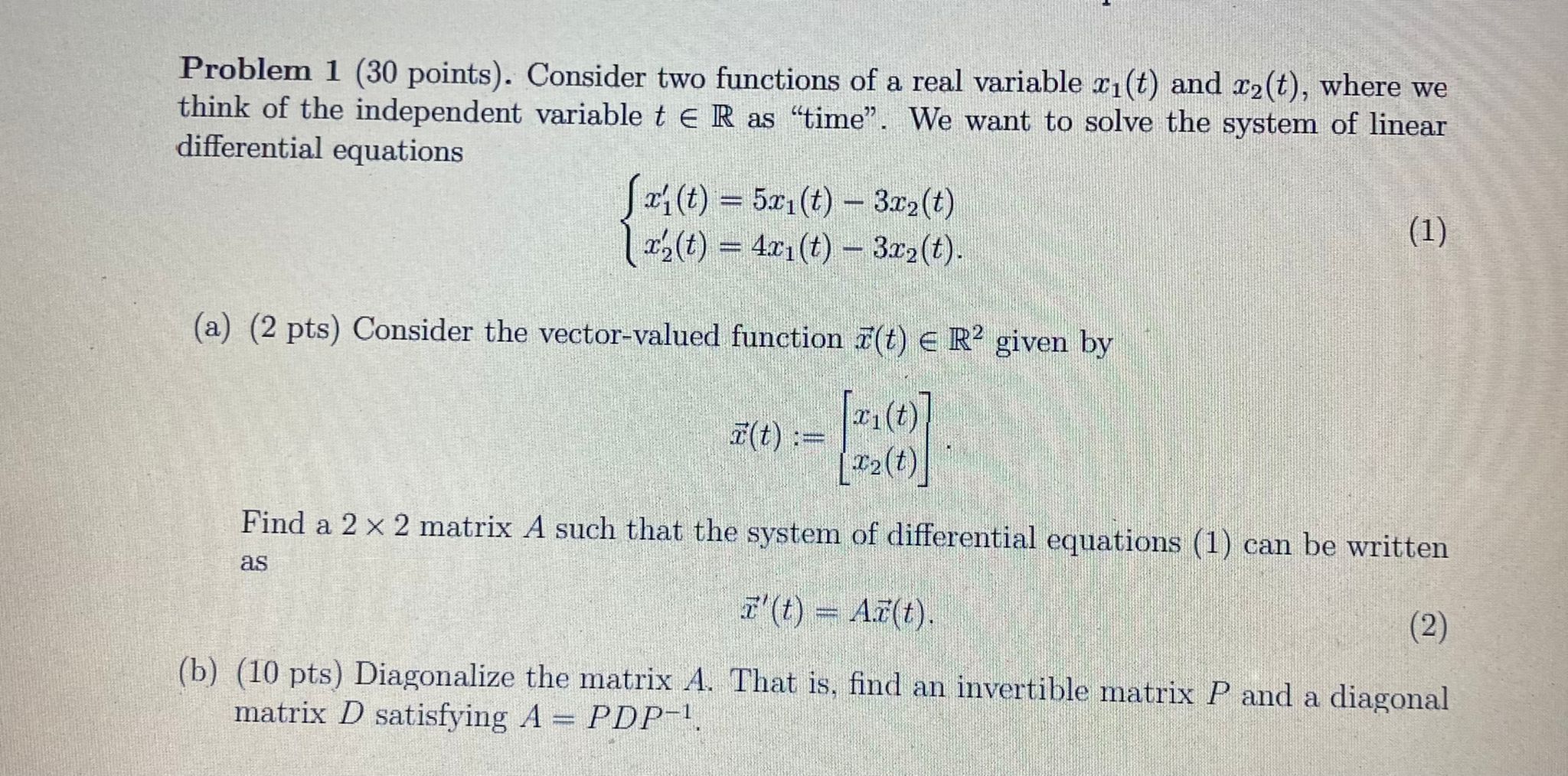
Question: Problem 1 (30 points). Consider two functions of a real variable ri(t) and 12(t), where we think of the independent variable t E R as
Problem 1 (30 points). Consider two functions ofProblem 1 (30 points). Consider two functions of
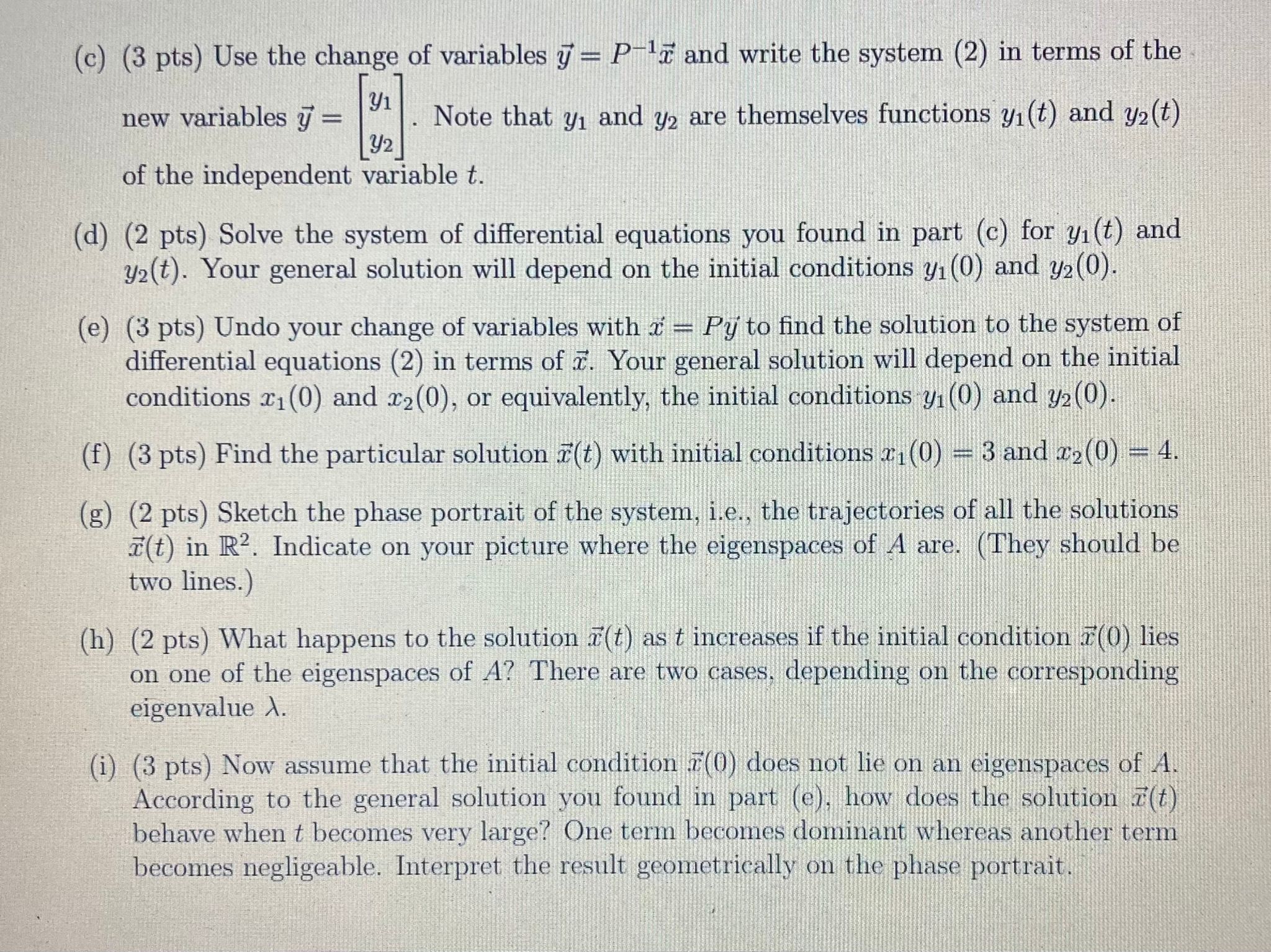
Problem 1 (30 points). Consider two functions of a real variable ri(t) and 12(t), where we think of the independent variable t E R as "time". We want to solve the system of linear differential equations JI,(t) - 5x1(t) - 312(t) 12 (t) = 41 (t) - 3x2(t). (1) (a) (2 pts) Consider the vector-valued function r(t) E R given by i(t) := 1 (t) 12 (t) Find a 2 x 2 matrix A such that the system of differential equations (1) can be written as I'(t) = AT(t). (2) (b) (10 pts) Diagonalize the matrix A. That is, find an invertible matrix P and a diagonal matrix D satisfying A = PDP-1.(c) (3 pts) Use the change of variables y = P T and write the system (2) in terms of the new variables y = y1 Note that y1 and yz are themselves functions y1(t) and y2(t) y2 of the independent variable t. (d) (2 pts) Solve the system of differential equations you found in part (c) for y1 (t) and y2(t). Your general solution will depend on the initial conditions y1 (0) and y2(0). (e) (3 pts) Undo your change of variables with z - Py to find the solution to the system of differential equations (2) in terms of T. Your general solution will depend on the initial conditions x1(0) and 12(0), or equivalently, the initial conditions y1 (0) and y2 (0). (f) (3 pts) Find the particular solution r(t) with initial conditions z, (0) - 3 and r2(0) = 4. (g) (2 pts) Sketch the phase portrait of the system, i.e., the trajectories of all the solutions I(t) in R2. Indicate on your picture where the eigenspaces of A are. (They should be two lines.) (h) (2 pts) What happens to the solution I(t) as t increases if the initial condition F(0) lies on one of the eigenspaces of A? There are two cases, depending on the corresponding eigenvalue A. (i) (3 pts) Now assume that the initial condition T(0) does not lie on an eigenspaces of A. According to the general solution you found in part (e), how does the solution i(t) behave when t becomes very large? One term becomes dominant whereas another term becomes negligeable. Interpret the result geometrically on the phase portrait

Step by Step Solution

There are 3 Steps involved in it

1 Expert Approved Answer
Step: 1 Unlock blur-text-image
Question Has Been Solved by an Expert!

Get step-by-step solutions from verified subject matter experts

Step: 2 Unlock
Step: 3 Unlock

Students Have Also Explored These Related Mathematics Questions!