







Question: Problem 1 [30 pts) An aqueous stream containing a reactive component A starts to flow in a circular pipe with a constant cross sectional area.
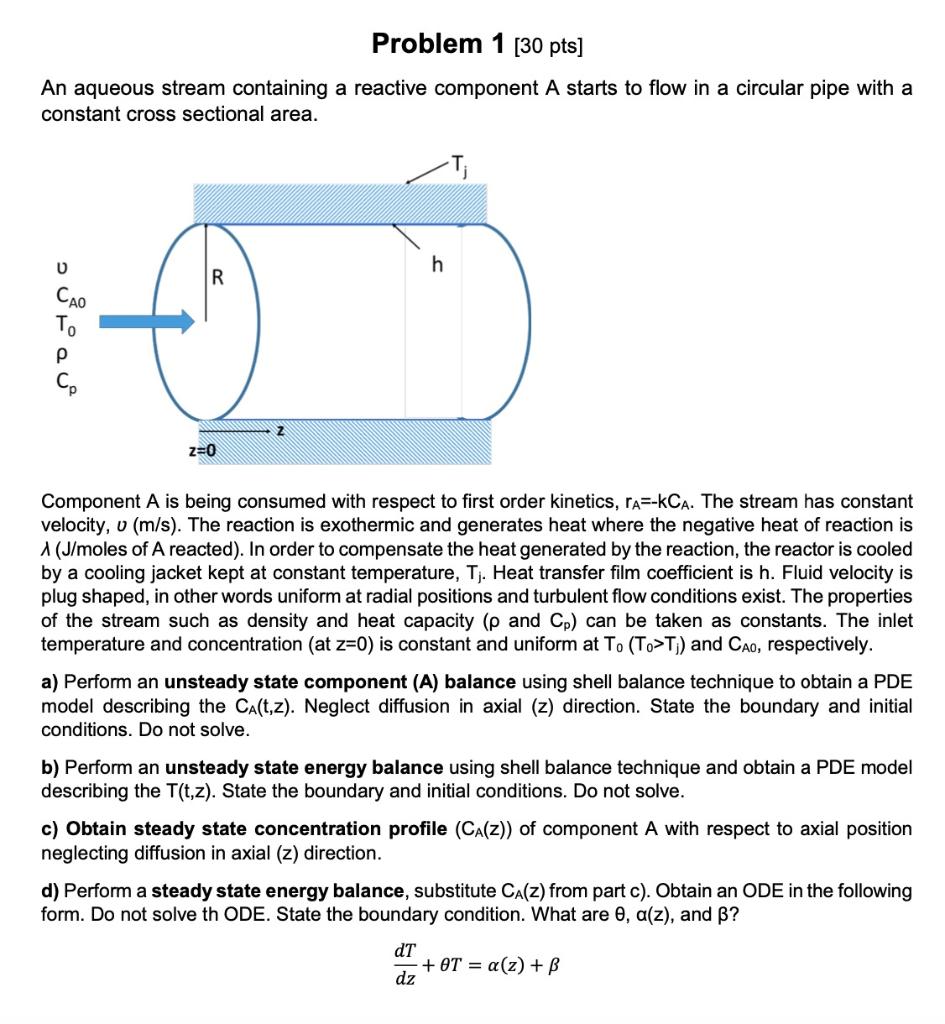
Problem 1 [30 pts) An aqueous stream containing a reactive component A starts to flow in a circular pipe with a constant cross sectional area. h R Z z=0 Component A is being consumed with respect to first order kinetics, ra=-kCA. The stream has constant velocity, u (m/s). The reaction is exothermic and generates heat where the negative heat of reaction is (J/moles of A reacted). In order to compensate the heat generated by the reaction, the reactor is cooled by a cooling jacket kept at constant temperature, Tj. Heat transfer film coefficient is h. Fluid velocity is plug shaped, in other words uniform at radial positions and turbulent flow conditions exist. The properties of the stream such as density and heat capacity (p and Cp) can be taken as constants. The inlet temperature and concentration (at z=0) is constant and uniform at To (To>T) and Cao, respectively. a) Perform an unsteady state component (A) balance using shell balance technique to obtain a PDE model describing the Cat,z). Neglect diffusion in axial (z) direction. State the boundary and initial conditions. Do not solve. b) Perform an unsteady state energy balance using shell balance technique and obtain a PDE model describing the T(tz). State the boundary and initial conditions. Do not solve. c) Obtain steady state concentration profile (CA(z)) of component A with respect to axial position neglecting diffusion in axial (z) direction. d) Perform a steady state energy balance, substitute CA(z) from partc). Obtain an ODE in the following form. Do not solve th ODE. State the boundary condition. What are o, a(z), and B? d + OT = a(z) + B dz
Step by Step Solution
There are 3 Steps involved in it

Get step-by-step solutions from verified subject matter experts
 Study Help