







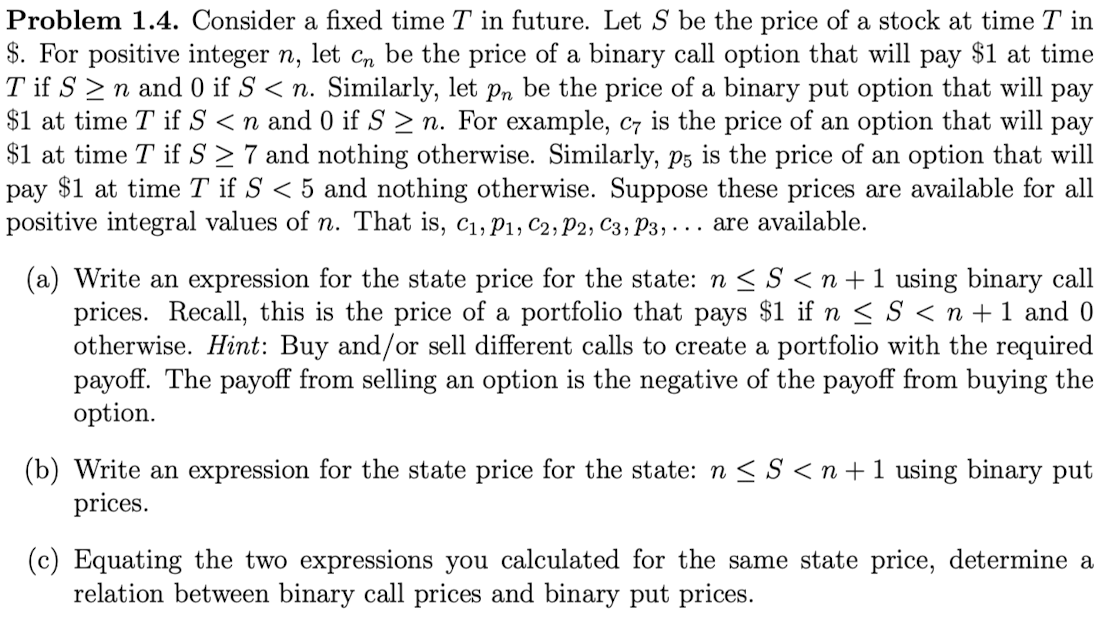
Question: Problem 1 . 4 . Consider a fixed time T in future. Let S be the price of a stock at time T in $
Problem Consider a fixed time in future. Let be the price of a stock at time in
$ For positive integer let be the price of a binary call option that will pay $ at time
if and if $$$dots$ using binary put
prices.
Equating the two expressions you calculated for the same state price, determine
relation between binary call prices and binary put prices. and
otherwise. Hint: Buy sell different calls create a portfolio with the required
payoff. The payoff from selling option the negative the payoff from buying the
option.
Write expression for the state price for the state: using binary put
prices.
Equating the two expressions you calculated for the same state price, determine
relation between binary call prices and binary put prices. using binary call
prices. Recall, this the price a portfolio that pays $ and
otherwise. Hint: Buy sell different calls create a portfolio with the required
payoff. The payoff from selling option the negative the payoff from buying the
option.
Write expression for the state price for the state: using binary put
prices.
Equating the two expressions you calculated for the same state price, determine
relation between binary call prices and binary put prices. and For example, the price option that will pay
$ time and nothing otherwise. Similarly, the price option that will
pay $ time and nothing otherwise. Suppose these prices are available for all
positive integral values That dots are available.
Write expression for the state price for the state: using binary call
prices. Recall, this the price a portfolio that pays $ and
otherwise. Hint: Buy sell different calls create a portfolio with the required
payoff. The payoff from selling option the negative the payoff from buying the
option.
Write expression for the state price for the state: using binary put
prices.
Equating the two expressions you calculated for the same state price, determine
relation between binary call prices and binary put prices. Similarly, let the price a binary put option that will pay
$ time and For example, the price option that will pay
$ time and nothing otherwise. Similarly, the price option that will
pay $ time and nothing otherwise. Suppose these prices are available for all
positive integral values That dots are available.
Write expression for the state price for the state: using binary call
prices. Recall, this the price a portfolio that pays $ and
otherwise. Hint: Buy sell different calls create a portfolio with the required
payoff. The payoff from selling option the negative the payoff from buying the
option.
Write expression for the state price for the state: using binary put
prices.
Equating the two expressions you calculated for the same state price, determine
relation between binary call prices and binary put prices.
Step by Step Solution
There are 3 Steps involved in it
1 Expert Approved Answer
Step: 1 Unlock

Question Has Been Solved by an Expert!
Get step-by-step solutions from verified subject matter experts
Step: 2 Unlock
Step: 3 Unlock
 Study Help