







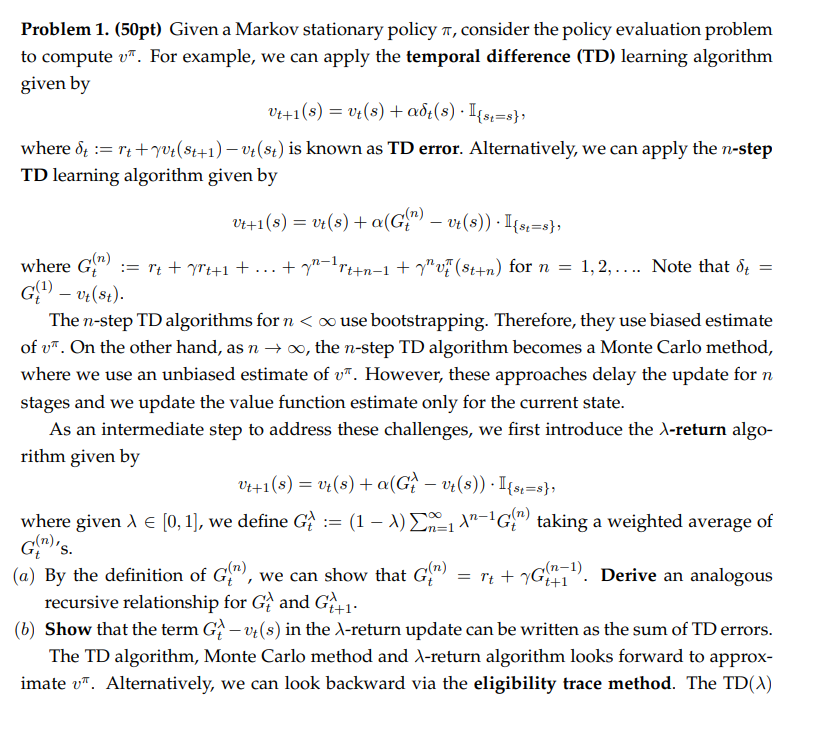
Question: Problem 1 . ( 5 0 pt ) Given a Markov stationary policy , consider the policy evaluation problem to compute v . For example,
Problem pt Given a Markov stationary policy consider the policy evaluation problem
to compute For example, we can apply the temporal difference TD learning algorithm
given by
where : is known as TD error. Alternatively, we can apply the step
TD learning algorithm given by
where :dots for dots. Note that
The step TD algorithms for use bootstrapping. Therefore, they use biased estimate
of On the other hand, as the step TD algorithm becomes a Monte Carlo method,
where we use an unbiased estimate of However, these approaches delay the update for
stages and we update the value function estimate only for the current state.
As an intermediate step to address these challenges, we first introduce the return algo
rithm given by
where given we define : taking a weighted average of
s
a By the definition of we can show that Derive an analogous
recursive relationship for and
b Show that the term in the return update can be written as the sum of TD errors.
The TD algorithm, Monte Carlo method and return algorithm looks forward to approx
imate Alternatively, we can look backward via the eligibility trace method. TheTD
Step by Step Solution
There are 3 Steps involved in it
1 Expert Approved Answer
Step: 1 Unlock

Question Has Been Solved by an Expert!
Get step-by-step solutions from verified subject matter experts
Step: 2 Unlock
Step: 3 Unlock
 Study Help