







Question: Problem 1 (50 Points): Consider the following IP problem: minimize = 71 + 62 + 63 + 54 + 10001 + 8002 + 7003 +
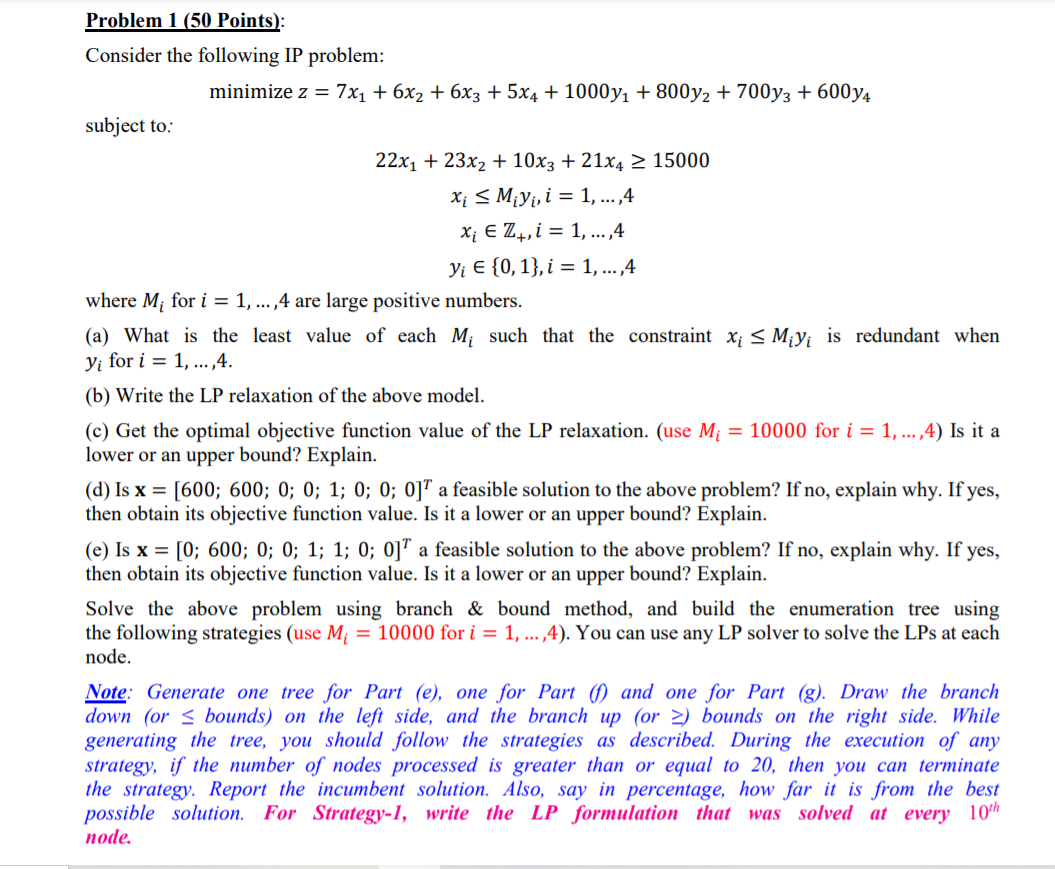
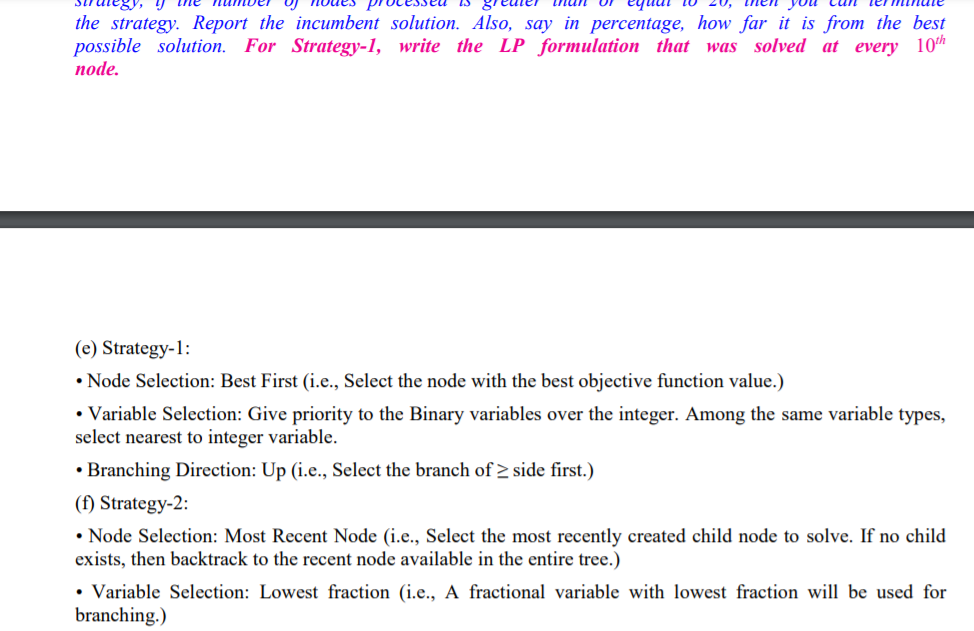 Problem 1 (50 Points): Consider the following IP problem: minimize = 71 + 62 + 63 + 54 + 10001 + 8002 + 7003 + 6004 subject to: 221 + 232 + 103 + 214 15000 , = 1, ,4 +, = 1, ,4 {0, 1}, = 1, ,4 where for = 1, ,4 are large positive numbers. (a) What is the least value of each such that the constraint is redundant when for = 1, ,4. (b) Write the LP relaxation of the above model. (c) Get the optimal objective function value of the LP relaxation. (use = 10000 for = 1, ,4) Is it a lower or an upper bound? Explain. (d) Is = [600; 600; 0; 0; 1; 0; 0; 0] a feasible solution to the above problem? If no, explain why. If yes, then obtain its objective function value. Is it a lower or an upper bound? Explain. (e) Is = [0; 600; 0; 0; 1; 1; 0; 0] a feasible solution to the above problem? If no, explain why. If yes, then obtain its objective function value. Is it a lower or an upper bound? Explain. Solve the above problem using branch & bound method, and build the enumeration tree using the following strategies (use = 10000 for = 1, ,4). You can use any LP solver to solve the LPs at each node. Note: Generate one tree for Part (e), one for Part (f) and one for Part (g). Draw the branch down (or bounds) on the left side, and the branch up (or ) bounds on the right side. While generating the tree, you should follow the strategies as described. During the execution of any strategy, if the number of nodes processed is greater than or equal to 20, then you can terminate the strategy. Report the incumbent solution. Also, say in percentage, how far it is from the best possible solution. For Strategy-1, write the LP formulation that was solved at every 10th node. (e) Strategy-1: Node Selection: Best First (i.e., Select the node with the best objective function value.) Variable Selection: Give priority to the Binary variables over the integer. Among the same variable types, select nearest to integer variable. Branching Direction: Up (i.e., Select the branch of side first.) (f) Strategy-2: Node Selection: Most Recent Node (i.e., Select the most recently created child node to solve. If no child exists, then backtrack to the recent node available in the entire tree.) Variable Selection: Lowest fraction (i.e., A fractional variable with lowest fraction will be used for branching.) Branching Direction: Down (i.e., Select the branch of side first.) (g) Strategy-3: Node Selection: Breadth First the Best Next (i.e., All nodes at one level of the search tree are processed before any node at a deeper level. In a given level, best node should be processed first.) Variable Selection: Highest fraction (i.e., A fractional variable with highest fraction will be used for branching.) Branching Direction: You are free to pick any rule.
Problem 1 (50 Points): Consider the following IP problem: minimize z = 7x1 + 6x2 + 6x3 + 5x4 + 1000y + 800y2 + 700y3 + 60074 subject to: 22x1 + 23x2 + 10x3 + 21x4 > 15000 Xi Miyi, i = 1,...,4 Xi E Z+, i = 1, ...,4 Yi E {0,1}, i = 1, ... ,4 where M; for i = 1, ... ,4 are large positive numbers. (a) What is the least value of each M such that the constraint Xi Miyi is redundant when Yi for i = 1, ...,4. (b) Write the LP relaxation of the above model. (c) Get the optimal objective function value of the LP relaxation. (use Mi = 10000 for i = 1, ...,4) Is it a lower or an upper bound? Explain. (d) Is x = [600; 600; 0; 0; 1; 0; 0; 0]" a feasible solution to the above problem? If no, explain why. If yes, then obtain its objective function value. Is it a lower or an upper bound? Explain. (e) Is x = [0; 600; 0; 0; 1; 1; 0; 0]" a feasible solution to the above problem? If no, explain why. If yes, then obtain its objective function value. Is it a lower or an upper bound? Explain. Solve the above problem using branch & bound method, and build the enumeration tree using the following strategies (use Mi = 10000 for i = 1, ... ,4). You can use any LP solver to solve the LPs at each node. Note: Generate one tree for Part (e), one for Part and one for Part (g). Draw the branch down (or = bounds) on the left side, and the branch up (or >) bounds on the right side. While generating the tree, you should follow the strategies as described. During the execution of any strategy, if the number of nodes processed is greater than or equal to 20, then you can terminate the strategy. Report the incumbent solution. Also, say in percentage, how far it is from the best possible solution. For Strategy-1, write the LP formulation that was solved at every 10h node. equur the strategy. Report the incumbent solution. Also, say in percentage, how far it is from the best possible solution. For Strategy-1, write the LP formulation that was solved at every 10th node. (e) Strategy-1: Node Selection: Best First (i.e., Select the node with the best objective function value.) Variable Selection: Give priority to the Binary variables over the integer. Among the same variable types, select nearest to integer variable. Branching Direction: Up (i.e., Select the branch of side first.) (f) Strategy-2: Node Selection: Most Recent Node (i.e., Select the most recently created child node to solve. If no child exists, then backtrack to the recent node available in the entire tree.) Variable Selection: Lowest fraction (i.e., A fractional variable with lowest fraction will be used for branching.) Problem 1 (50 Points): Consider the following IP problem: minimize z = 7x1 + 6x2 + 6x3 + 5x4 + 1000y + 800y2 + 700y3 + 60074 subject to: 22x1 + 23x2 + 10x3 + 21x4 > 15000 Xi Miyi, i = 1,...,4 Xi E Z+, i = 1, ...,4 Yi E {0,1}, i = 1, ... ,4 where M; for i = 1, ... ,4 are large positive numbers. (a) What is the least value of each M such that the constraint Xi Miyi is redundant when Yi for i = 1, ...,4. (b) Write the LP relaxation of the above model. (c) Get the optimal objective function value of the LP relaxation. (use Mi = 10000 for i = 1, ...,4) Is it a lower or an upper bound? Explain. (d) Is x = [600; 600; 0; 0; 1; 0; 0; 0]" a feasible solution to the above problem? If no, explain why. If yes, then obtain its objective function value. Is it a lower or an upper bound? Explain. (e) Is x = [0; 600; 0; 0; 1; 1; 0; 0]" a feasible solution to the above problem? If no, explain why. If yes, then obtain its objective function value. Is it a lower or an upper bound? Explain. Solve the above problem using branch & bound method, and build the enumeration tree using the following strategies (use Mi = 10000 for i = 1, ... ,4). You can use any LP solver to solve the LPs at each node. Note: Generate one tree for Part (e), one for Part and one for Part (g). Draw the branch down (or = bounds) on the left side, and the branch up (or >) bounds on the right side. While generating the tree, you should follow the strategies as described. During the execution of any strategy, if the number of nodes processed is greater than or equal to 20, then you can terminate the strategy. Report the incumbent solution. Also, say in percentage, how far it is from the best possible solution. For Strategy-1, write the LP formulation that was solved at every 10h node. equur the strategy. Report the incumbent solution. Also, say in percentage, how far it is from the best possible solution. For Strategy-1, write the LP formulation that was solved at every 10th node. (e) Strategy-1: Node Selection: Best First (i.e., Select the node with the best objective function value.) Variable Selection: Give priority to the Binary variables over the integer. Among the same variable types, select nearest to integer variable. Branching Direction: Up (i.e., Select the branch of side first.) (f) Strategy-2: Node Selection: Most Recent Node (i.e., Select the most recently created child node to solve. If no child exists, then backtrack to the recent node available in the entire tree.) Variable Selection: Lowest fraction (i.e., A fractional variable with lowest fraction will be used for branching.)
Step by Step Solution
There are 3 Steps involved in it

Get step-by-step solutions from verified subject matter experts
 Study Help