







Question: Problem 1 (50 points): The Heckscher-Ohlin Model Consider two countries, Home and Foreign (), each with two sectors, agriculture (A) and industry (I) using two
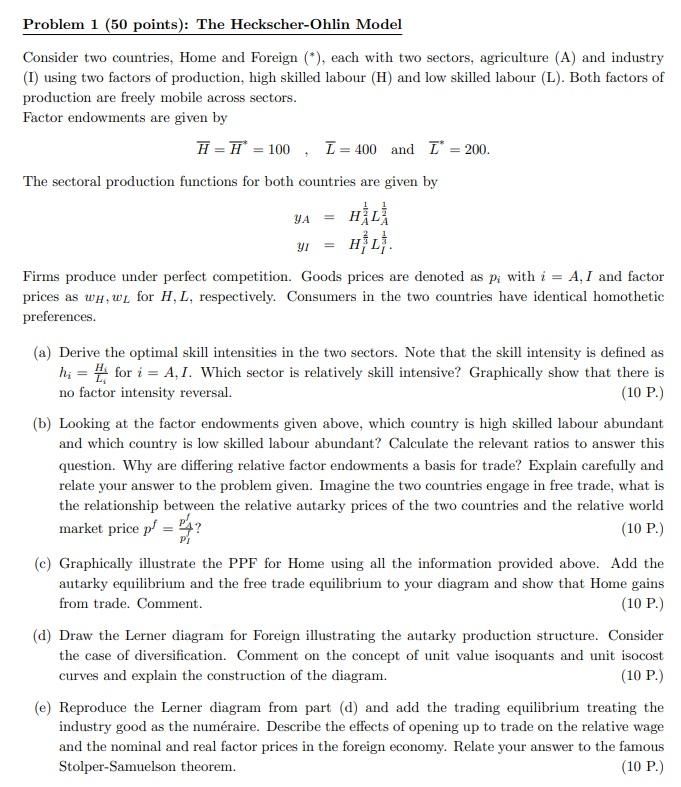
Problem 1 (50 points): The Heckscher-Ohlin Model Consider two countries, Home and Foreign (), each with two sectors, agriculture (A) and industry (I) using two factors of production, high skilled labour (H) and low skilled labour (L). Both factors of production are freely mobile across sectors. Factor endowments are given by H=H=100,L=400andL=200. The sectoral production functions for both countries are given by yAyI=HA21LA21=HI32LI31. Firms produce under perfect competition. Goods prices are denoted as pi with i=A,I and factor prices as wH,wL for H,L, respectively. Consumers in the two countries have identical homothetic preferences. (a) Derive the optimal skill intensities in the two sectors. Note that the skill intensity is defined as hi=LiHi for i=A,I. Which sector is relatively skill intensive? Graphically show that there is no factor intensity reversal. (10 P.) (b) Looking at the factor endowments given above, which country is high skilled labour abundant and which country is low skilled labour abundant? Calculate the relevant ratios to answer this question. Why are differing relative factor endowments a basis for trade? Explain carefully and relate your answer to the problem given. Imagine the two countries engage in free trade, what is the relationship between the relative autarky prices of the two countries and the relative world market price pf=pIpAf ? (10 P.) (c) Graphically illustrate the PPF for Home using all the information provided above. Add the autarky equilibrium and the free trade equilibrium to your diagram and show that Home gains from trade. Comment. (10 P.) (d) Draw the Lerner diagram for Foreign illustrating the autarky production structure. Consider the case of diversification. Comment on the concept of unit value isoquants and unit isocost curves and explain the construction of the diagram. (10 P.) (e) Reproduce the Lerner diagram from part (d) and add the trading equilibrium treating the industry good as the numraire. Describe the effects of opening up to trade on the relative wage and the nominal and real factor prices in the foreign economy. Relate your answer to the famous Stolper-Samuelson theorem. (10 P.) Problem 1 (50 points): The Heckscher-Ohlin Model Consider two countries, Home and Foreign (), each with two sectors, agriculture (A) and industry (I) using two factors of production, high skilled labour (H) and low skilled labour (L). Both factors of production are freely mobile across sectors. Factor endowments are given by H=H=100,L=400andL=200. The sectoral production functions for both countries are given by yAyI=HA21LA21=HI32LI31. Firms produce under perfect competition. Goods prices are denoted as pi with i=A,I and factor prices as wH,wL for H,L, respectively. Consumers in the two countries have identical homothetic preferences. (a) Derive the optimal skill intensities in the two sectors. Note that the skill intensity is defined as hi=LiHi for i=A,I. Which sector is relatively skill intensive? Graphically show that there is no factor intensity reversal. (10 P.) (b) Looking at the factor endowments given above, which country is high skilled labour abundant and which country is low skilled labour abundant? Calculate the relevant ratios to answer this question. Why are differing relative factor endowments a basis for trade? Explain carefully and relate your answer to the problem given. Imagine the two countries engage in free trade, what is the relationship between the relative autarky prices of the two countries and the relative world market price pf=pIpAf ? (10 P.) (c) Graphically illustrate the PPF for Home using all the information provided above. Add the autarky equilibrium and the free trade equilibrium to your diagram and show that Home gains from trade. Comment. (10 P.) (d) Draw the Lerner diagram for Foreign illustrating the autarky production structure. Consider the case of diversification. Comment on the concept of unit value isoquants and unit isocost curves and explain the construction of the diagram. (10 P.) (e) Reproduce the Lerner diagram from part (d) and add the trading equilibrium treating the industry good as the numraire. Describe the effects of opening up to trade on the relative wage and the nominal and real factor prices in the foreign economy. Relate your answer to the famous Stolper-Samuelson theorem. (10 P.)
Step by Step Solution
There are 3 Steps involved in it

Get step-by-step solutions from verified subject matter experts
 Study Help