







Question: Problem 1 (6 points). Consider the equation 1'4 73':2 + 6:3 10 = U on the interval [2, 3]. (3.) Explain why we know that

![10 = U on the interval [2, 3]. (3.) Explain why we](https://s3.amazonaws.com/si.experts.images/answers/2024/06/66669ebc29db3_34066669ebc0ccf4.jpg)

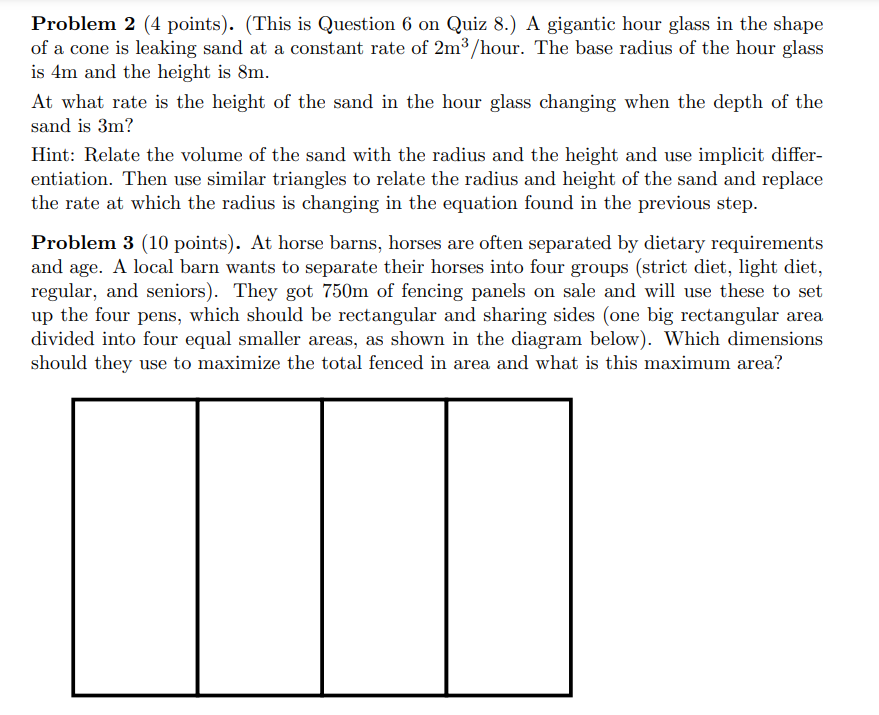
Problem 1 (6 points). Consider the equation 1'4 73':2 + 6:3 10 = U on the interval [2, 3]. (3.) Explain why we know that there is a root in the given interval. (Hint: Think back to the Bisection Method.) (13) Use Newton's Method to approximate the root accurate to four decimal places. Problem 2 (4 points). (This is Question 6 011 Quiz 8) A gigantic hour glass in the shape of a cone is leaking sand at a constant rate of 2m3/hour. rI'he base radius of the hour glass is 4m and the height is 8m. At what rate is the height of the sand in the hour glass changing when the depth of the sand is 3m? Hint: Relate the volume of the sand with the radius and the height and use implicit differ entiation. Then use similar triangles to relate the radius and height of the sand and replace the rate at which the radius is changing in the equation found in the previous step. Problem 3 (10 points). At horse barns, horses are often separated by dietary requirements and age. A local barn wants to separate their horses into four groups (strict diet, light diet, regular, and seniors). They got 750m of fencing panels on sale and will use these to set up the four pens, which should he rectangular and sharing sides (one big rectangular area divided into four equal smaller areas, as shown in the diagram below). W'hich dimensions should they use to maximize the total fenced in area and what is this maximum area
Step by Step Solution
There are 3 Steps involved in it

Get step-by-step solutions from verified subject matter experts
 Study Help