







Question: Problem 1. (8 points) It is estimated that approximately 10.5% of Americans are afflicted with diabetes. Suppose that a new diagnostic test is being checked
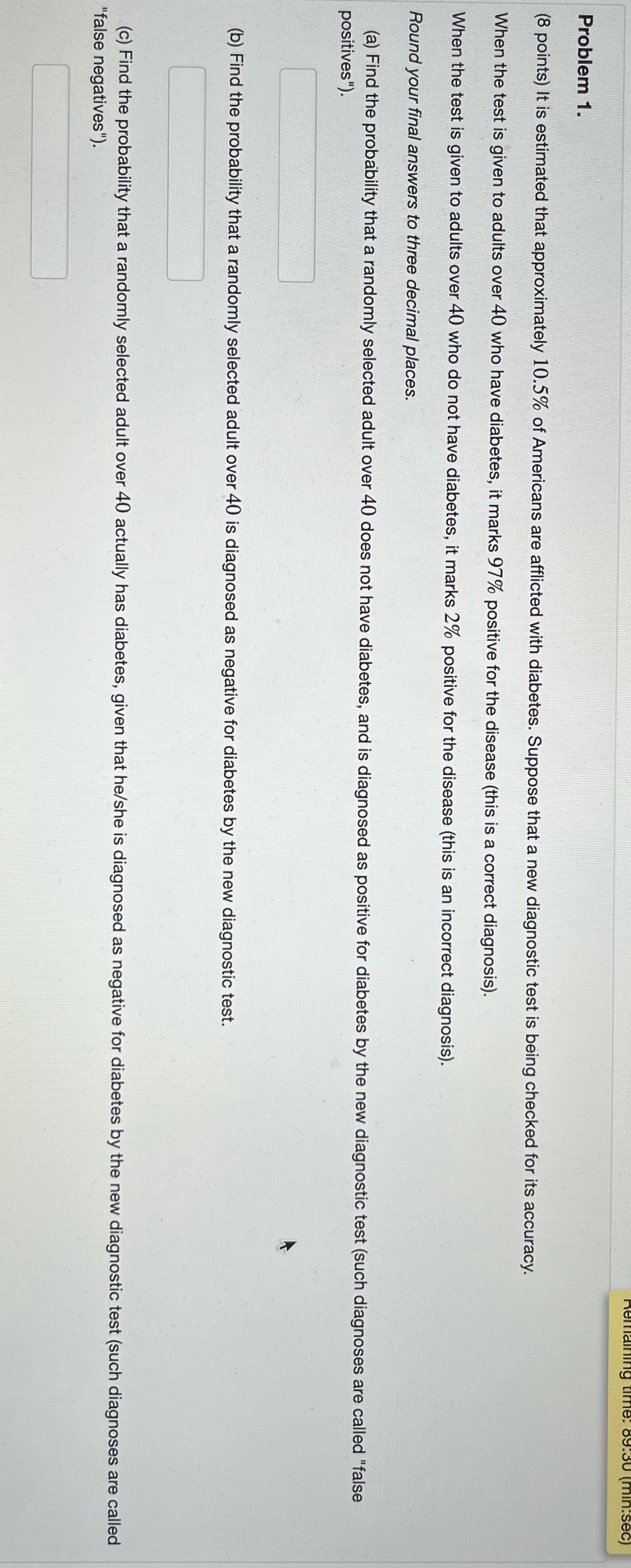
Problem 1. (8 points) It is estimated that approximately 10.5% of Americans are afflicted with diabetes. Suppose that a new diagnostic test is being checked for its accuracy. When the test is given to adults over 40 who have diabetes, it marks 97% positive for the disease (this is a correct diagnosis). When the test is given to adults over 40 who do not have diabetes, it marks 2% positive for the disease (this is an incorrect diagnosis). Round your final answers to three decimal places. (a) Find the probability that a randomly selected adult over 40 does not have diabetes, and is diagnosed as positive for diabetes by the new diagnostic test (such diagnoses are called "false positives"). (b) Find the probability that a randomly selected adult over 40 is diagnosed as negative for diabetes by the new diagnostic test. (c) Find the probability that a randomly selected adult over 40 actually has diabetes, given that he/she is diagnosed as negative for diabetes by the new diagnostic test (such diagnoses are called "false negatives")
Step by Step Solution
There are 3 Steps involved in it

Get step-by-step solutions from verified subject matter experts
 Study Help