







Question: Problem # 1 . A, B, C Chapter 11 M 6. The lean production firms should a. Marire their process flexibility that the difference between
Problem # 1 . A, B, C 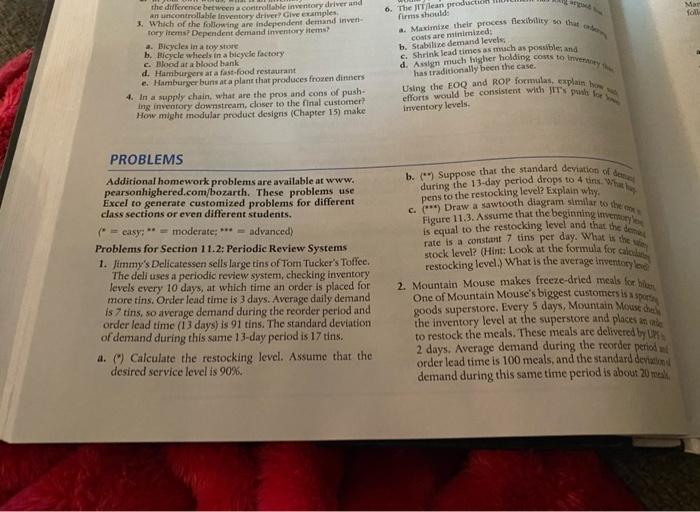
M 6. The lean production firms should a. Marire their process flexibility that the difference between a controllable inventory driver and an uncontrollable Inventory driver Give examples 3. Which of the following are independent demand inven tory items? Dependent demand inventory items! . Bicycles in a toy store b. Bicycle wheels in a bicycle factory c. Blood at a blood bank d. Marriburgers at a fast-food restaurant e Hamburger buns at a plant that produces frozen dinners 4. In a supply chain, what are the pros and cons of push- ing inventory downstream, closer to the final customer How might modular product designs (Chapter 15) make costs are minimized b. Stabilize demand levels Shrink lead times as much as possible, and has traditionally been the case. d. Assign much higher holding costs to Using the EOQ and ROP formulas, cupla efforts would be consistent with spus Inventory levels pens to the restocking level? Explain why, PROBLEMS Additional homework problems are available at www. pearsonhighered.com/bozarth. These problems use Excel to generate customized problems for different class sections or even different students. (=casy, moderate: *** = advanced) Problems for Section 11.2: Periodic Review Systems 1. Jimmy's Delicatessen sells large tins of Tom Tucker's Toffee, The deli uses a periodic review system, checking inventory levels every 10 days, at which time an order is placed for more tins. Order lead time is 3 days. Average daily demand is 7 tins, so average demand during the reorder period and order lead time (13 days) is 91 tins. The standard deviation of demand during this same 13-day period is 17 tins. a. Calculate the restocking level. Assume that the desired service level is 90% b. (*) Suppose that the standard deviation of de during the 13-day period drops to 4 tin c. (***) Draw a Sawtooth diagram similar to the Figure 11.3. Assume that the beginning in is equal to the restocking level and that in de rate is a constant 7 tins per day. What is the stock level? (Hint: Look at the formula for calda restocking level.) What is the average Inventory lod 2. Mountain Mouse makes freeze-dried meals for One of Mountain Mouse's biggest customers is goods superstore. Every 5 days, Mountain Model the inventory level at the superstore and places an inte to restock the meals. These meals are delivered by UK 2 days. Average demand during the reorder periode order lead time is 100 meals and the standard deviation demand during this same time period is about 20 meal M 6. The lean production firms should a. Marire their process flexibility that the difference between a controllable inventory driver and an uncontrollable Inventory driver Give examples 3. Which of the following are independent demand inven tory items? Dependent demand inventory items! . Bicycles in a toy store b. Bicycle wheels in a bicycle factory c. Blood at a blood bank d. Marriburgers at a fast-food restaurant e Hamburger buns at a plant that produces frozen dinners 4. In a supply chain, what are the pros and cons of push- ing inventory downstream, closer to the final customer How might modular product designs (Chapter 15) make costs are minimized b. Stabilize demand levels Shrink lead times as much as possible, and has traditionally been the case. d. Assign much higher holding costs to Using the EOQ and ROP formulas, cupla efforts would be consistent with spus Inventory levels pens to the restocking level? Explain why, PROBLEMS Additional homework problems are available at www. pearsonhighered.com/bozarth. These problems use Excel to generate customized problems for different class sections or even different students. (=casy, moderate: *** = advanced) Problems for Section 11.2: Periodic Review Systems 1. Jimmy's Delicatessen sells large tins of Tom Tucker's Toffee, The deli uses a periodic review system, checking inventory levels every 10 days, at which time an order is placed for more tins. Order lead time is 3 days. Average daily demand is 7 tins, so average demand during the reorder period and order lead time (13 days) is 91 tins. The standard deviation of demand during this same 13-day period is 17 tins. a. Calculate the restocking level. Assume that the desired service level is 90% b. (*) Suppose that the standard deviation of de during the 13-day period drops to 4 tin c. (***) Draw a Sawtooth diagram similar to the Figure 11.3. Assume that the beginning in is equal to the restocking level and that in de rate is a constant 7 tins per day. What is the stock level? (Hint: Look at the formula for calda restocking level.) What is the average Inventory lod 2. Mountain Mouse makes freeze-dried meals for One of Mountain Mouse's biggest customers is goods superstore. Every 5 days, Mountain Model the inventory level at the superstore and places an inte to restock the meals. These meals are delivered by UK 2 days. Average demand during the reorder periode order lead time is 100 meals and the standard deviation demand during this same time period is about 20 meal Chapter 11
Step by Step Solution
There are 3 Steps involved in it
1 Expert Approved Answer
Step: 1 Unlock

Question Has Been Solved by an Expert!
Get step-by-step solutions from verified subject matter experts
Step: 2 Unlock
Step: 3 Unlock
 Study Help