







Question: Problem 1 A blue bird and a red bird are initially sitting atop two different trees while a hunter {represented by the arrow) is watching
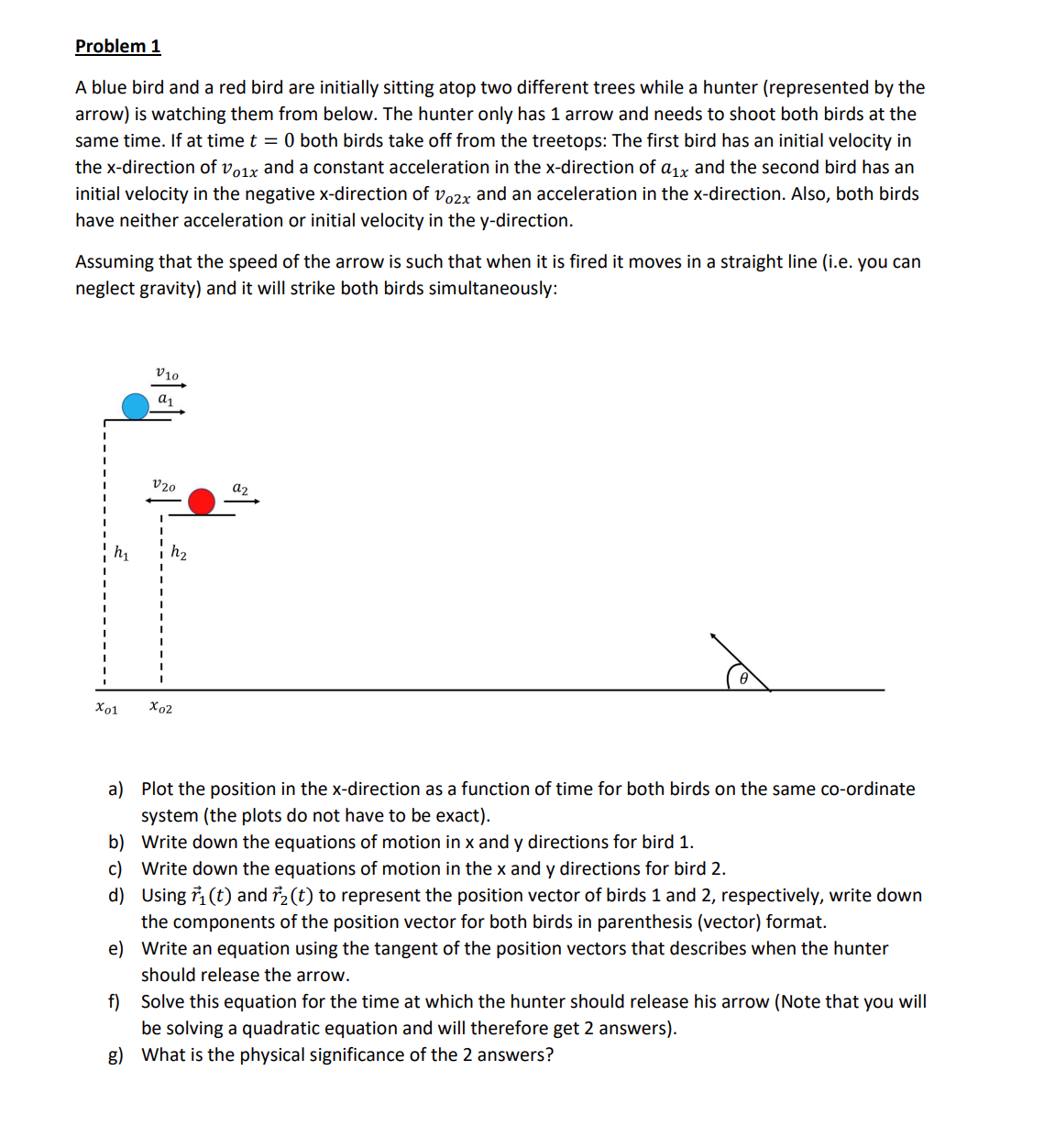
Problem 1 A blue bird and a red bird are initially sitting atop two different trees while a hunter {represented by the arrow) is watching them from below. The hunter only has 1 arrow and needs to shoot both birds at the same time. If at time t = 0 both birds take off from the treetops: The first bird has an initial velocity in the xdirection of \"01x and a constant acceleration in the xdirection of [11x and the second bird has an initial velocity in the negative xdirection of \"02x and an acceleration in the xdirection. Also, both birds have neither acceleration or initial velocity in the y-direction. Assuming that the speed of the arrow is such that when it is fired it moves in a straight line (i.e. you can neglect gravity) and it will strike both birds simultaneously: 1') g} Plot the position in the xdirection as a function of time for both birds on the same coordinate system (the plots do not have to be exact). Write down the equations of motion in x and y directions for bird 1. Write down the equations of motion in the x and y directions for bird 2. Using F1 (t) and F2 (t) to represent the position vector of birds 1 and 2, respectively, write down the components of the position vector for both birds in parenthesis (vector) format. Write an equation using the tangent of the position vectors that describes when the hunter should release the arrow. Solve this equation for the time at which the hunter should release his arrow (Note that you will be solving a quadratic equation and will therefore get 2 answers). What is the physical significance of the 2 answers
Step by Step Solution
There are 3 Steps involved in it

Get step-by-step solutions from verified subject matter experts
 Study Help