







Question: Problem 1. A computer with a 5-stage pipeline like the one described in class deals with conditional branches by stalling for the next three cycles,
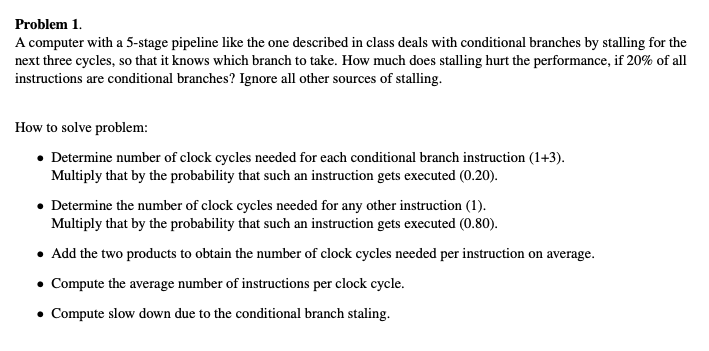
Problem 1. A computer with a 5-stage pipeline like the one described in class deals with conditional branches by stalling for the next three cycles, so that it knows which branch to take. How much does stalling hurt the performance, if 20% of all instructions are conditional branches? Ignore all other sources of stalling. How to solve problem: Determine number of clock cycles needed for each conditional branch instruction (1+3). Multiply that by the probability that such an instruction gets executed (0.20). Determine the number of clock cycles needed for any other instruction (1). Multiply that by the probability that such an instruction gets executed (0.80). Add the two products to obtain the number of clock cycles needed per instruction on average. Compute the average number of instructions per clock cycle. Compute slow down due to the conditional branch staling
Step by Step Solution
There are 3 Steps involved in it

Get step-by-step solutions from verified subject matter experts
 Study Help