







Question: Problem 1: A grammar for arithmetic expressions is given as Grammar G1: F a l (s) This grammar in unambiguous which means that for each
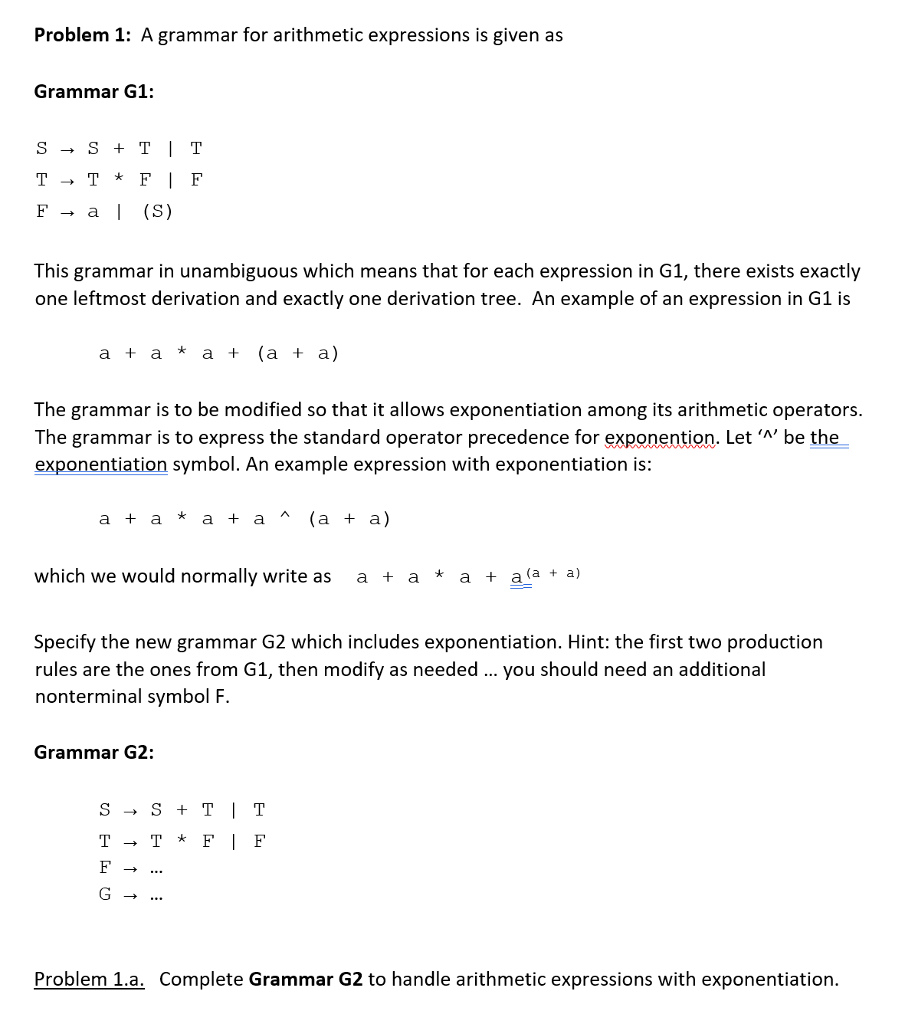
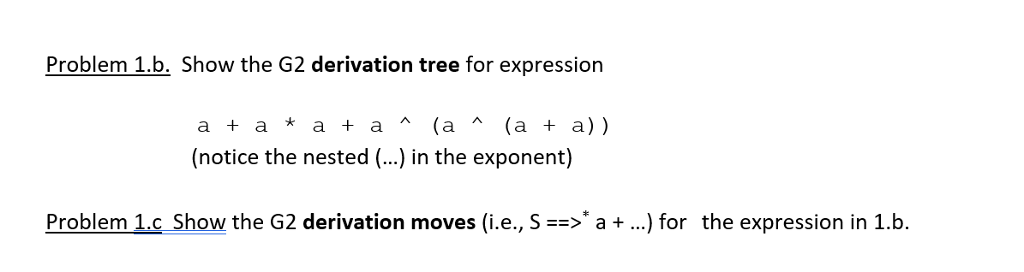
Problem 1: A grammar for arithmetic expressions is given as Grammar G1: F a l (s) This grammar in unambiguous which means that for each expression in G1, there exists exactly one leftmost derivation and exactly one derivation tree. An example of an expression in G1 is a + a * a+ (a + a) The grammar is to be modified so that it allows exponentiation among its arithmetic operators. The grammar is to express the standard operator precedence for exponention. Let 'be the exponentiation symbol. An example expression with exponentiation is: a+a* aa (a a) which we would normally write as a a * a a(a + a) Specify the new grammar G2 which includes exponentiation. Hint: the first two production rules are the ones from G1, then modify as needed. you should need an additional nonterminal symbolF. Grammar G2: Problem 1.a. Complete Grammar G2 to handle arithmetic expressions with exponentiation
Step by Step Solution
There are 3 Steps involved in it

Get step-by-step solutions from verified subject matter experts
 Study Help