







Question: Problem 1 A new venture is expected to require a capital investment of $2.5 million in fixed assets and an investment of $200,000 in initial
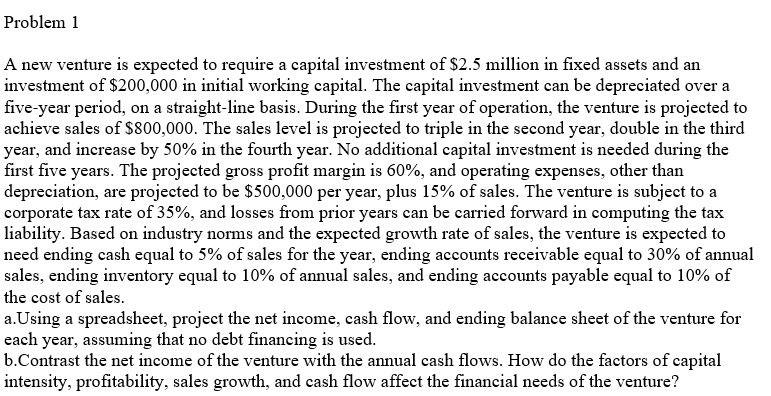
Problem 1 A new venture is expected to require a capital investment of $2.5 million in fixed assets and an investment of $200,000 in initial working capital. The capital investment can be depreciated over a five-year period, on a straight-line basis. During the first year of operation, the venture is projected to achieve sales of $800,000. The sales level is projected to triple in the second year, double in the third year, and increase by 50% in the fourth year. No additional capital investment is needed during the first five years. The projected gross profit margin is 60%, and operating expenses, other than depreciation, are projected to be $500,000 per year, plus 15% of sales. The venture is subject to a corporate tax rate of 35%, and losses from prior years can be carried forward in computing the tax liability. Based on industry norms and the expected growth rate of sales, the venture is expected to need ending cash equal to 5% of sales for the year, ending accounts receivable equal to 30% of annual sales, ending inventory equal to 10% of annual sales, and ending accounts payable equal to 10% of the cost of sales. a.Using a spreadsheet, project the net income, cash flow, and ending balance sheet of the venture for each year, assuming that no debt financing is used. b.Contrast the net income of the venture with the annual cash flows. How do the factors of capital intensity, profitability, sales growth, and cash flow affect the financial needs of the venture? Problem 1 A new venture is expected to require a capital investment of $2.5 million in fixed assets and an investment of $200,000 in initial working capital. The capital investment can be depreciated over a five-year period, on a straight-line basis. During the first year of operation, the venture is projected to achieve sales of $800,000. The sales level is projected to triple in the second year, double in the third year, and increase by 50% in the fourth year. No additional capital investment is needed during the first five years. The projected gross profit margin is 60%, and operating expenses, other than depreciation, are projected to be $500,000 per year, plus 15% of sales. The venture is subject to a corporate tax rate of 35%, and losses from prior years can be carried forward in computing the tax liability. Based on industry norms and the expected growth rate of sales, the venture is expected to need ending cash equal to 5% of sales for the year, ending accounts receivable equal to 30% of annual sales, ending inventory equal to 10% of annual sales, and ending accounts payable equal to 10% of the cost of sales. a.Using a spreadsheet, project the net income, cash flow, and ending balance sheet of the venture for each year, assuming that no debt financing is used. b.Contrast the net income of the venture with the annual cash flows. How do the factors of capital intensity, profitability, sales growth, and cash flow affect the financial needs of the venture
Step by Step Solution
There are 3 Steps involved in it

Get step-by-step solutions from verified subject matter experts
 Study Help