







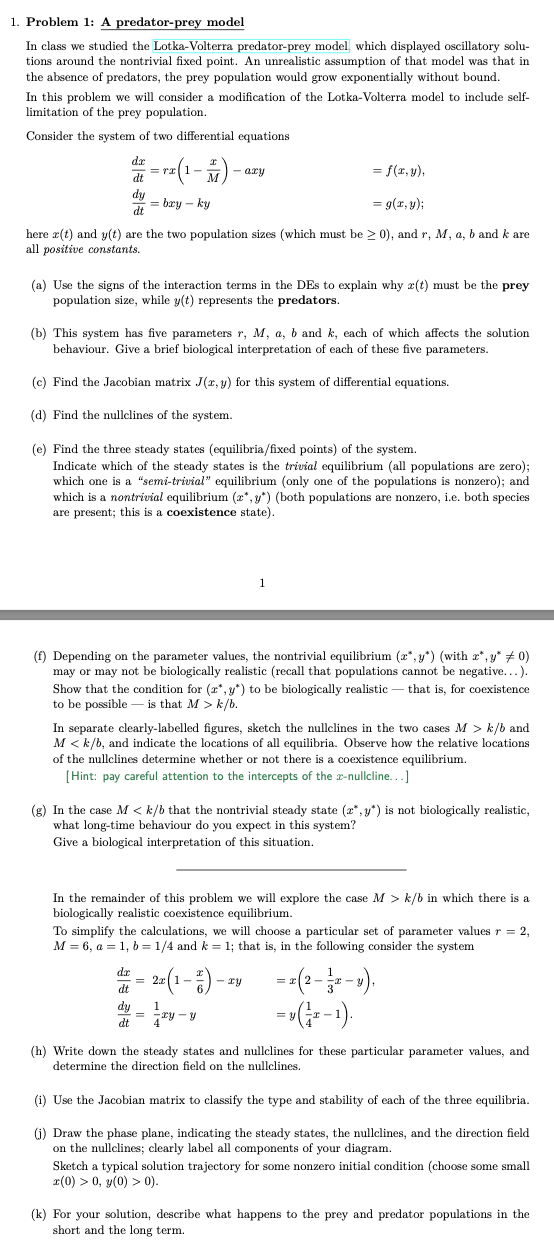
Question: Problem 1 : A predator - prey model In class we studied the Lotka - Volterra predator - prey model which displayed oscillatory solu -
Problem : A predatorprey model
In class we studied the LotkaVolterra predatorprey model which displayed oscillatory solu
tions around the nontrivial fixed point. An unrealistic assumption of that model was that in
the absence of predators, the prey population would grow exponentially without bound.
In this problem we will consider a modification of the LotkaVolterra model to include self
limitation of the prey population.
Consider the system of two differential equations
axy,
;
here and are the two population sizes which must be and and are
all positive constants.
a Use the signs of the interaction terms in the DEs to explain why must be the prey
population size, while represents the predators.
b This system has five parameters and each of which affects the solution
behaviour. Give a brief biological interpretation of each of these five parameters.
c Find the Jacobian matrix for this system of differential equations.
d Find the nullclines of the system.
e Find the three steady states equilibriafixed points of the system.
Indicate which of the steady states is the trivial equilibrium all populations are zero;
which one is a "semitrivial" equilibrium only one of the populations is nonzero; and
which is a nontrivial equilibrium both populations are nonzero, ie both species
are present; this is a coexistence state
f Depending on the parameter values, the nontrivial equilibrium with
may or may not be biologically realistic recall that populations cannot be negative...
Show that the condition for to be biologically realistic that is for coexistence
to be possible is that
In separate clearlylabelled figures, sketch the nullclines in the two cases and
that the nontrivial steady state not biologically realistic,
what longtime behaviour you expect this system?
Give a biological interpretation this situation.
the remainder this problem will explore the case which there
biologically realistic coexistence equilibrium.
simplify the calculations, will choose a particular set parameter values
and ; that the following consider the system
Write down the steady states and nullclines for these particular parameter values, and
determine the direction field the nullclines.
Use the Jacobian matrix classify the type and stability each the three equilibria.
Draw the phase plane, indicating the steady states, the nullclines, and the direction field
the nullclines; clearly label all components your diagram.
Sketch a typical solution trajectory for some nonzero initial condition some small
For your solution, describe what happens the prey and predator populations the
short and the long term. and indicate the locations all equilibria. Observe how the relative locations
the nullclines determine whether not there a coexistence equilibrium.
: pay careful attention the intercepts the nullcline...
the case that the nontrivial steady state not biologically realistic,
what longtime behaviour you expect this system?
Give a biological interpretation this situation.
the remainder this problem will explore the case which there
biologically realistic coexistence equilibrium.
simplify the calculations, will choose a particular set parameter values
and ; that the following consider the system
Write down the steady states and nullclines for these particular parameter values, and
determine the direction field the nullclines.
Use the Jacobian matrix classify the type and stability each the three equilibria.
Draw the phase plane, indicating the steady states, the nullclines, and the direction field
the nullclines; clearly label all components your diagram.
Sketch a typical solution trajectory for some nonzero initial condition some small
For your solution, describe what happens the prey and predator populations the
short and the long term.
Step by Step Solution
There are 3 Steps involved in it
1 Expert Approved Answer
Step: 1 Unlock

Question Has Been Solved by an Expert!
Get step-by-step solutions from verified subject matter experts
Step: 2 Unlock
Step: 3 Unlock
 Study Help