





Question: Problem 1. A proposal is on the table to tax fast food restaurants in order to tackle childhood obesity. You've been asked by the governor
Problem 1. A proposal is on the table to tax fast

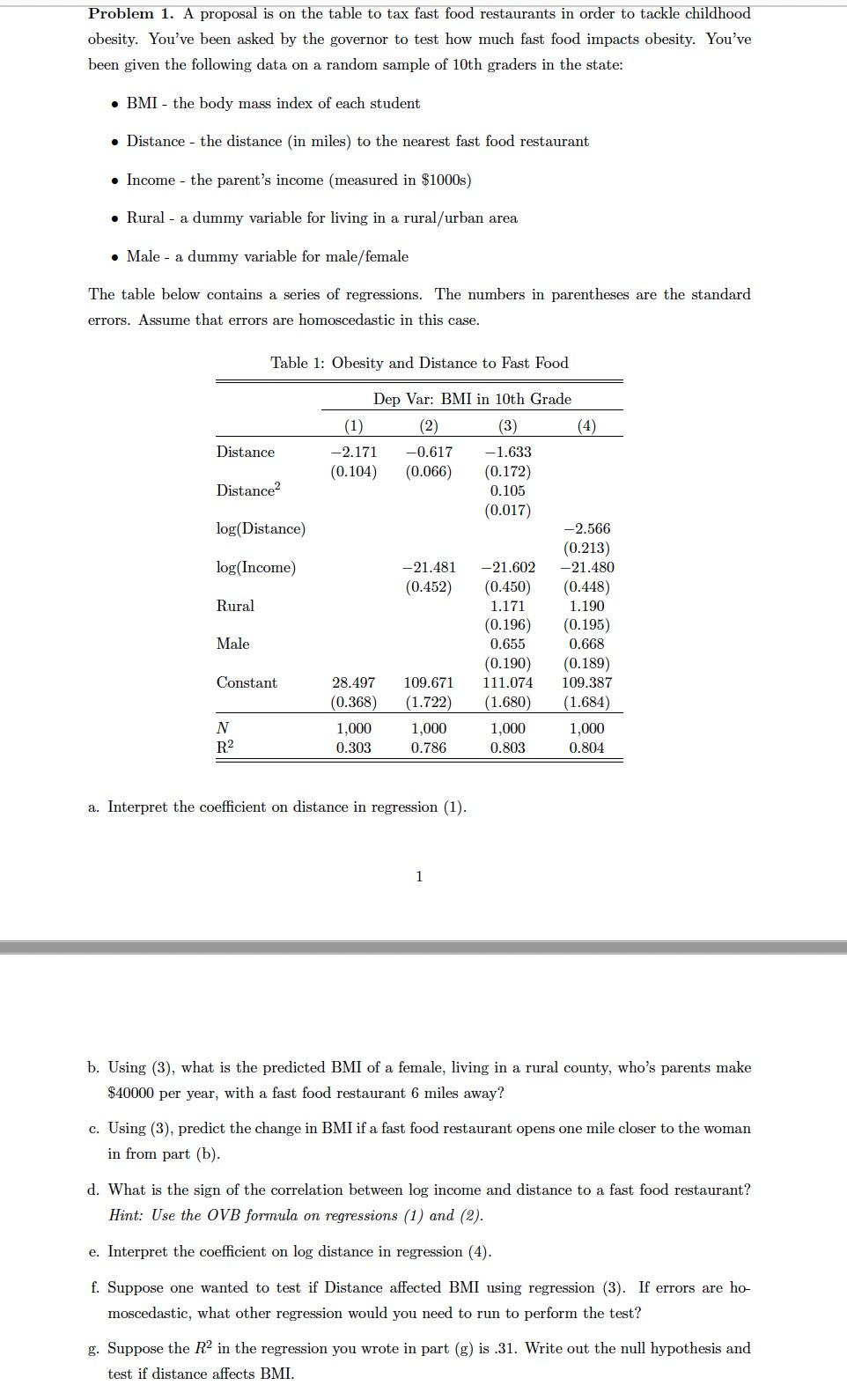
Problem 1. A proposal is on the table to tax fast food restaurants in order to tackle childhood obesity. You've been asked by the governor to test how much fast food impacts obesity. You've been given the following data on a random sample of 10th graders in the state: BMI - the body mass index of each student Distance - the distance (in miles) to the nearest fast food restaurant Income - the parent's income (measured in $1000s) Rural - a dummy variable for living in a rural/urban area Male - a dummy variable for male/female The table below contains a series of regressions. The numbers in parentheses are the standard errors. Assume that errors are homoscedastic in this case. Table 1: Obesity and Distance to Fast Food Distance Distance2 log(Distance) log(Income) Dep Var: BMI in 10th Grade (1) (2) (3) -2.171 -0.617 -1.633 (0.104) (0.066) (0.172) 0.105 (0.017) -2.566 (0.213) -21.481 -21.602 -21.480 (0.452) (0.450) (0.448) 1.171 1.190 (0.196) (0.195) 0.655 0.668 (0.190) (0.189) 28.497 109.671 111.074 109.387 (0.368) (1.722) (1.680) (1.684) 1,000 1,000 1,000 1,000 0.303 0.786 0.803 0.804 Rural Male Constant N R2 a. Interpret the coefficient on distance in regression (1). 1 b. Using (3), what is the predicted BMI of a female, living in a rural county, who's parents make $40000 per year, with a fast food restaurant 6 miles away? c. Using (3), predict the change in BMI if a fast food restaurant opens one mile closer to the woman in from part (b). d. What is the sign of the correlation between log income and distance to a fast food restaurant? Hint: Use the OVB formula on regressions (1) and (2). e. Interpret the coefficient on log distance in regression (4). f. Suppose one wanted to test if Distance affected BMI using regression (3). If errors are ho moscedastic, what other regression would you need to run to perform the test? g. Suppose the R2 in the regression you wrote in part (g) is.31. Write out the null hypothesis and test if distance affects BMI

Step by Step Solution

There are 3 Steps involved in it

1 Expert Approved Answer
Step: 1 Unlock blur-text-image

Question Has Been Solved by an Expert!

Get step-by-step solutions from verified subject matter experts

Step: 2 Unlock
Step: 3 Unlock

Students Have Also Explored These Related General Management Questions!