







Question: Problem 1 A site has been selected for a light commercial development ( i . e . strip mall ) . A subsurface investigation of
Problem
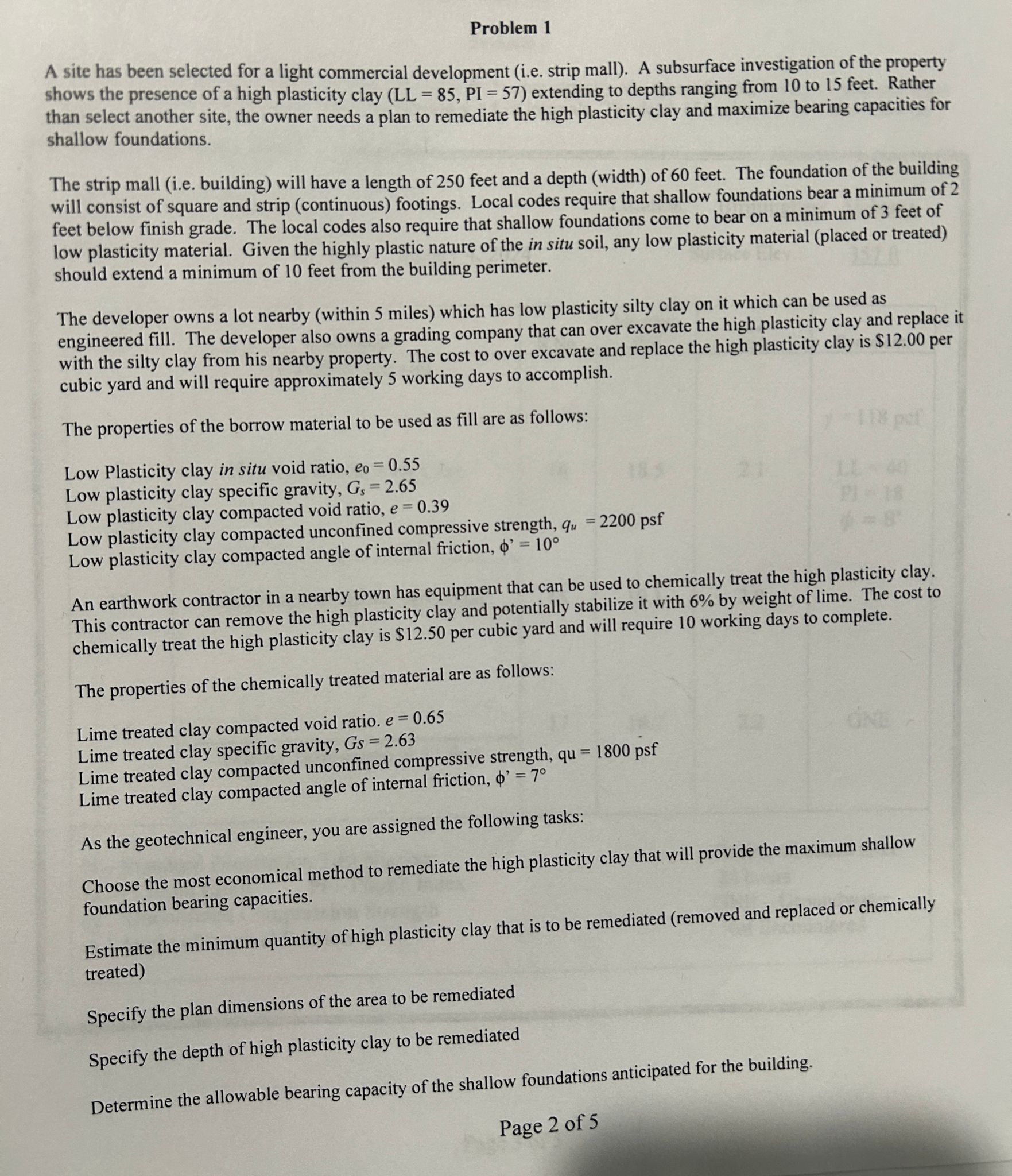
A site has been selected for a light commercial development ie strip mall A subsurface investigation of the property
shows the presence of a high plasticity clay I extending to depths ranging from to feet. Rather
than select another site, the owner needs a plan to remediate the high plasticity clay and maximize bearing capacities for
shallow foundations.
The strip mall ie building will have a length of feet and a depth width of feet. The foundation of the building
will consist of square and strip continuous footings. Local codes require that shallow foundations bear a minimum of
feet below finish grade. The local codes also require that shallow foundations come to bear on a minimum of feet of
low plasticity material. Given the highly plastic nature of the in situ soil, any low plasticity material placed or treated
should extend a minimum of feet from the building perimeter.
The developer owns a lot nearby within miles which has low plasticity silty clay on it which can be used as
engineered fill. The developer also owns a grading company that can over excavate the high plasticity clay and replace it
with the silty clay from his nearby property. The cost to over excavate and replace the high plasticity clay is $ per
cubic yard and will require approximately working days to accomplish.
The properties of the borrow material to be used as fill are as follows:
Low Plasticity clay in situ void ratio,
Low plasticity clay specific gravity,
Low plasticity clay compacted void ratio,
Low plasticity clay compacted unconfined compressive strength,
Low plasticity clay compacted angle of internal friction,
An earthwork contractor in a nearby town has equipment that can be used to chemically treat the high plasticity clay.
This contractor can remove the high plasticity clay and potentially stabilize it with by weight of lime The cost to
chemically treat the high plasticity clay is $ per cubic yard and will require working days to complete.
The properties of the chemically treated material are as follows:
Lime treated clay compacted void ratio.
Lime treated clay specific gravity,
Lime treated clay compacted unconfined compressive strength,
Lime treated clay compacted angle of internal friction,
As the geotechnical engineer, you are assigned the following tasks:
Choose the most economical method to remediate the high plasticity clay that will provide the maximum shallow
foundation bearing capacities.
Estimate the minimum quantity of high plasticity clay that is to be remediated removed and replaced or chemically
treated
Specify the plan dimensions of the area to be remediated
Specify the depth of high plasticity clay to be remediated
Determine the allowable bearing capacity of the shallow foundations anticipated for the building.
Step by Step Solution
There are 3 Steps involved in it
1 Expert Approved Answer
Step: 1 Unlock

Question Has Been Solved by an Expert!
Get step-by-step solutions from verified subject matter experts
Step: 2 Unlock
Step: 3 Unlock
 Study Help