



Question: Problem 1: A wetted-wall column is sometimes used to strip volatile organic solutes such as TCE from an aqueous solution. To estimate the gas film
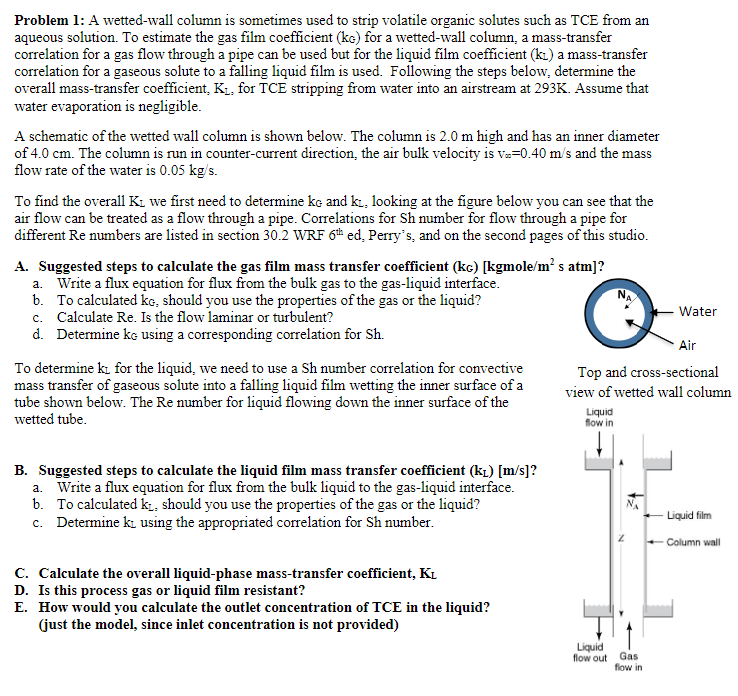
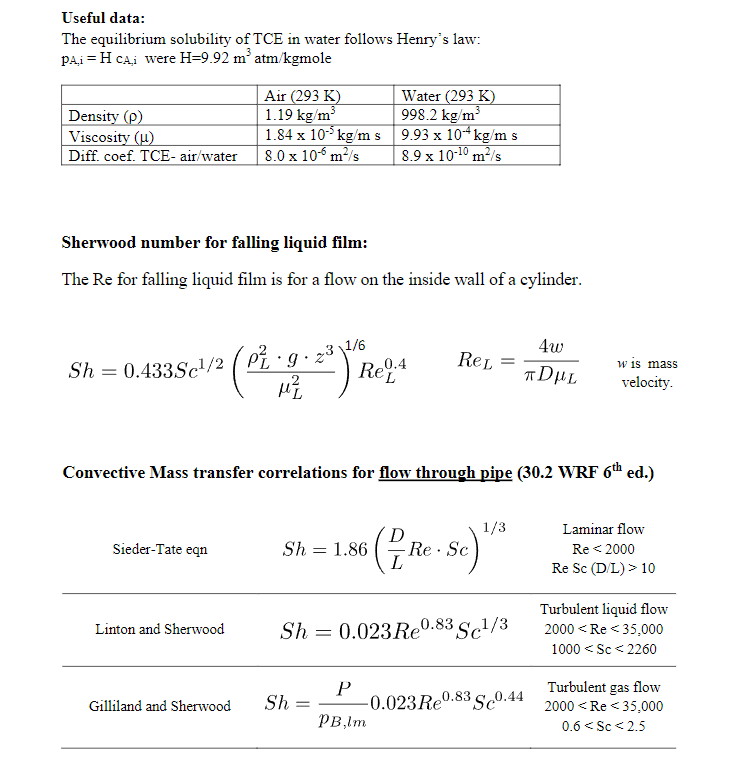
Problem 1: A wetted-wall column is sometimes used to strip volatile organic solutes such as TCE from an aqueous solution. To estimate the gas film coefficient (kG) for a wetted-wall column, a mass-transfer correlation for a gas flow through a pipe can be used but for the liquid film coefficient ( kL) a mass-transfer correlation for a gaseous solute to a falling liquid film is used. Following the steps below, determine the overall mass-transfer coefficient, KL, for TCE stripping from water into an airstream at 293K. Assume that water evaporation is negligible. A schematic of the wetted wall column is shown below. The column is 2.0m high and has an inner diameter of 4.0cm. The column is run in counter-current direction, the air bulk velocity is vas =0.40m/s and the mass flow rate of the water is 0.05kg/s. To find the overall KL we first need to determine kG and kL, looking at the figure below you can see that the air flow can be treated as a flow through a pipe. Correlations for Sh number for flow through a pipe for different Re numbers are listed in section 30.2WRF6th ed, Perry's, and on the second pages of this studio. A. Suggested steps to calculate the gas film mass transfer coefficient (kG)[kgmole/m2satm] ? a. Write a flux equation for flux from the bulk gas to the gas-liquid interface. b. To calculated kG, should you use the properties of the gas or the liquid? c. Calculate Re. Is the flow laminar or turbulent? d. Determine kG using a corresponding correlation for Sh. To determine kL for the liquid, we need to use a Sh number correlation for convective mass transfer of gaseous solute into a falling liquid film wetting the inner surface of a tube shown below. The Re number for liquid flowing down the inner surface of the wetted tube. Top and cross-sectional view of wetted wall column B. Suggested steps to calculate the liquid film mass transfer coefficient (kL)[m/s] ? a. Write a flux equation for flux from the bulk liquid to the gas-liquid interface. b. To calculated kL, should you use the properties of the gas or the liquid? c. Determine kL using the appropriated correlation for Sh number. C. Calculate the overall liquid-phase mass-transfer coefficient, KL D. Is this process gas or liquid film resistant? E. How would you calculate the outlet concentration of TCE in the liquid? (just the model, since inlet concentration is not provided) Useful data: The equilibrium solubility of TCE in water follows Henry's law: pA,i=H cA,i were H=9.92m3atm/kgmole Sherwood number for falling liquid film: The Re for falling liquid film is for a flow on the inside wall of a cylinder. Sh=0.433Sc1/2(L2L2gz3)1/6ReL0.4ReL=DL4wwismassvelocity. Convective Mass transfer correlations for flow through pipe (30.2 WRF 6th ed.) Problem 1: A wetted-wall column is sometimes used to strip volatile organic solutes such as TCE from an aqueous solution. To estimate the gas film coefficient (kG) for a wetted-wall column, a mass-transfer correlation for a gas flow through a pipe can be used but for the liquid film coefficient ( kL) a mass-transfer correlation for a gaseous solute to a falling liquid film is used. Following the steps below, determine the overall mass-transfer coefficient, KL, for TCE stripping from water into an airstream at 293K. Assume that water evaporation is negligible. A schematic of the wetted wall column is shown below. The column is 2.0m high and has an inner diameter of 4.0cm. The column is run in counter-current direction, the air bulk velocity is vas =0.40m/s and the mass flow rate of the water is 0.05kg/s. To find the overall KL we first need to determine kG and kL, looking at the figure below you can see that the air flow can be treated as a flow through a pipe. Correlations for Sh number for flow through a pipe for different Re numbers are listed in section 30.2WRF6th ed, Perry's, and on the second pages of this studio. A. Suggested steps to calculate the gas film mass transfer coefficient (kG)[kgmole/m2satm] ? a. Write a flux equation for flux from the bulk gas to the gas-liquid interface. b. To calculated kG, should you use the properties of the gas or the liquid? c. Calculate Re. Is the flow laminar or turbulent? d. Determine kG using a corresponding correlation for Sh. To determine kL for the liquid, we need to use a Sh number correlation for convective mass transfer of gaseous solute into a falling liquid film wetting the inner surface of a tube shown below. The Re number for liquid flowing down the inner surface of the wetted tube. Top and cross-sectional view of wetted wall column B. Suggested steps to calculate the liquid film mass transfer coefficient (kL)[m/s] ? a. Write a flux equation for flux from the bulk liquid to the gas-liquid interface. b. To calculated kL, should you use the properties of the gas or the liquid? c. Determine kL using the appropriated correlation for Sh number. C. Calculate the overall liquid-phase mass-transfer coefficient, KL D. Is this process gas or liquid film resistant? E. How would you calculate the outlet concentration of TCE in the liquid? (just the model, since inlet concentration is not provided) Useful data: The equilibrium solubility of TCE in water follows Henry's law: pA,i=H cA,i were H=9.92m3atm/kgmole Sherwood number for falling liquid film: The Re for falling liquid film is for a flow on the inside wall of a cylinder. Sh=0.433Sc1/2(L2L2gz3)1/6ReL0.4ReL=DL4wwismassvelocity. Convective Mass transfer correlations for flow through pipe (30.2 WRF 6th ed.)
Step by Step Solution
There are 3 Steps involved in it

Get step-by-step solutions from verified subject matter experts