







Question: Problem 1. Addictive goods. (23 points) In this exercise, we propose a generalization of Cobb- Douglas preferences that incorporates the concept of reference point. We
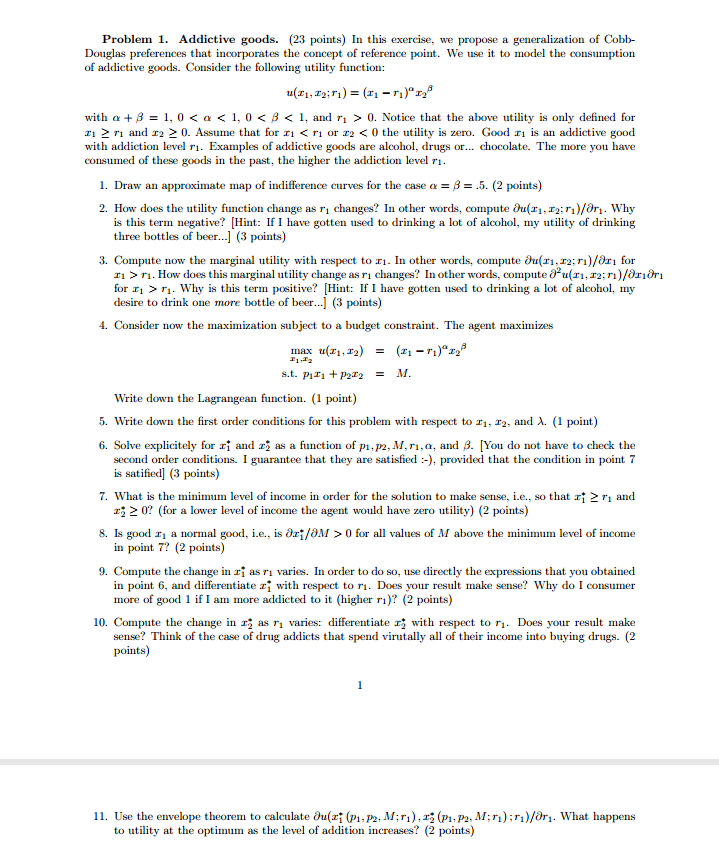
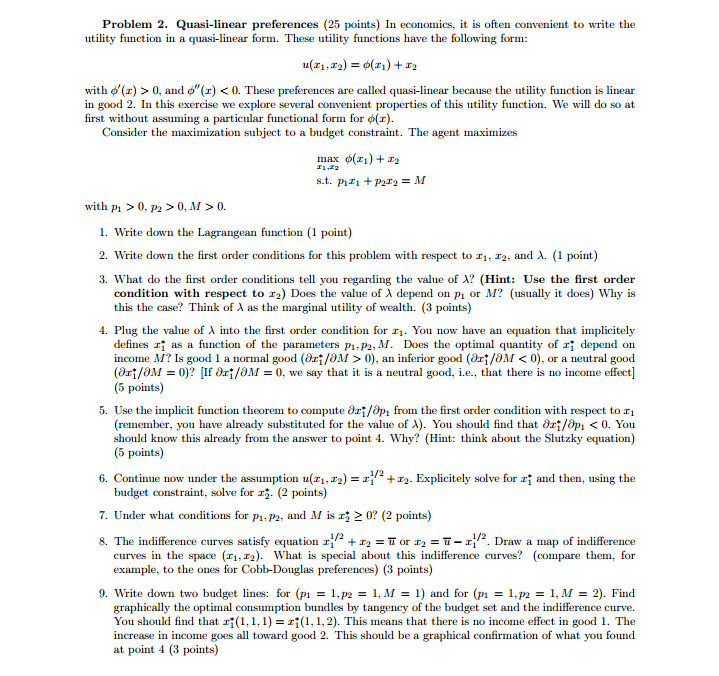
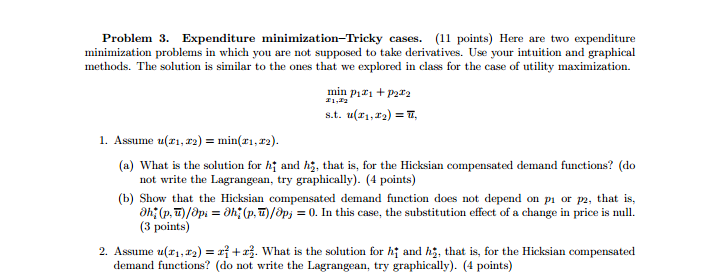
Problem 1. Addictive goods. (23 points) In this exercise, we propose a generalization of Cobb- Douglas preferences that incorporates the concept of reference point. We use it to model the consumption of addictive goods. Consider the following utility function: with a + 8 = 1, 0 0. Notice that the above utility is only defined for 1 2 mi and 12 2 0. Assume that for ri mi. How does this marginal utility change as ri changes? In other words, compute Ou(11, 12; n)/dridri for r1 > ni. Why is this term positive? [Hint: If I have gotten used to drinking a lot of alcohol, my desire to drink one more bottle of beer...] (3 points) 4. Consider now the maximization subject to a budget constraint. The agent maximizes max u(21,12) = (21-1)22 at. Pill + p272 = M. Write down the Lagrangean function. (1 point) 5. Write down the first order conditions for this problem with respect to 21, 12, and A. (1 point) 6. Solve explicitely for rj and z; as a function of pi, pa, M, ri, a, and 8. [You do not have to check the second order conditions. I guarantee that they are satisfied :-), provided that the condition in point 7 is satified] (3 points) 7. What is the minimum level of income in order for the solution to make sense, i.e., so that r; 2 7, and x; 2 07 (for a lower level of income the agent would have zero utility) (2 points) 8. Is good r, a normal good, i.e., is Or;/OM > 0 for all values of M above the minimum level of income in point 7? (2 points) 9. Compute the change in cj as ri varies. In order to do so, use directly the expressions that you obtained in point 6, and differentiate z; with respect to ri. Does your result make sense? Why do I consumer more of good 1 if I am more addicted to it (higher ri)? (2 points) 10. Compute the change in r; as r, varies: differentiate r; with respect to ry. Does your result make sense? Think of the case of drug addicts that spend virutally all of their income into buying drugs. (2 points) 11. Use the envelope theorem to calculate Ou(a; (pi, pa, M;) , I; (mi. p2. M;n); ni)/Or. What happens to utility at the optimum as the level of addition increases? (2 points)Problem 2. Quasi-linear preferences (25 points) In economics, it is often convenient to write the utility function in a quasi-linear form. These utility functions have the following form: u(21. 12) = (21) + 12 with '(x) > 0, and o"(r) 0, p2 > 0, M > 0. 1. Write down the Lagrangean function (1 point) 2. Write down the first order conditions for this problem with respect to F1, 12, and A. (1 point) 3. What do the first order conditions tell you regarding the value of A? (Hint: Use the first order condition with respect to r2) Does the value of A depend on p, or MY (usually it does) Why is this the case? Think of A as the marginal utility of wealth. (3 points) 4. Plug the value of A into the first order condition for 1. You now have an equation that implicitely defines r; as a function of the parameters p1, p2, M. Does the optimal quantity of r; depend on income M? Is good 1 a normal good (Or;/OM > 0), an inferior good (Or; /OM
Step by Step Solution
There are 3 Steps involved in it

Get step-by-step solutions from verified subject matter experts
 Study Help