







Question: Problem #1 (Algorithmic Complexity) (10 pts) 1. (4 pts) Algorithmic Complexity a. What is the asymptotic complexity (Big-O) of the function b. What is
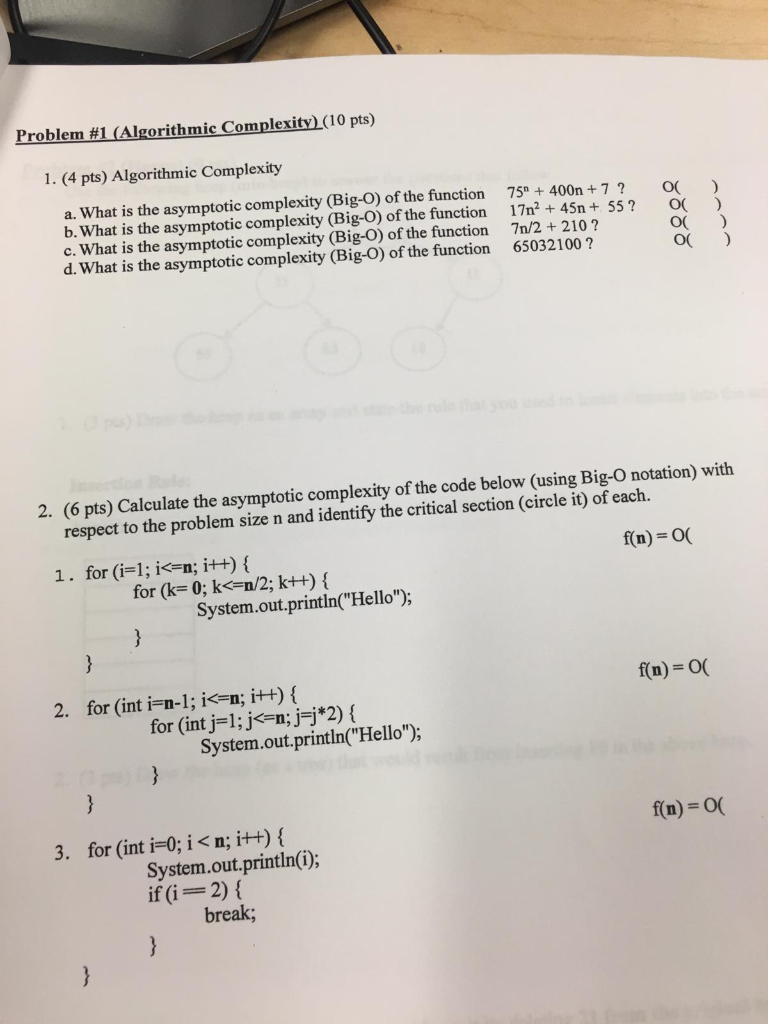
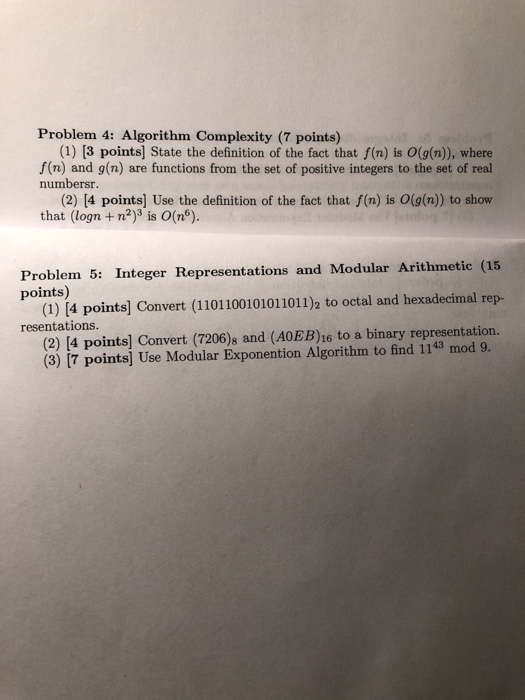
Problem #1 (Algorithmic Complexity) (10 pts) 1. (4 pts) Algorithmic Complexity a. What is the asymptotic complexity (Big-O) of the function b. What is the asymptotic complexity (Big-O) of the function c. What is the asymptotic complexity (Big-O) of the function d. What is the asymptotic complexity (Big-O) of the function 75+400n+7? 17n2+45n+ 55? 7n/2 + 210? 65032100? O( O( O( ) Insertion 2. (6 pts) Calculate the asymptotic complexity of the code below (using Big-O notation) with respect to the problem size n and identify the critical section (circle it) of each. 1. for (i=1; i Problem 4: Algorithm Complexity (7 points) (1) [3 points] State the definition of the fact that f(n) is O(g(n)), where f(n) and g(n) are functions from the set of positive integers to the set of real numbersr. (2) [4 points] Use the definition of the fact that f(n) is O(g(n)) to show that (logn+n2)3 is O(n). fetoloq Problem 5: Integer Representations and Modular Arithmetic (15 points) (1) [4 points] Convert (1101100101011011)2 to octal and hexadecimal rep- resentations. (2) [4 points] Convert (7206), and (A0EB) 16 to a binary representation. (3) [7 points] Use Modular Exponention Algorithm to find 1143 mod 9.
Step by Step Solution
There are 3 Steps involved in it

Get step-by-step solutions from verified subject matter experts
 Study Help