







Question: Problem 1 - Bargaining Model with Finite Horizon Let's consider Rubinstein's bargaining model as discussed in class, but with a finite time horizon. A time
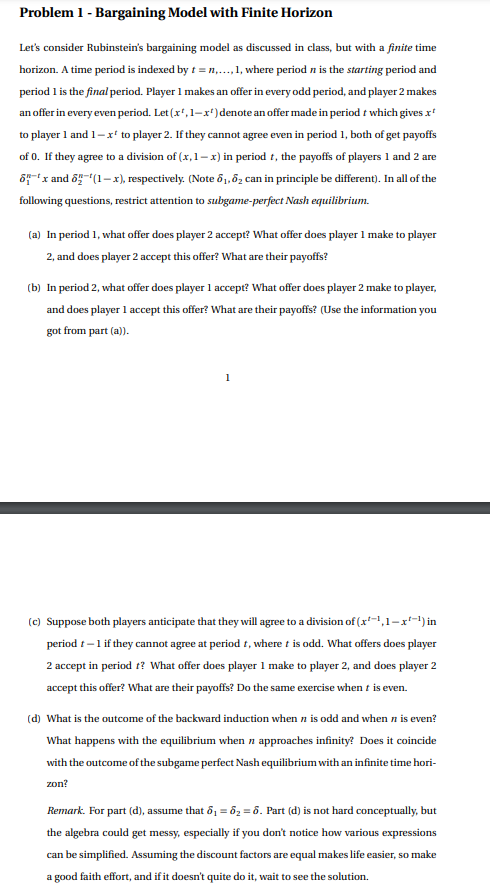
Problem 1 - Bargaining Model with Finite Horizon Let's consider Rubinstein's bargaining model as discussed in class, but with a finite time horizon. A time period is indexed by t = n..., 1, where period n is the starting period and period 1 is the final period. Player 1 makes an offer in every odd period, and player 2 makes an offer in every even period. Let (x*,1-x)denote an offer made in period t which gives x to player 1 and 1 - x' to player 2. If they cannot agree even in period 1, both of get payoffs of 0. If they agree to a division of (x,1 x) in period t, the payoffs of players 1 and 2 are 6"-x and 6"-"(1 - x), respectively. (Note , 6, can in principle be different). In all of the following questions, restrict attention to subgame-perfect Nash equilibrium. (a) In period 1, what offer does player 2 accept? What offer does player 1 make to player 2, and does player 2 accept this offer? What are their payoffs? (b) In period 2, what offer does player 1 accept? What offer does player 2 make to player, and does player 1 accept this offer? What are their payoffs? (Use the information you got from part (a)). 1 (C) Suppose both players anticipate that they will agree to a division of (x#,1x-1) in period - 1 if they cannot agree at period t, where t is odd. What offers does player 2 accept in period t? What offer does player 1 make to player 2, and does player 2 accept this offer? What are their payoffs? Do the same exercise when t is even. (d) What is the outcome of the backward induction when n is odd and when n is even? What happens with the equilibrium when n approaches infinity? Does it coincide with the outcome of the subgame perfect Nash equilibrium with an infinite time hori- zon? Remark. For part (d), assume that 8, = 72 = 8. Part (d) is not hard conceptually, but the algebra could get messy, especially if you don't notice how various expressions can be simplified. Assuming the discount factors are equal makes life easier, so make a good faith effort, and if it doesn't quite do it, wait to see the solution. Problem 1 - Bargaining Model with Finite Horizon Let's consider Rubinstein's bargaining model as discussed in class, but with a finite time horizon. A time period is indexed by t = n..., 1, where period n is the starting period and period 1 is the final period. Player 1 makes an offer in every odd period, and player 2 makes an offer in every even period. Let (x*,1-x)denote an offer made in period t which gives x to player 1 and 1 - x' to player 2. If they cannot agree even in period 1, both of get payoffs of 0. If they agree to a division of (x,1 x) in period t, the payoffs of players 1 and 2 are 6"-x and 6"-"(1 - x), respectively. (Note , 6, can in principle be different). In all of the following questions, restrict attention to subgame-perfect Nash equilibrium. (a) In period 1, what offer does player 2 accept? What offer does player 1 make to player 2, and does player 2 accept this offer? What are their payoffs? (b) In period 2, what offer does player 1 accept? What offer does player 2 make to player, and does player 1 accept this offer? What are their payoffs? (Use the information you got from part (a)). 1 (C) Suppose both players anticipate that they will agree to a division of (x#,1x-1) in period - 1 if they cannot agree at period t, where t is odd. What offers does player 2 accept in period t? What offer does player 1 make to player 2, and does player 2 accept this offer? What are their payoffs? Do the same exercise when t is even. (d) What is the outcome of the backward induction when n is odd and when n is even? What happens with the equilibrium when n approaches infinity? Does it coincide with the outcome of the subgame perfect Nash equilibrium with an infinite time hori- zon? Remark. For part (d), assume that 8, = 72 = 8. Part (d) is not hard conceptually, but the algebra could get messy, especially if you don't notice how various expressions can be simplified. Assuming the discount factors are equal makes life easier, so make a good faith effort, and if it doesn't quite do it, wait to see the solution
Step by Step Solution
There are 3 Steps involved in it

Get step-by-step solutions from verified subject matter experts
 Study Help