







Question: Problem 1: Bigrams (a) Compute the bigram count table, C(w2|w1) for the sentence I saw Susie sitting in a shoe shine shop. Where Susie sits
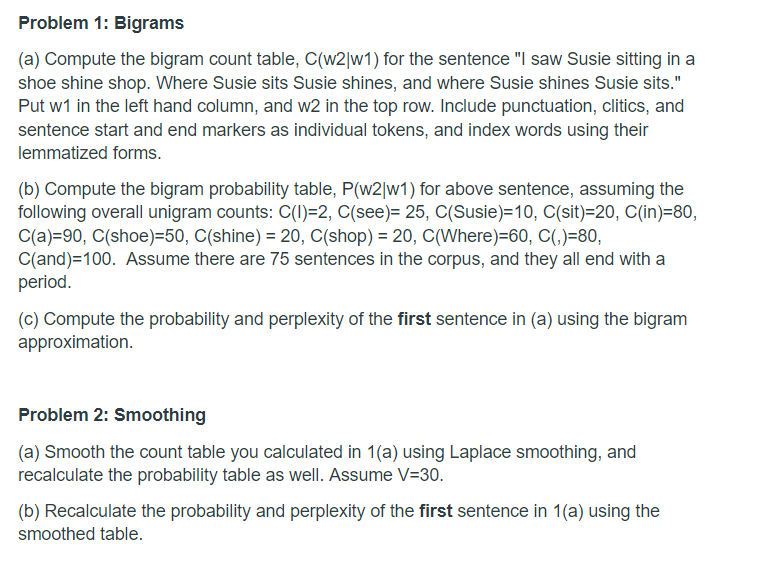
Problem 1: Bigrams (a) Compute the bigram count table, C(w2|w1) for the sentence "I saw Susie sitting in a shoe shine shop. Where Susie sits Susie shines, and where Susie shines Susie sits." Put w1 in the left hand column, and w2 in the top row. Include punctuation, clitics, and sentence start and end markers as individual tokens, and index words using their lemmatized forms. (b) Compute the bigram probability table, P(w2/w1) for above sentence, assuming the following overall unigram counts: C(1)=2, C(see)= 25, C(Susie)=10, C(sit)=20, C(in)=80, C(a)=90, C(shoe)=50, C(shine) = 20, C(shop) = 20, C(Where)=60, C(,)=80, C(and)=100. Assume there are 75 sentences in the corpus, and they all end with a period. (c) Compute the probability and perplexity of the first sentence in (a) using the bigram approximation. Problem 2: Smoothing (a) Smooth the count table you calculated in 1(a) using Laplace smoothing, and recalculate the probability table as well. Assume V=30. (b) Recalculate the probability and perplexity of the first sentence in 1(a) using the smoothed table. Problem 1: Bigrams (a) Compute the bigram count table, C(w2|w1) for the sentence "I saw Susie sitting in a shoe shine shop. Where Susie sits Susie shines, and where Susie shines Susie sits." Put w1 in the left hand column, and w2 in the top row. Include punctuation, clitics, and sentence start and end markers as individual tokens, and index words using their lemmatized forms. (b) Compute the bigram probability table, P(w2/w1) for above sentence, assuming the following overall unigram counts: C(1)=2, C(see)= 25, C(Susie)=10, C(sit)=20, C(in)=80, C(a)=90, C(shoe)=50, C(shine) = 20, C(shop) = 20, C(Where)=60, C(,)=80, C(and)=100. Assume there are 75 sentences in the corpus, and they all end with a period. (c) Compute the probability and perplexity of the first sentence in (a) using the bigram approximation. Problem 2: Smoothing (a) Smooth the count table you calculated in 1(a) using Laplace smoothing, and recalculate the probability table as well. Assume V=30. (b) Recalculate the probability and perplexity of the first sentence in 1(a) using the smoothed table
Step by Step Solution
There are 3 Steps involved in it

Get step-by-step solutions from verified subject matter experts
 Study Help